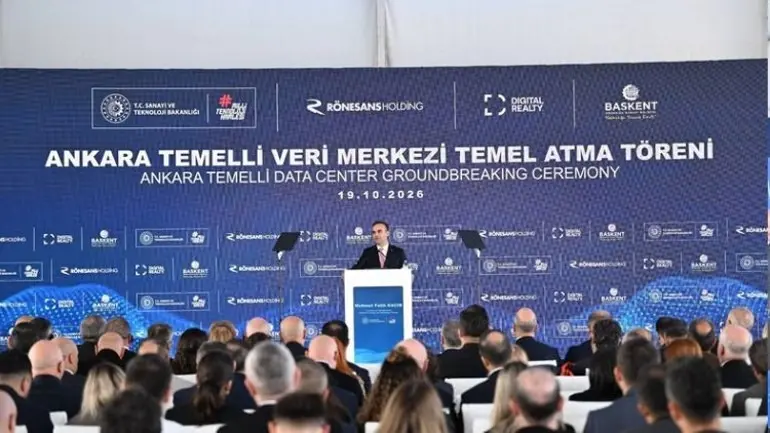
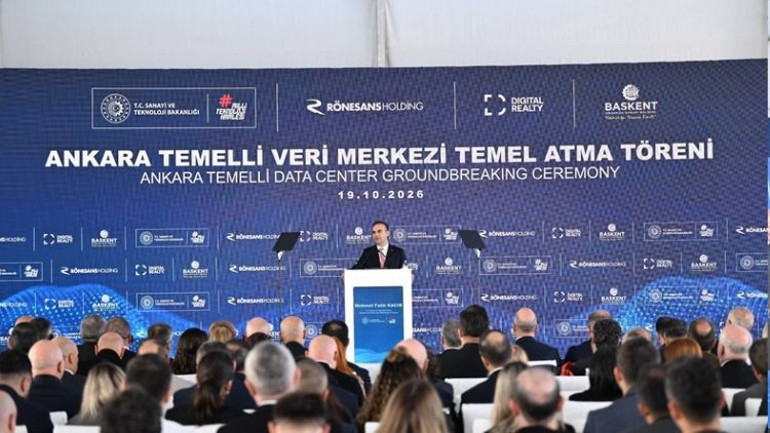
ANKARA — In a major step toward establishing the country as a regional hub for advanced computing and cloud services, Türkiye has officially commenced construction on a cutting-edge data center campus in the capital’s Temelli district. The Ankara Temelli Data Center, realized through a joint venture between Turkish conglomerate Rönesans Holding and global infrastructure provider Digital Realty, will ultimately represent a $4.1 billion fixed-capital investment across all development phases, Minister of Industry and Technology Mehmet Fatih Kacır announced during the groundbreaking ceremony at the Başkent Organized Industrial Zone (OSB).
The ambitious project kicks off with an initial $450 million phase dedicated to baseline infrastructure and core building development, delivering an initial IT load capacity of 22 megawatts. This initial footprint will be followed by a secondary $900 million investment envelope dedicated to advanced cooling systems and high-capacity computational infrastructure. Once fully built, the specialized complex is designed to answer the rapidly expanding data processing, secure storage, and mission-critical cloud computing requirements of Turkish public institutions, private corporations, and global tech enterprises.
Speaking at the ceremony, Minister Kacır framed the project as a cornerstone of Türkiye’s broader digital sovereignty agenda, stressing that sovereign control over computational infrastructure is becoming as decisive for national prosperity in the twenty-first century as access to raw materials was during previous industrial revolutions.
Technology Infrastructure
Addressing an audience of industry leaders, public officials, and project stakeholders, Kacır emphasized that the ongoing global digital disruption rests entirely upon the strength of physical computing networks. Technologies such as generative artificial intelligence, multi-tenant cloud ecosystems, advanced big data analytics, and the Internet of Things (IoT) are reshaping manufacturing processes, commercial workflows, daily societal routines, and the global economic architecture.
"Behind all these transformations lies a technological infrastructure that is expanding and maturing every single day," Kacır noted. "Just as access to raw materials and stable energy resources dictated the trajectory of the global economy throughout the opening eras of the industrial revolution, today the capacity to own, process, and convert data into tangible economic output holds critical, strategic value for sovereign nations and global enterprises alike."
Kacır pointed out that while commentators frequently describe data as the "petroleum of the 21st century" to highlight its immense strategic importance, this comparison provides only a limited view of the modern digital landscape. Unlike physical commodities, which are depleted through use, data behaves as a compounding resource whose true value multiplies through processing, algorithmic integration, and iterative analysis.

The Evolution of Modern Data Centers
The minister explained that realizing the actual economic dividend of information requires structured aggregation, algorithmic sorting to uncover hidden patterns, and the conversion of data streams into actionable scientific breakthroughs and high-margin economic value. Consequently, the operational mandate of enterprise data facilities has undergone a comprehensive transformation.
Data centers are no longer passive server storehouses designed simply to house records and maintain routine uptime for basic digital applications. Today, the demands of the modern data-driven economy require advanced hyper-scale facilities that unify high-density processing power, innovative liquid and air cooling solutions, resilient low-latency networks, and immense flash-storage matrices under a single roof.
These modernized structures serve as high-performance compute engines where large machine learning algorithms are trained, expansive foundational models are fine-tuned, and complex real-time computational applications are hosted. Minister Kacır pointed out that this structural shift explains why capital deployment toward next-generation data centers is accelerating across every major economic territory worldwide, serving industries ranging from heavy manufacturing and financial technology to advanced academic research and digitized public administration.
The Global Technology Race
Highlighting the sheer scale of the international shift toward digital infrastructure, Kacır stated that in 2025, more than one-fifth of the total value of all newly announced cross-border investment projects worldwide was directed specifically into data centers. Industry projections indicate that global installed data center power capacity, which hovered around 103 gigawatts in 2025, is on track to nearly double to 200 gigawatts within the next five years.
"This remarkable dynamic illustrates that competition in the global technology race is no longer confined to writing software code or designing isolated applications," Kacır said. "Securing the high-density processing hardware and the specialized physical facilities that allow those technologies to function has evolved into a high-stakes struggle for strategic superiority."
Kacır asserted that countries capable of safeguarding, managing, and crunching their domestic data through sustainable, highly reliable, and energy-efficient data platforms will be the ones that turn modern technological dividends into enduring public prosperity. Such capabilities, he noted, directly underpin technological independence, shielding states from systemic vulnerabilities while anchoring high-value domestic digital ecosystems.

National Technology Initiative
Kacır contextualized the Ankara Temelli groundbreaking within Türkiye’s overarching "National Technology Initiative" (Millî Teknoloji Hamlesi), an institutional strategy spearheaded under the leadership of President Recep Tayyip Erdoğan. The minister reflected on the success of this policy framework across sectors such as aerospace, defense hardware, automotive engineering, and advanced precision manufacturing, where Turkish engineering teams have developed internationally recognized proprietary capabilities.
He argued that the country must now replicate these achievements across computational hardware, sovereign cloud architectures, and machine intelligence.
"Digital sovereignty constitutes an inseparable dimension of our broader national independence," Kacır told attendees. "Safeguarding the integrity of domestic information, guaranteeing the uninterrupted operation of critical state and enterprise systems, and securing Türkiye’s standing among the global leaders in artificial intelligence can only be accomplished through a sovereign computational foundation worthy of the ‘Century of Türkiye’ vision."
To support these objectives, the Ministry of Industry and Technology has codified an overarching support framework crafted to systematically attract international digital capital while fostering home-grown infrastructure development.
Investment Incentives and Scientific Supercomputing
Türkiye’s push into high-density computation builds upon ongoing investments in public digital research platforms. Kacır underscored the achievements of the Turkish National Science e-Infrastructure (TRUBA), an institutional framework that has supported more than 8,900 scientific researchers across the country. Operating under TRUBA, public research capacity has scaled up to encompass more than 80,000 computing processor cores, 504 advanced graphics processing units (GPUs), and an aggregate storage capacity of 26 petabytes.
Beyond national scientific networks, Türkiye has deepened its institutional ties with top European high-performance computing organizations. Through active participation in the EuroHPC Joint Undertaking, domestic researchers have gained direct computational access to pan-European supercomputing nodes. A key milestone in this partnership includes Türkiye’s co-ownership stake in MareNostrum 5, one of the world’s most powerful supercomputers, opening access to high-performance computing resources for Turkish academic investigators, scientific institutions, and early-stage tech innovators.

Turning to economic mechanisms, Kacır detailed how targeted public incentives have systematically fostered data hosting infrastructure across the private sector. Through targeted state incentive certificates issued since 2012, the government has facilitated 42 billion Turkish liras in specialized data center capital expenditures.
Under the umbrella of HIT-30—Türkiye’s flagship high-technology incentive program, which aims to channel $30 billion in state support to high-tech manufacturing, energy transition, and IT projects through 2030—the administration has unlocked specialized incentive streams formulated specifically to lower capital expenditure thresholds for hyperscale digital developers.
HIT Calls for Data Centers, AI, and Quantum Research
Under the HIT-30 framework, the Ministry has launched targeted calls to accelerate the deployment of high-tier computational assets:
The HIT-Data Center Call, supported by a dedicated $1.5 billion funding pool, offers comprehensive incentive packages to developers constructing secure, highly efficient computing centers with an individual energy throughput capacity of at least 30 megawatts.
The HIT-Artificial Intelligence Call, backed by an allocation of $1.6 billion, is structured to incentivize cloud-native data networks, helping automate and digitize workflows across core economic verticals including heavy industrial production, clinical healthcare, financial systems, and multimodal transportation logistics.
Complementing these initiatives, the government has introduced the HIT-Quantum Call, aimed at establishing research testbeds and hardware laboratories for quantum computing architectures that transcend the operational ceilings of classical silicon chips. Kacır emphasized that these combined support mechanisms are calibrated to elevate Türkiye into a regional processing axis capable of capturing high-value workflows across Eurasia and the Middle East.

The 2030 AI Action Plan and Private Sector Collaboration
These capital incentives closely align with the government’s official 2030 National Artificial Intelligence Action Plan, which sets specific operational metrics for computing infrastructure. Under this national roadmap, the administration intends to expand the country’s total operational data center energy footprint to at least 1 gigawatt by the year 2030, ensuring the industrial sector has access to sufficient computing capacity to deploy machine intelligence tools at scale.
Emphasizing the vital role of private capital in reaching this target, Kacır reiterated that the state maintains an investor-friendly posture focused on streamlining administrative procedures and minimizing structural barriers.
"Our President consistently advises us to remove obstacles standing in the way of private enterprise, to accelerate their investment cycles, to work alongside private firms day and night, and to champion an environment where private leadership guides Türkiye toward its future milestones," the minister said. He projected that through this collaborative dynamic, cumulative private investments in enterprise data facilities, sovereign cloud fabrics, and machine-learning compute infrastructure will comfortably surpass $10 billion by 2030.
Fostering the Broader AI Ecosystem
Expanding beyond physical buildings and power grids, Kacır detailed ongoing initiatives designed to ensure equitable compute access across the broader innovation ecosystem. Under the planned "Artificial Intelligence Growth Zones," academic researchers, tech startups, and institutional investors will be integrated into common innovation districts connected directly to high-throughput compute clusters.
To eliminate financial bottlenecks that often prevent young firms from testing compute-intensive models, the ministry is rolling out its "GPU for Everyone Program." This computational initiative will provide distributed access to enterprise-grade accelerators, ensuring domestic researchers and early-stage startups can secure processing time without prohibitive capital costs.
"We are determined to ensure that the scientific journeys of our researchers and the global ambitions of our entrepreneurs are never hindered by difficulties in accessing computational capacity or data infrastructure," Kacır said. "The goal is to allow groundbreaking concepts born across every corner of Türkiye to integrate seamlessly with sophisticated digital infrastructures, evolving into high-value commercial solutions and globally competitive technology brands."
Strategic Scope of the Ankara Temelli Campus
The Ankara Temelli installation represents the first concrete phase of an expansive infrastructure pipeline planned by Rönesans Holding and Digital Realty. Designed to meet modern international requirements, the facility will feature energy-efficient server hall layouts and advanced cooling systems aimed at minimizing overall energy consumption.
Power optimization remains a key focus for the project, particularly given projections by the International Energy Agency (IEA) indicating that global electricity demand from data centers will double by 2030. The Temelli complex has incorporated efficiency-minded architectural designs, closed-loop cooling configurations, and optimized power delivery systems to maintain sustainable operational standards aligned with nationwide decarbonization goals.
Beyond $10 Billion: A Multi-Campus Vision
The partnership between Rönesans Holding and Digital Realty is planned as a broader, multi-region investment program. Beyond the Ankara Temelli complex, the two partners intend to direct upwards of $10 billion into large-scale computing campuses spanning both Ankara and Istanbul.
Together, these planned joint developments aim to deliver 200 megawatts of capacity across their operational footprints. Once realized, the joint venture’s planned facilities would account for roughly 20 percent of Türkiye’s national target of 1 gigawatt of total installed data center capacity by 2030.
Closing his remarks, Minister Kacır emphasized that Türkiye offers an optimal environment for enterprise compute investments, citing its geographical role as an intercontinental digital junction, an expanding domestic industrial base, resilient clean energy supplies, and an educated base of young engineering talent.
"With our country’s strategic geographical location bridging continents, our advanced industrial infrastructure, our rapidly expanding digital services market, our competitive energy sourcing, our robust renewable energy resources, our qualified demographic dividend, and our far-reaching investor incentives, Türkiye provides an ideal foundation for hyperscale data center deployments," Kacır concluded. "We will remain steadfast partners to every enterprise and investor that places trust in Türkiye’s potential and helps build our shared digital and technological future."