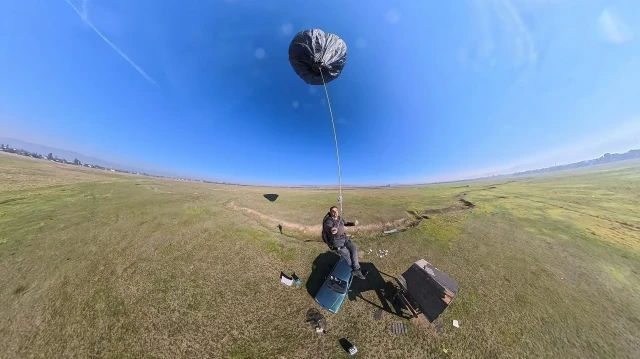
In the rural district of Sinanpaşa in Turkey’s western Afyonkarahisar province, 38-year-old Halil Akdeniz has achieved a remarkable feat of ingenuity and aviation ambition. Driven by a lifelong passion for flight and constrained by the high financial costs of commercial aviation equipment, Akdeniz took matters into his own hands—literally. Unable to afford traditional gear, he set out to engineer and construct his own atmospheric balloon using accessible, everyday materials.
Akdeniz’rinsic fascination with aviation began in his childhood and youth, laying the groundwork for a lifelong pursuit of the skies. His formal journey into the aviation community started in 2006, eventually leading him to pursue professional training. From 2010 onward, he trained under various instructors and successfully earned his P2 paragliding certification. However, the recurring expenses associated with regular flights prompted him to look for more economical ways to sustain his passion.
Turning to Solar Energy Due to the High Cost of Helium
As Akdeniz searched for cost-effective alternatives to fuel his aviation pursuits, he quickly realized that traditional lifting gases presented a major financial obstacle. Helium, commonly used in lighter-than-air craft, proved to be prohibitively expensive for an independent enthusiast working with a limited budget. Determined not to let financial barriers ground his ambitions, he began researching alternative lifting technologies.
His research led him to the concept of solar balloons—vessels that ascend by utilizing solar energy to heat the air trapped inside, reducing its density and creating natural lift. When the COVID-19 pandemic brought widespread lockdowns and extra free time in 2020, Akdeniz intensified his independent studies and workshop efforts.
To bridge the gap in his technical knowledge, he reached out internationally, contacting French experts Laurent Besset and Paul Ferney, who specialize in solar balloon technology. Through correspondence with these specialists, Akdeniz gathered essential technical documents, theoretical insights, and operational principles. He then translated these complex concepts from theory into a practical, hands-on design tailored to his available resources.
Constructing a Deconstructed Aircraft from 600 Trash Bags
With theoretical knowledge in hand, Akdeniz faced the challenge of sourcing materials that were both lightweight and airtight. His solution was as unorthodox as it was resourceful: he collected approximately 600 household trash bags, carefully laying them side by side and sealing them together to form the massive envelope of the balloon.
Constructing a reliable lighter-than-air craft out of thin plastic presented immediate structural hurdles. The initial seams were vulnerable to tearing and pressure separation under the strain of heated air. To address this, Akdeniz initially reinforced the connection points with standard packing tape. Recognizing that standard tape would not withstand ongoing flight tests, he upgraded to high-strength fibrous tape to secure the structure permanently.
Whenever structural integrity issues or small tears emerged during testing phases, Akdeniz meticulously repaired the damaged areas by hand. Through trial, error, and continuous reinforcement, he successfully developed a functional prototype that he estimates possesses a lifting capacity between 80 and 90 kilograms.
While Akdeniz himself weighs 101 kilograms and continues to work on managing his personal weight alongside safety equipment and tethered flight tests, his extraordinary project has captured public attention. The local ingenuity and unwavering determination displayed in Sinanpaşa have even drawn nostalgic comparisons in popular culture, recalling a famous historical video clip from years prior in Afyonkarahisar where local youths excitedly filmed a local resident attempting amateur flight—an affectionate reminder of the region’s long-running fascination with taking to the air against all odds.