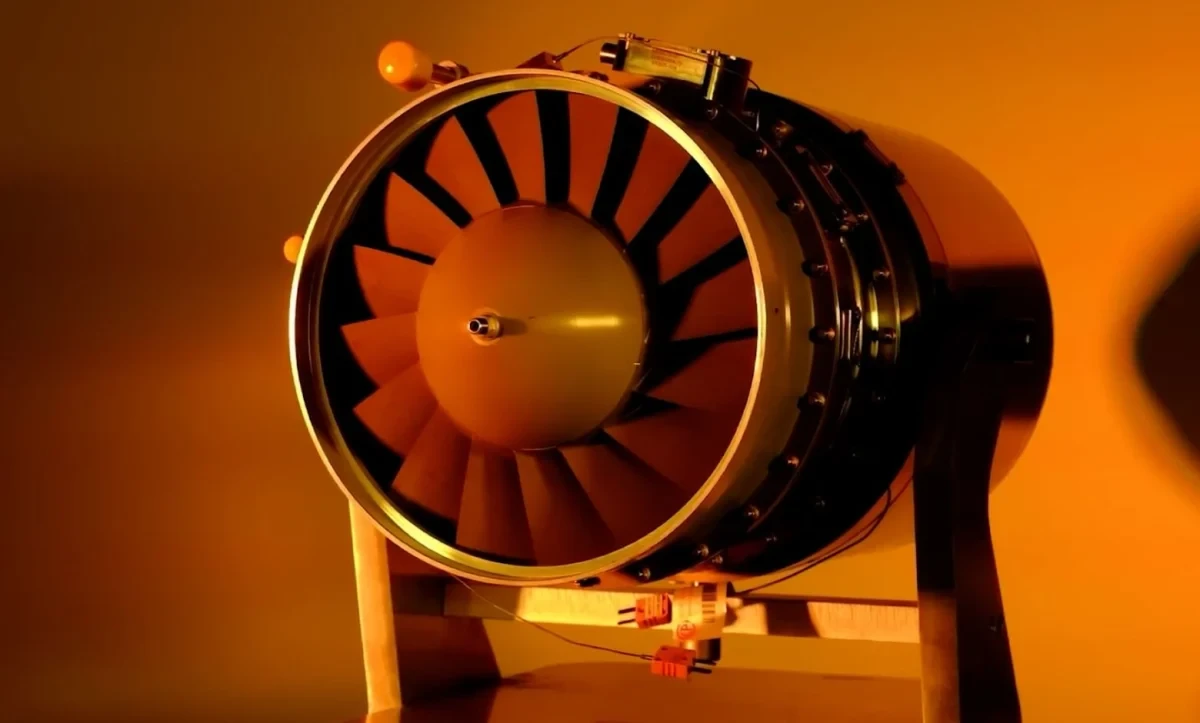
Kale Jet Engines has outlined an expansive technology and production roadmap aimed at strengthening its presence across the global defense and aerospace propulsion sectors. Speaking at the 2026 Kale Group Defence and Aerospace Supplier Meeting, Ali Rıza Alptekin, Head of the Defence and Aerospace Group at Kale Group, revealed that the company is actively preparing to launch new turbojet and turbofan engines across several distinct thrust categories.
The comprehensive strategy includes entering the mini turbojet domain with a 400-Newton engine within a year, completing a prototype for a high-demand 1,500-Newton turbojet by the end of this year, and bringing an indigenous turbofan engine to operational readiness within three years. By aligning its production capacity with clear gaps in the global marketplace, Kale Jet Engines aims to address widespread supply shortages while advancing Turkey’s self-reliance in critical defense technologies.
Assessing the 400 Newton Class and Mini Turbojet Market Dynamics
In his address to suppliers and industry stakeholders, Alptekin highlighted the strategic considerations surrounding the mini turbojet category, specifically engines operating within the 250 to 400 Newton thrust range. This segment of small-scale jet engines is widely utilized in compact uncrewed aerial vehicles (UAVs), target drones, and lightweight precision-guided weapons.
Globally, the market for mini turbojets features a high concentration of established international manufacturers. Historically, Kale Jet Engines has not maintained an active product line within this lightweight category. The company’s current production portfolio has primarily focused on larger, higher-thrust turbojets characterized by complex four-stage axial compressor designs, such as those powering medium- and long-range missile platforms.
Alptekin disclosed that internal discussions are ongoing regarding whether Kale should permanently enter the mini engine market. A key technical distinction between Kale’s current engine lineup and standard market offerings in the 250–400 Newton class lies in compressor architecture. Most commercial and defense mini turbojets in this lower thrust range rely on single-stage radial (centrifugal) compressors to minimize manufacturing complexity and operational costs. In contrast, Kale’s existing engineering foundation relies on multi-stage axial compressors, which offer superior efficiency and performance at higher thrust levels but require different manufacturing and design processes.

Despite these architecture differences and active strategic deliberations, Kale Jet Engines has established a tentative development schedule for this class. The company plans to bring a 400-Newton mini turbojet engine to fruition in approximately one year, leveraging its existing design experience to enter a segment where global demand for small aerial platform propulsion continues to expand.
Addressing Critical Global Demand in the 1,500 Newton Thrust Segment
Beyond mini turbojets, Kale Jet Engines is placing significant emphasis on mid-range propulsion systems, specifically targeting the 1,000 to 2,000 Newton thrust bracket. Within this category, the company has prioritized the development of a 1,500-Newton turbojet engine—a thrust class where Alptekin identified a pronounced deficit in global manufacturing capacity.
Currently, the global supply of engines in the 1,500-Newton class is largely dominated by established European suppliers, most notably the Czech aerospace manufacturer PBS (První brněnská strojírna). While PBS maintains a strong market footprint and a reputation for reliable small turbine engines, its current manufacturing throughput is unable to fully keep pace with the surging global demand for uncrewed platforms and cruise missiles. As defense forces worldwide accelerate the procurement of aerial target systems, loitering munitions, and tactical missiles, airframe manufacturers have increasingly encountered extended lead times and component bottlenecks from existing suppliers.
This international capacity shortfall has prompted defense clients to actively seek alternative, reliable suppliers, directly approaching Kale Jet Engines to develop a 1,500-Newton solution. Responding to these market demands, Kale has fast-tracked its engineering workflow.
According to the timeline shared by Alptekin, the company plans to finalize the first prototype of its 1,500-Newton turbojet engine by the end of this year. Ground testing and system integration will follow, with the engine expected to be delivered to commercial and defense customers next year. Alptekin emphasized that a ready customer base is already waiting for the platform, ensuring an immediate transition from prototype validation to early production integration once qualification milestones are met.

Developing a Domestic Turbofan Engine to Break Market Monopolies
The most technologically ambitious element of Kale Jet Engines’ forward-looking roadmap is the development of an indigenous turbofan engine designed for long-range, high-efficiency aerial applications. Turbofan architecture, which bypasses a portion of intake air around the core combustion chamber, offers significantly higher fuel efficiency and longer operational endurance compared to traditional turbojets. These characteristics make turbofans the preferred choice for long-range cruise missiles, advanced uncrewed combat aerial vehicles (UCAVs), and reconnaissance platforms.
Alptekin underscored that the global turbofan market currently suffers from structural supply limitations. The international supply chain for small-to-medium turbofan engines is heavily dominated by a single major American manufacturer. Because this sole primary supplier faces severe capacity constraints and must prioritize domestic military contracts, international aerospace programs frequently experience severe delays or outright supply blockages. As a result, numerous countries around the world are actively seeking alternative turbofan suppliers to power their next-generation aviation and defense platforms.
Kale Jet Engines has initiated a dedicated engineering program to address this global vulnerability. Developing a turbofan requires mastering advanced aerodynamic modeling, dual-spool mechanical arrangements, multi-stage fans, and high-temperature turbine materials. Alptekin estimated that the company’s turbofan project will require approximately three years of continuous development, testing, and optimization before the engine is ready to enter active service. Once operational, the engine is expected to provide both domestic and international platform builders with a viable alternative to existing market monopolies.
A Specialized Focus and Three-Pillar Supply Chain Strategy
A core philosophy guiding Kale Group’s aerospace activities is specialized component and propulsion mastery rather than full platform assembly. Alptekin reaffirmed that Kale has no intention of expanding into complete airframe or aircraft manufacturing. Instead, the company remains dedicated to filling critical engineering bottlenecks in propulsion systems and specialized electromechanical actuators—the high-precision control mechanisms responsible for steering control surfaces and vectoring thrust in advanced aerial platforms.
By positioning itself as an independent, tier-one propulsion and actuation vendor, Kale aims to partner with diverse airframe manufacturers across multiple countries. Recognizing that propulsion remains the main bottleneck constraining global drone and missile production, Kale seeks to scale its operations internationally by providing tailored engine variants to partner nations.

To support this industrial scaling while mitigating the risks of foreign embargoes or supply disruptions, Kale Jet Engines employs a comprehensive three-pillar supply chain strategy. This operational framework is designed to minimize external dependencies across raw materials, sub-assemblies, and critical manufacturing processes:
- Pillar One: Direct Component Sourcing and Strategic Procurement – Establishing direct, non-restricted procurement channels for baseline aerospace-grade materials and components from diverse, independent global vendors.
- Pillar Two: Strategic Partnering without End-User Restrictions – Engaging directly with domestic and international defense clients through collaborative industrial frameworks that avoid restrictive third-party end-user certificates (EUCs), streamlining delivery timelines and export processes.
- Pillar Three: Deep In-House Manufacturing and Localization – Expanding internal manufacturing capabilities to produce high-stress rotational elements, single-crystal turbine blades, combustion chambers, and electronic control units natively within Turkey.
Alptekin confirmed that in its domestic operations within Turkey, Kale relies predominantly on the second pillar of this supply chain strategy. By operating without reliance on restrictive third-party end-user certificates for domestic clients, the company ensures that local defense projects can proceed without the threat of foreign vetoes or regulatory delays.
Altitude Test Infrastructure Accelerates Engine Qualification Timelines
A decisive factor behind Kale Jet Engines’ accelerated development schedule is its investment in specialized test and evaluation infrastructure, most notably Altitude Test Facilities (İrtifa Test Düzenekleri – İTD). Developing high-performance jet engines typically requires years of iterative flight testing, which can be costly, weather-dependent, and risky for unproven prototypes.
Altitude Test Facilities solve this challenge by recreating the extreme environmental conditions encountered at various flight altitudes and speeds inside a controlled ground laboratory. The İTD infrastructure allows engineers to simulate low atmospheric pressure, sub-zero temperatures, and high-speed intake air conditions (ram pressure) while measuring engine thrust, fuel burn, air-bleed performance, and thermal limits in real time.
Alptekin emphasized that the İTD infrastructure provides Kale Jet Engines with a major competitive advantage over international peers. By conducting rigorous altitude simulation tests on the ground, the company can rapidly identify design flaws, refine combustion dynamics, and validate engine control software in a fraction of the time required by traditional test-flight regimes. This capability not only accelerates qualification timelines but also guarantees higher product quality and reliability before engines are delivered to integration partners.

While international aerospace firms in countries such as India, Japan, and several European nations are actively attempting to expand their own small-turbine propulsion capabilities, Alptekin noted that no single entity has yet managed to fully satisfy the global market demand. Supported by advanced altitude testing infrastructure, a targeted supply chain model, and a focused engineering portfolio spanning from 400-Newton mini jets to 1,500-Newton turbojets and multi-year turbofan initiatives, Kale Jet Engines is positioning itself to capture a substantial share of the global aerospace propulsion market.