

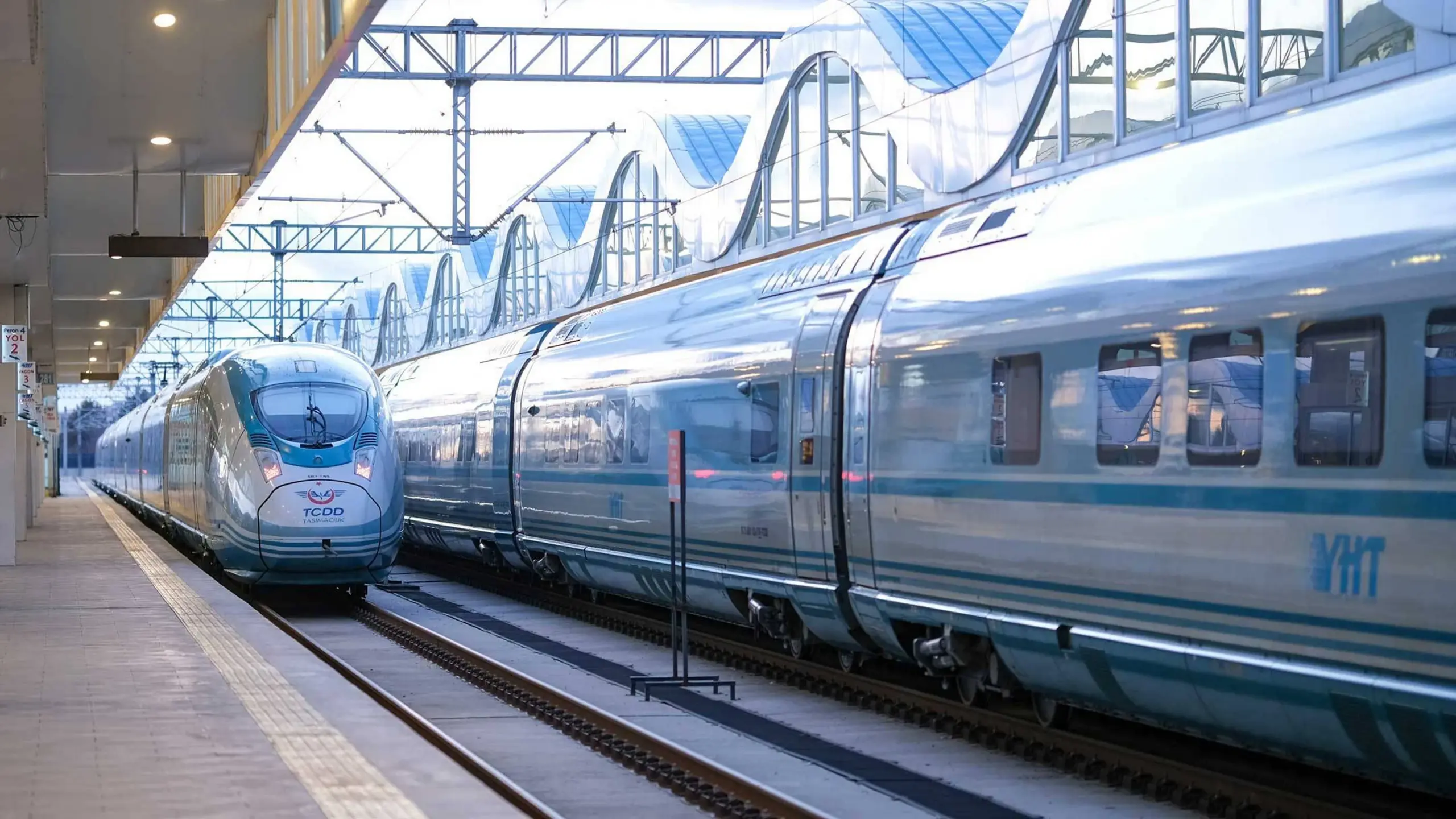
Travel Between Two Major Cities to Drop to 3.5 Hours: Minister Uraloğlu Announces New High-Speed Rail Projects
ANKARA — Transport and Infrastructure Minister Abdulkadir Uraloğlu has unveiled sweeping updates regarding Turkey’s ongoing high-speed rail network expansion, announcing that the much-anticipated Ankara-İzmir High-Speed Train Line will reduce the travel time between the two major cities to just 3.5 hours upon completion.

The comprehensive updates were shared during the deliberations of the 2027 budget for the Ministry of Transport and Infrastructure, held at the Grand National Assembly of Turkey (TBMM) Plan and Budget Committee. Chaired by AK Parti Samsun Deputy Mehmet Muş, the high-profile legislative session evaluated the budgetary allocations, final accounts, and Court of Accounts audit reports for the Ministry, alongside the General Directorate of Highways, the Directorate General of Civil Aviation, and the Information and Communications Technologies Authority.
Taking the floor during the parliamentary budget hearings, Minister Uraloğlu provided a detailed status report on strategic transportation corridors spanning multiple regions across the country, emphasizing that Turkey’s nationwide railway modernization strategy continues to hit key milestones.
Ankara-İzmir High-Speed Train Line Will Reduce Travel Time to 3.5 Hours
Highlighting the transformative impact of the projects currently under construction, Uraloğlu detailed how regional connectivity will drastically improve in the coming years.

"When our Ankara-İzmir High-Speed Train Line is fully completed, the travel time between the two cities will drop to 3.5 hours," Uraloğlu stated, pointing to the economic and social integration the corridor will foster between Central Anatolia and the Aegean coast.
Progress is similarly advancing in the country’s industrial and agricultural heartlands. The Mersin-Adana-Osmaniye-Gaziantep High-Speed Train Line, once finalized, will slash the travel time between Mersin and Gaziantep down to just 2 hours and 15 minutes.
Meanwhile, testing phases commenced in November along the crucial Bursa-Osmaneli route. According to the Minister, Bursa is on track to officially welcome high-speed rail services in 2027. Construction work is also moving forward steadily on the Halkalı-Çerkezköy section. Upon the integration of this segment, Istanbul will be linked seamlessly to Kapıkule at the Bulgarian border via an uninterrupted high-speed rail network.

Additional momentum has been recorded in Central and Eastern Anatolia. Uraloğlu highlighted that the 120-kilometer Delice-Çorum High-Speed Train Project, which broke ground last year, has already achieved a 47 percent physical completion rate in a remarkably short span of just 19 months. Once the Yerköy-Kayseri High-Speed Train Line is operational, the journey between Ankara and Kayseri will be completed in 1 hour and 45 minutes.
Regional logistical corridors are also expanding. The Karaman-Ulukışla High-Speed Train Line will reduce travel time between Konya and Ulukışla to 1 hour and 35 minutes, while the wider Aksaray-Ulukışla-Yenice network is designed to establish a vital rail link connecting Central Anatolia directly to Mediterranean ports.
Furthermore, technical planning has concluded for several key corridors, including the Eskişehir-Afyonkarahisar, Afyonkarahisar-Konya, and Sivas-Çetinkaya-Malatya high-speed rail lines. Project design works are actively ongoing for the Bursa-Gemlik, Samsun-Eastern Black Sea, and the ultra-fast Ankara-Istanbul Super High-Speed Train lines, which aim to push the boundaries of domestic rail transit.

Ankara-Istanbul Travel Time to Drop to 80 Minutes
Addressing the futuristic plans for the nation’s busiest passenger corridor, Minister Uraloğlu elaborated on the conceptualization of the next-generation super-fast connection between the capital and the country’s economic metropolis.
"We are continuing the project works for our Ankara-Istanbul Super High-Speed Train Line," Uraloğlu said. "While a journey between Ankara and Istanbul takes approximately 8.5 hours by conventional train and around 4 hours with our existing high-speed rail service, this travel time will be reduced to a mere 80 minutes."
The ambitious project marks a significant step forward in technological integration, aiming to turn inter-city commutes into ultra-short metropolitan transits.

Target: High-Speed Rail Access for 32 Cities by 2030
Reviewing the broader scope of Turkey’s rail infrastructure achievements, Uraloğlu shared up-to-date network statistics. The nation’s total conventional railway network has expanded to 14,272 kilometers, while the dedicated high-speed rail network has reached 2,604 kilometers.
Reflecting on operational volume over the past year, the Minister noted that the railway system successfully transported 353 million passengers and 31 million tons of freight. In a major milestone for domestic industrial capability, mass production has officially commenced for Turkey’s first national high-speed train sets, which are capable of reaching speeds of 225 kilometers per hour.
Currently, Turkey provides high-speed rail services to 23 provinces, reaching approximately 53 percent of the national population and having accommodated a cumulative total of 117 million passengers since the inception of the service.

Laying out the administrative roadmap for the end of the decade, Uraloğlu concluded that the government’s strategic target is to expand direct high-speed train accessibility to a total of 32 provinces nationwide by the year 2030.