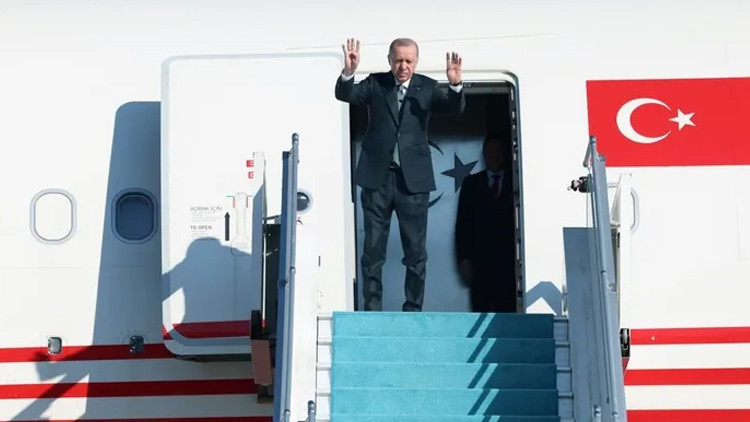
In a significant move aimed at deepening the long-standing diplomatic and economic ties between Ankara and Seoul, Turkish President Recep Tayyip Erdoğan is scheduled to embark on an official state visit to the Republic of Korea this November. The visit, which comes at the invitation of South Korean President Lee Jae-myung, underscores the growing importance of the Asia-Pacific region in Turkey’s multi-dimensional foreign policy and highlights the enduring "blood brotherhood" that has defined the relationship between the two nations for over seven decades.
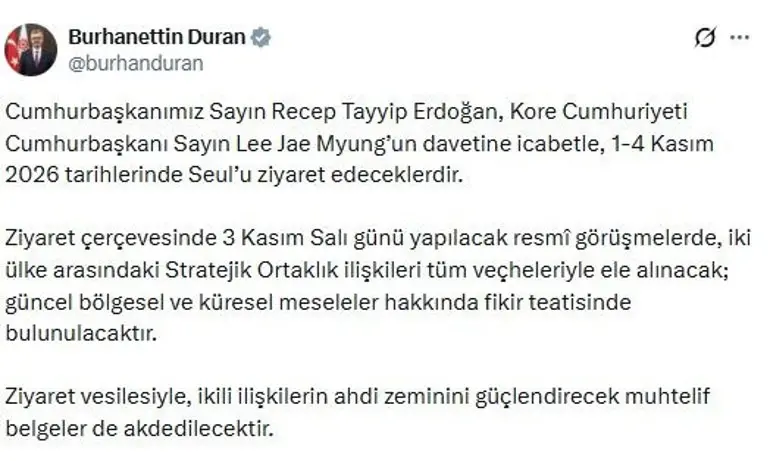
The announcement was officially made by Burhanettin Duran, the Head of the Turkish Presidency’s Directorate of Communications. In a statement shared via his social media accounts, Duran confirmed that the visit will take place between November 1 and November 4, 2026. This high-profile diplomatic mission is expected to serve as a platform for comprehensive discussions on bilateral cooperation, regional security, and the evolving dynamics of the global geopolitical landscape.
The four-day itinerary is designed to maximize engagement between the leadership of both nations, with a particular focus on the official meetings scheduled for Tuesday, November 3. During these sessions, President Erdoğan and President Lee Jae-myung are expected to co-chair discussions that will delve into the various facets of the strategic partnership that connects the two countries. The dialogue will not only address existing cooperation in trade, technology, and defense but will also explore new avenues for growth in an increasingly complex international environment.
President Recep Tayyip Erdoğan to Visit Seoul Following Invitation from President Lee Jae-myung
The upcoming visit to Seoul represents a pivotal moment in the diplomatic calendar for both Turkey and South Korea. As two members of the G20 and the MIKTA (Mexico, Indonesia, Korea, Turkey, and Australia) partnership, Ankara and Seoul share a common interest in promoting global stability, economic resilience, and a rules-based international order. The invitation extended by President Lee Jae-myung reflects a mutual desire to elevate these relations to a more robust and institutionalized level.
According to the details provided by the Directorate of Communications, the official talks on November 3 will be the centerpiece of the visit. These discussions are anticipated to cover the entirety of the strategic partnership, a status that was formally established between the two countries in 2012. Since then, the relationship has evolved from a historical bond rooted in the Korean War to a modern, forward-looking alliance characterized by significant industrial collaboration and diplomatic alignment.
A key objective of the visit is the strengthening of what Turkish officials refer to as the "contractual basis" (ahdi zemin) of bilateral relations. To this end, the two leaders are expected to oversee the signing of various documents and agreements. These legal frameworks are intended to facilitate smoother cooperation in sectors ranging from trade and investment to cultural exchange and technological transfer. By updating and expanding these agreements, both nations aim to provide their respective private sectors and public institutions with a clearer and more supportive environment for joint ventures.
Beyond bilateral concerns, the meeting in Seoul will provide a vital opportunity for a high-level exchange of views on regional and global issues. Given the strategic locations of both countries—Turkey as a bridge between Europe, Asia, and the Middle East, and South Korea as a leading power in East Asia—their perspectives on global security are of significant consequence. The leaders are expected to discuss the ongoing challenges in their respective regions, including the security situation in the Middle East and the stability of the Korean Peninsula.
The economic dimension of the visit is also expected to be a major focus. South Korea remains one of Turkey’s most important trading partners in Asia, with a trade volume that has seen steady growth over the years. Major South Korean corporations have a significant presence in Turkey, particularly in the automotive, electronics, and infrastructure sectors. Notable examples of this cooperation include the construction of the 1915 Çanakkale Bridge, which was built by a Turkish-South Korean consortium and stands as a testament to the engineering and financial synergy between the two nations.

Furthermore, the defense industry has emerged as a cornerstone of the Turkey-South Korea relationship. In recent years, the two countries have engaged in significant technology transfers and joint development projects. Turkey’s domestic main battle tank project, the Altay, famously benefited from South Korean technical support and engine technology. As Turkey continues to expand its domestic defense manufacturing capabilities, the talks in Seoul may pave the way for further collaboration in aerospace, naval technologies, and advanced electronics.
The timing of the visit is also noteworthy within the context of Turkey’s "Asia Anew" (Yeniden Asya) initiative. Launched in 2019, this policy framework aims to diversify Turkey’s foreign relations by strengthening ties with Asian nations across various sectors. By engaging deeply with South Korea, one of the world’s most advanced technological hubs, Turkey seeks to align its economic goals with the rapid growth and innovation occurring in the East.
In his announcement, Burhanettin Duran emphasized the comprehensive nature of the upcoming talks. He noted that the strategic partnership would be evaluated in all its dimensions, ensuring that no aspect of the relationship is left unexamined. This holistic approach suggests that the leaders will look beyond traditional diplomacy to include discussions on energy security, digital transformation, and climate change—areas where both nations have significant interests and capabilities.

The social and cultural ties between the two nations also provide a warm backdrop for the official proceedings. The "Korean War brotherhood" remains a deeply felt sentiment in both countries. Turkey’s decision to send the fourth-largest contingent of troops to the Korean War in the 1950s is remembered with great gratitude in South Korea. This historical legacy has created a unique level of soft power and mutual respect that simplifies the task of modern diplomats and political leaders.
As the international community watches, the outcomes of the November 1-4 visit will likely have implications far beyond the two countries. In an era of shifting alliances and economic uncertainty, the consolidation of ties between a major NATO ally like Turkey and a key US ally in the Pacific like South Korea represents a significant data point in global geopolitics. The ability of these two middle powers to coordinate their actions and strengthen their bilateral framework could serve as a model for other nations navigating the complexities of the 21st century.
Preparations for the visit are already underway in both Ankara and Seoul. Diplomatic delegations are working to finalize the texts of the agreements that will be signed, ensuring that the visit yields tangible results for both the Turkish and South Korean people. The focus remains on creating a sustainable and mutually beneficial partnership that can withstand the pressures of a changing world.

President Erdoğan’s visit to Seoul is not merely a diplomatic formality; it is a strategic necessity. For Turkey, it is an opportunity to solidify its presence in the East and secure high-tech partnerships. For South Korea, it is a chance to deepen its engagement with a rising regional power that sits at the crossroads of global trade routes. As November approaches, the expectations for this visit continue to grow, with both sides looking forward to a new chapter in their storied relationship.
The official program is expected to include not only the high-level meetings at the presidential palace but also engagements with the South Korean business community. President Erdoğan has frequently used his international visits to promote Turkish investment opportunities to foreign business leaders, and this trip is likely to be no exception. Given South Korea’s status as a global leader in innovation, the prospect of joint R&D projects and increased foreign direct investment into Turkey will undoubtedly be on the agenda.
In summary, the scheduled visit from November 1 to November 4, 2026, marks a major milestone in the diplomatic history of Turkey and the Republic of Korea. With a packed schedule of official talks, the signing of new bilateral instruments, and a shared commitment to addressing global challenges, President Erdoğan and President Lee Jae-myung are set to reinforce a partnership that is as much about the future as it is about their shared past. The world will be watching as these two influential nations reaffirm their commitment to cooperation, stability, and mutual prosperity.