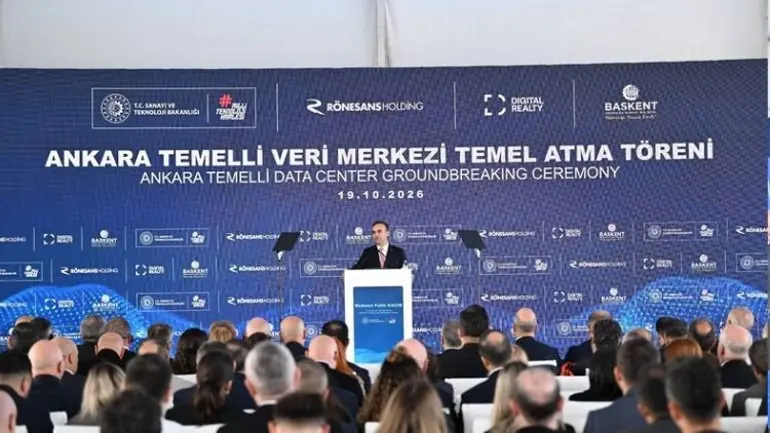
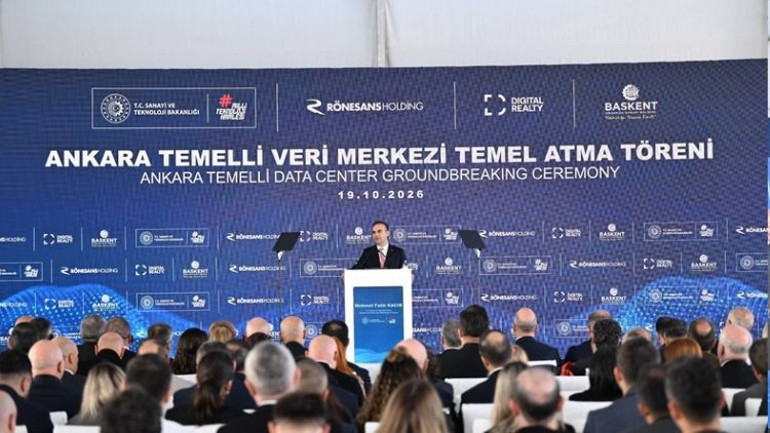
ANKARA — In a major move to expand Turkey’s digital infrastructure and computational sovereignty, Minister of Industry and Technology Mehmet Fatih Kacır has announced the groundbreaking of a massive data center development in Ankara’s Temelli industrial corridor. Developed through a strategic partnership between Turkish construction conglomerate Rönesans Holding and global data center operator Digital Realty, the campus at the Başkent Organized Industrial Zone (Başkent OSB) will represent a $4.1 billion fixed capital investment once all construction phases are completed.
Speaking at the project’s official groundbreaking ceremony, Kacır highlighted the transformative nature of modern digital infrastructure, outlining how data storage and advanced compute capacity have become foundational elements of modern industrial strategy. The initial phase of the facility will be launched with a $450 million investment in core infrastructure and physical buildings, delivering an initial power capacity of 22 megawatts (MW). This initial stage will be swiftly followed by an additional $900 million outlay focused on deploying next-generation liquid and advanced cooling systems alongside high-capacity enterprise computing infrastructure.
The project is structured to address the increasingly complex data storage and processing needs of public institutions, private corporations, and burgeoning technology firms. It also forms the initial footprint of an expansive joint roadmap between Rönesans Holding and Digital Realty, which envisions deploying more than $10 billion in capital across multiple projects in Ankara and Istanbul to establish over 200 MW of high-performance computing capacity.
Technological Infrastructure as the Modern Economic Engine
Addressing attendees at the groundbreaking, Kacır underscored that the rapid proliferation of artificial intelligence, cloud computing, big data systems, and the Internet of Things (IoT) is driving structural disruptions across traditional business models, international commerce, and national economies. Drawing a historical parallel, the minister noted that while access to raw materials and hydrocarbon resources dictated the trajectory of early industrial revolutions, processing power and data governance have emerged as the defining strategic metrics of the twenty-first century.
While the conceptual framing of data as the "new oil" has become commonplace to illustrate its immense strategic worth, Kacır remarked that the comparison only partially captures the distinct dynamics of the modern digital economy. Unlike unrefined hydrocarbons, data does not generate inherent value merely through possession; its utility is derived from the ability to process, analyze, and convert vast information sets into actionable insights, scientific breakthroughs, and industrial productivity.

"To unlock the true economic value of data, countries must possess the capability to systematically classify information arriving from disparate streams, utilize sophisticated algorithms to reveal previously undiscovered patterns, and transform those findings into technological innovation," Kacır stated. He emphasized that this processing imperative requires a complete departure from the historical role of storage centers, shifting the focus toward facilities designed around ultra-high processing density.
Redefining the Role of Modern Data Centers
The fundamental architecture of data management has shifted dramatically over the past decade. Kacır explained that data facilities were historically conceived as passive digital storehouses designed primarily to archive organizational records securely and guarantee basic uptime for online services. Today, however, the explosive emergence of generative artificial intelligence and high-throughput enterprise systems has transformed data centers into active computational engines.
Modern facilities are now engineered to unite immense processing power, specialized hardware acceleration, high-density storage arrays, and low-latency networking fabrics within a single physical footprint. These integrated environments provide the raw computational muscle required to train multi-billion-parameter foundation models, execute real-time simulations, and support automated operations across manufacturing, medical research, national defense, and financial clearinghouses.
Recognizing that computing capacity has become a critical bottleneck for innovation, governments and global enterprises have triggered a historic wave of digital real estate development. Kacır noted that countries lacking domestic access to these high-density computational environments risk falling into technological dependency, underscoring why expanding Turkey’s domestic server capacity has become a matter of strategic urgency.
The Global Race for Computing Capacity
The Ankara project comes amid unprecedented global capital allocation toward artificial intelligence and computing infrastructure. Citing recent international investment data, Kacır noted that in 2025, data center developments accounted for more than one-fifth of the total value of all newly announced cross-border investment projects worldwide.

Industry forecasts project that global operational data center power capacity will expand from approximately 103 gigawatts (GW) in 2025 to 200 GW within the next five years. This surge underscores how computational capacity has transformed into a strategic geopolitical asset.
According to Kacır, global competitiveness is no longer determined solely by software design or algorithmic talent, but by the physical compute capacity available to operationalize those tools. Sovereign states that can securely host, govern, and analyze their domestic data using energy-efficient, resilient facilities will secure meaningful economic autonomy, while those dependent entirely on foreign digital infrastructure will remain exposed to cross-border disruptions and strategic vulnerabilities.
Digital Sovereignty and the National Technology Initiative
Kacır positioned the Temelli campus as an integral milestone within Turkey’s broader "National Technology Initiative" (Millî Teknoloji Hamlesi), an overarching industrial policy championed by President Recep Tayyip Erdoğan. The initiative has historically driven significant domestic manufacturing gains across defense systems, aerospace, automotive engineering, and automated machinery.
The government is now seeking to replicate those domestic engineering achievements within the digital sphere, treating high-performance computing, advanced algorithms, and sovereign cloud systems as indispensable extensions of national independence. Minister Kacır asserted that digital sovereignty is fundamentally intertwined with national defense, arguing that data security and system continuity represent foundational requirements for the country’s strategic development.
To ensure that Turkish researchers, emerging tech startups, and established enterprises are not priced out or restricted by international compute shortages, the Ministry of Industry and Technology has launched targeted support frameworks designed to channel both domestic capital and foreign direct investment into advanced digital infrastructure.

Strategic Incentives and High-Performance Compute Infrastructure
To illustrate the state’s multi-layered approach to digital infrastructure, Kacır detailed ongoing investments in national high-performance computing (HPC) assets. Among these is the Turkish National Science e-Infrastructure (TRUBA), a public compute network that has supported more than 8,900 researchers across the country. Through sustained hardware expansions, TRUBA currently operates with more than 80,000 processor cores, 504 specialized graphics processing units (GPUs), and 26 petabytes of high-performance storage.
Beyond domestic clusters, Turkey has integrated its academic and industrial research base into broader European compute ecosystems through its participation in the EuroHPC Joint Undertaking. As part of this multilateral framework, Turkey gained partnership access to MareNostrum 5, one of the world’s most powerful supercomputing installations hosted in Spain, giving Turkish researchers and commercial enterprises direct computational allocations for cutting-edge modeling and simulations.
On the commercial front, Kacır stated that Turkey’s regulatory and financial incentive programs have unlocked 42 billion Turkish Liras in private data center investments since 2012. The state is currently utilizing its flagship HIT-30 High-Tech Incentive Program—a long-term strategy armed with a total budget of $30 billion through 2030—to attract further capital into advanced semiconductor, digital infrastructure, and manufacturing capabilities.
HIT-30 and the Quantum Computing Frontier
Within the broader HIT-30 program, the government has launched targeted funding tracks tailored specifically to computing architecture. The "HIT-Data Center" call provides a $1.5 billion financial allocation to de-risk and accelerate large-scale, enterprise-tier facilities that feature a minimum power threshold of 30 MW and incorporate stringent energy-efficiency standards.
Complementing the foundational infrastructure track, the ministry is deploying a $1.6 billion "HIT-Artificial Intelligence" program. This initiative is designed to subsidize the adoption of domestic cloud architectures and accelerate workflow modernization across public administration, healthcare diagnostics, logistics, financial services, and traditional industrial manufacturing.

Furthermore, looking beyond the theoretical limits of classical silicon architectures, the ministry has established a specialized "HIT-Quantum" funding track. This program aims to build baseline national expertise and physical research infrastructure in quantum computing, ensuring that Turkish academia and deep-tech ventures remain positioned for the post-classical computing transition.
The 2030 AI Action Plan and National Targets
These specialized financing vehicles are closely aligned with the benchmarks established under the 2030 Turkey Artificial Intelligence Action Plan. A primary quantitative goal of the roadmap is to raise Turkey’s aggregate operational data center capacity to at least 1 gigawatt (1,000 MW) by the end of the decade, establishing the country as a regional compute transit hub and capturing a larger share of the international cloud market.
Kacır reiterated that achieving this gigawatt target will rely heavily on private capital and foreign partnerships. Under explicit instructions from the presidency, government agencies have been directed to streamline regulatory processes, eliminate land-use bottlenecks, and coordinate utility access for global and domestic data center operators.
The ministry anticipates that cumulative private sector capital deployment across domestic data centers, enterprise cloud platforms, and specialized artificial intelligence infrastructure will surpass $10 billion by 2030.
Expanding the Artificial Intelligence Ecosystem
In parallel with physical groundbreakings, the ministry is rolling out programmatic frameworks to democratize developer access to high-density hardware. Kacır highlighted the creation of specialized "AI Growth Zones," designed to cluster academic researchers, venture-backed startups, and institutional investors around subsidized compute clusters.
To prevent structural compute shortages from stalling innovation, the ministry has introduced the "GPU for Everyone" program (Herkes İçin GPU). The program lowers financial barriers for early-stage founders and academic researchers who require access to high-end processing hardware to train domain-specific models.
Kacır stated that Turkey’s technological ambitions should never be constrained by hardware shortages or exorbitant cloud hosting costs, emphasizing that ideas originating anywhere in the country should have access to the compute pipelines required to scale into global businesses.
Project Breakdown: The Temelli Başkent Facility
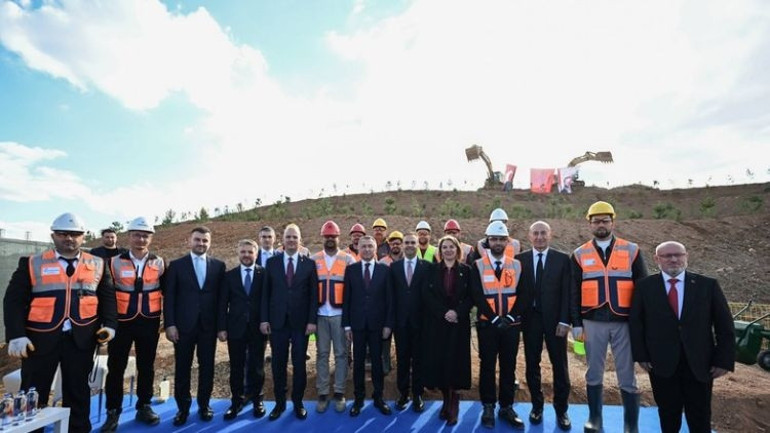
The groundbreaking at Ankara Temelli Başkent OSB marks the execution phase of these coordinated strategies. In its initial iteration, the $450 million investment will establish the physical campus, foundational power distribution networks, and a 22 MW operating capacity.
The subsequent $900 million phase will integrate specialized cooling architectures and compute hardware. High-density server deployments generate massive thermal loads, requiring advanced mechanical designs to preserve operational stability without excessive power consumption. When all construction cycles conclude, total fixed capital deployment at the Temelli site will reach $4.1 billion.
Energy management remains a focal point of the development. As highlighted by Kacır, International Energy Agency (IEA) projections indicate that global electricity consumption by data centers will double by 2030. In this environment, computational competitiveness will depend not only on aggregate processing power, but also on minimizing the energy footprint of each computational cycle. The Temelli facility has been designed to satisfy rigorous energy and resource efficiency metrics, aligning with national sustainable growth targets.
A Roadmap Exceeding $10 Billion
The Temelli groundbreaking represents the opening component of a wider joint investment campaign between Rönesans Holding and Digital Realty. Across planned facilities in both Ankara and Istanbul, the joint venture aims to develop 200 MW of power capacity, requiring over $10 billion in aggregate long-term investment. This planned pipeline alone would satisfy 20 percent of Turkey’s national 2030 target of 1 GW in operating data center capacity.
Concluding his address, Kacır stated that Turkey possesses distinct structural advantages that position it as an attractive destination for global infrastructure capital. He pointed to the nation’s physical position linking Europe, Asia, and the Middle East, its resilient industrial base, an increasingly diversified electric grid supported by expansive renewable energy development, competitive energy pricing, and a large demographic of young engineering talent.
Kacır reaffirmed that the government will continue providing long-term regulatory transparency, dedicated incentives, and administrative support to global and domestic investors committed to expanding Turkey’s advanced technological and computational footprint.