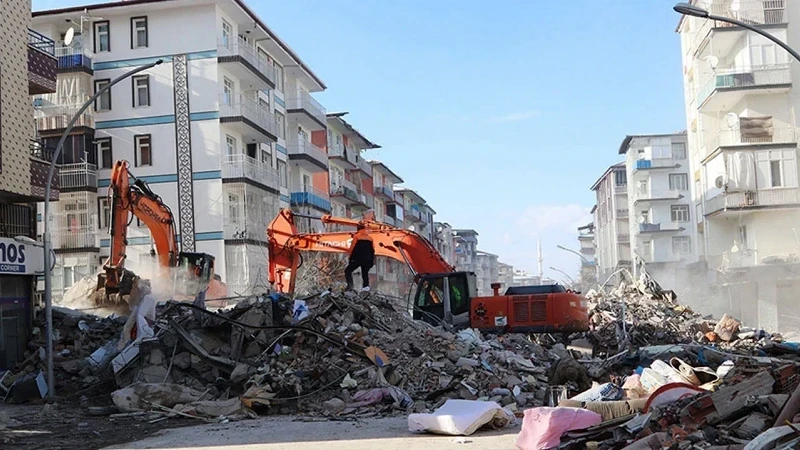
MALATYA — The 1st Heavy Penal Court in Malatya has handed down its rulings in the ongoing trial regarding the collapse of the Dağdeviren Apartment during the catastrophic Kahramanmaraş-centered earthquakes, an event that resulted in multiple fatalities and injuries. The legal proceedings, which have closely scrutinized the responsibility of builders and property stakeholders, reached a critical milestone as the judicial panel assessed the evidence, expert testimonies, and defense arguments presented by the respective legal counsels.
During the latest hearing at the Malatya 1st Heavy Penal Court, attorneys representing both the plaintiffs and the defendants were present in the courtroom to hear the final evaluations. Notably, one of the primary defendants in the case, Bülent Yeroğlu, who is currently held in detention in connection with an unrelated legal file, participated in the proceedings remotely via the Audio and Video Information System (SEGBİS). This technological link allowed the court to proceed with the final statements while maintaining judicial security and procedural continuity.

The prosecutor representing the state presented a comprehensive final opinion on the merits, known as the mütalaa, during the session. Within this evaluation, the prosecution formally noted that one of the original defendants in the case, identified by the initials A.T.Y., had passed away prior to the conclusion of the trial. Consequently, the legal proceedings against A.T.Y. were addressed in accordance with criminal procedure regarding deceased individuals. For the remaining defendants, however, the public prosecutor urged the court to issue convictions, demanding that they be held legally accountable under the Turkish Penal Code for the offense of "causing the death and injury of multiple persons by conscious negligence."
Defense attorneys representing the accused parties strongly contested the prosecution’s assessment during their closing arguments. They focused heavily on the timeline of the natural disaster, emphasizing that the Dağdeviren Apartment building did not collapse during the initial massive tremor that struck the region. Instead, the defense asserted that the structure sustained its critical structural failure and subsequent collapse during the second major earthquake that followed. Furthermore, the defense counsel argued that official warnings and advisories issued by competent authorities instructing citizens to stay away from damaged or potentially compromised buildings were disregarded. Based on these factors, the defense attorneys requested full acquittals for their respective clients, arguing that the causal link between their actions and the ultimate tragedy had been broken.
Addressing the court directly via the SEGBİS link, defendant Bülent Yeroğlu offered a defense centered on the historical engineering standards applied to the building. Yeroğlu argued before the bench that the Dağdeviren Apartment had been constructed strictly in accordance with the seismic and building regulations outlined in the 1975 earthquake code, which was the governing standard at the time of its erection. He emphasized that the structure successfully withstood the initial, highly destructive tremor and remained standing, pointing out that its eventual collapse during the secondary earthquake effectively severed the legal and direct causal connection between the original construction practices and the tragic outcomes that ensued.

Following the deliberation of all testimonies, evidence, and legal arguments submitted by the defense and the prosecution, the members of the judicial panel delivered their final verdicts. The court convicted defendants A.T.Ö. and Bülent Yeroğlu, sentencing each of them to 7 years and 6 months in prison. Additionally, the court found defendants A.Ö. and M.B. guilty of the charges, handing down prison sentences of 5 years, 6 months, and 20 days to each of them. To ensure compliance with the judicial process and prevent potential flight risks, the court further ruled that a judicial control measure imposing a ban on leaving the country should be applied to all the convicted defendants.
Legal Background and Case History
The judicial process stemming from the destruction of the Dağdeviren Apartment began in the wake of the devastating earthquakes centered in Kahramanmaraş, which shook a vast region of southern and southeastern Turkey, leaving immense structural devastation and significant loss of life in their wake. In the rubble of the Dağdeviren Apartment, three individuals lost their lives, while at least one other person sustained serious injuries, prompting an immediate judicial investigation into the circumstances surrounding the building’s failure.

As the investigation progressed, public prosecutors compiled extensive files pointing toward potential structural and administrative shortcomings. Consequently, formal public lawsuits were filed against five suspects—identified in court records as A.T.Ö., A.T.Y., B.Y., A.Ö., and M.B.—charging them collectively with the serious criminal offense of "causing the death and injury of multiple persons by conscious negligence." Under the applicable provisions of the criminal code, the indictments initially sought heavy prison sentences of up to 22 years and 6 months for each of the accused, reflecting the gravity of the loss of life and the severe societal impact of building collapses during major natural disasters.
The conclusion of the trial in the Malatya 1st Heavy Penal Court marks a significant chapter in the broader legal reckoning following the catastrophic earthquakes, as courts across the affected provinces continue to examine the accountability of contractors, engineers, and property owners involved in the construction and maintenance of buildings that failed during the seismic events.