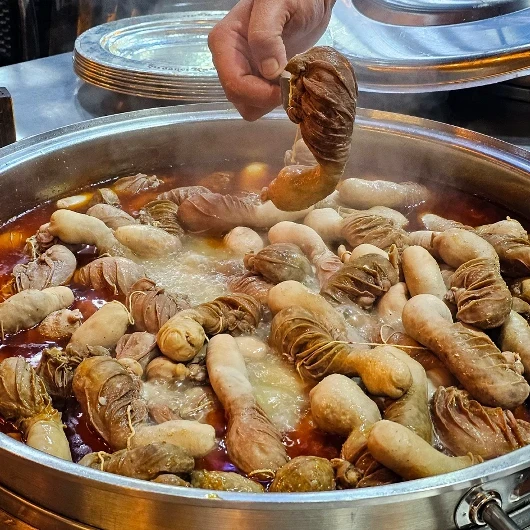
The culinary landscape of southern Turkey has received a welcome financial relief as sirdan, one of the region’s most beloved traditional delicacies following local kebabs, experienced a dramatic drop in price. Once threatening to become a luxury item due to soaring inflation and production costs, sirdan has seen its market price plummet from a peak of 240 Turkish Liras down to as low as 80 Turkish Liras. This sharp downward correction—amounting to roughly a 70 percent decrease—has fundamentally shifted the local dining dynamics, drawing crowds back to traditional offal eateries and causing daily consumption figures to skyrocket across the city.
Industry insiders and local merchants point directly to an increase in offal imports as the primary catalyst behind the sudden relief. In recent weeks, a steady influx of imported products has entered the domestic market, successfully expanding the overall supply of raw materials available to local businesses. As the volume of available stock grew, market competition and economic principles took over, driving down wholesale costs and, consequently, the retail prices paid by everyday consumers.
This unexpected affordability has immediately translated into a surge in consumer demand. Prior to the price correction, high costs had severely dampened the local appetite, with citywide consumption hovering between 20,000 and 25,000 pieces per day. However, with the steep drop in prices making the traditional delicacy accessible once again, daily consumption in the city has nearly doubled, surging closer to 50,000 pieces as locals eagerly reclaim a staple of their culinary heritage.
"Our Customers Can Now Enjoy Sirdan Without Doing Math"
Güngör Güler, a local culinary artisan and food vendor in the region, expressed immense relief over the normalization of market prices, explaining how the previous financial climate had strained both business owners and patrons.
"The soaring prices had severely hurt sirdan consumption throughout the entire city," Güler said, reflecting on the challenging period prior to the recent market shifts. "The introduction of imported products into the market successfully boosted supply and forced prices down. Because of this, our customers can now enjoy sirdan to their heart’s content without constantly calculating the cost in their heads."
Güler also offered a transparent look into the operational economics behind the dish, highlighting the stark contrast in his profit and loss margins. Previously, raw, uncooked sirdan alone cost him 135 Turkish Liras per piece. Once labor, cleaning, stuffing, and preparation costs were factored in, the baseline investment climbed to roughly 170 Turkish Liras, forcing vendors to price the finished product around 220 Turkish Liras just to stay afloat.
Today, the financial equation looks vastly different for local businesses. Güler noted that he now acquires raw sirdan for 45 Turkish Liras, allowing him to retail the finished, cooked delicacy for between 80 and 90 Turkish Liras. Despite the current stability and relief felt by consumers and merchants alike, Güler remains cautious about the long-term outlook, admitting that local vendors cannot reliably predict how long prices will remain at these favorable levels.
"We Are Practically Selling Out"
The retail enthusiasm is palpable on the ground, where vendors are struggling to keep up with the renewed appetite of the populace. Kadir Çıray, another prominent local seller, reported that the dramatic price reduction has triggered a purchasing frenzy that frequently empties display cases long before normal closing hours.
"Our citizens have been exceptionally pleased with these new prices, and the response has been overwhelming," Çıray said. "We are practically selling out every single day. We simply cannot keep up with the overwhelming demand. Our sirdan stocks are completely exhausted well before midnight arrives. Thanks to this shift, virtually all of our citizens have the opportunity to enjoy sirdan again."
The sentiment of widespread relief and satisfaction extends far beyond the kitchen counters, resonating deeply with the everyday residents who consider the dish an irreplaceable part of their cultural identity.
"We Are Thrilled to See the Prices Drop"
For local residents, the return of affordable sirdan represents more than just a cheaper meal; it marks the restoration of a cherished social routine. Dilara Doğan, a lifelong resident of the city, voiced her excitement over the market developments and extended an invitation to outsiders who might have missed out during the period of inflated prices.
"As locals, we truly love sirdan, and it stands out as one of the most famous and iconic delicacies of our city," Doğan said. "I warmly invite everyone who has never tried it before to come and taste it. The prices had climbed far too high, so we are genuinely happy to see them come down. We sincerely hope this favorable trend continues."
Another regular consumer, Onur Tatlı, shared a similar perspective, emphasizing how deeply ingrained the dish is in his weekly routine and how the recent market changes have directly improved his quality of life.
"We used to consume sirdan at very reasonable prices, but the costs had recently gotten completely out of hand," Tatlı noted. "Seeing such a widespread adjustment implemented across the city has made us all very happy. We consume sirdan with great pleasure, eating it nearly every other day now. This price drop has been an incredible relief for all of us."