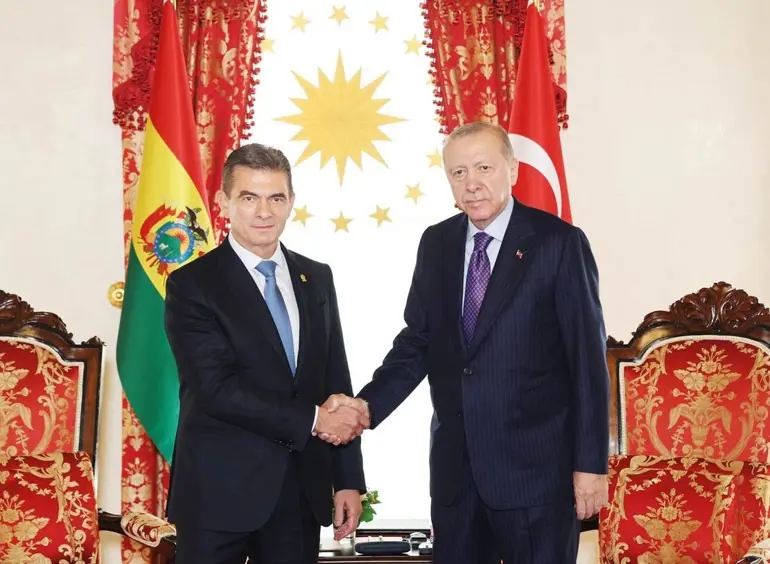
ISTANBUL — In a significant move to strengthen transcontinental ties and expand Turkey’s growing footprint in South America, President Recep Tayyip Erdoğan hosted Bolivian President Rodrigo Paz Pereira at the Presidential Dolmabahçe Working Office on November 15, 2026. The high-level meeting, characterized by a blend of formal state ceremony and strategic diplomatic consultation, focused on a wide array of bilateral interests, ranging from defense industry collaboration to the exploration of natural resources.
The visit comes at a time when Turkey is actively seeking to diversify its international partnerships under its "Latin America Opening" policy, while Bolivia looks toward the Eurasian power as a key ally in technological modernization and industrial development. The meeting in Istanbul serves as a cornerstone for what both leaders described as a new era of "win-win" cooperation between Ankara and La Paz.
A Grand Reception at Dolmabahçe
The diplomatic proceedings began with a formal welcoming ceremony at the historic Dolmabahçe Working Office, situated along the banks of the Bosphorus. President Erdoğan received President Paz Pereira with full honors, reflecting the importance Turkey attaches to its relations with Bolivia. Following the national anthems of both nations, the two leaders inspected the guard of honor before proceeding to the introduction of their respective delegations.
The Turkish delegation included high-ranking officials whose presence underscored the strategic nature of the talks. Among those in attendance were Minister of National Defense Yaşar Güler, Presidential Communications Director Burhanettin Duran, and the President of the Defense Industry Agency (SSB), Haluk Görgün. Their participation highlighted that the discussions would move beyond mere diplomatic pleasantries and into the realm of concrete technical and industrial cooperation.
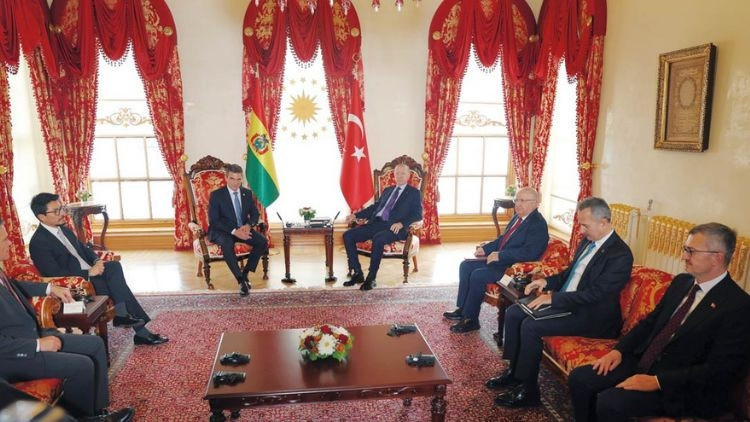
Following the ceremonial greeting, President Erdoğan and President Paz Pereira moved to a private, one-on-one meeting to discuss the nuances of the bilateral relationship and exchange views on pressing regional and global developments.
Strategic Partnership in the Defense Industry
One of the primary pillars of the meeting was the deepening of ties in the defense sector. According to statements released by the Turkish Presidency’s Directorate of Communications via social media, President Erdoğan emphasized that Turkey views Bolivia as a vital partner within the Latin American landscape. He specifically pointed to the defense industry as a field where cooperation should not only be maintained but significantly intensified.
Turkey’s defense sector has seen exponential growth over the last decade, transitioning from a buyer to a major global exporter of sophisticated military hardware, including unmanned aerial vehicles (UAVs), armored vehicles, and naval platforms. For Bolivia, a nation looking to modernize its security infrastructure and enhance its border monitoring capabilities, the Turkish model offers an attractive alternative to traditional Western or Eastern suppliers.
The presence of Haluk Görgün, the head of the SSB, suggests that the talks likely touched upon the potential for technology transfer, joint production, or the acquisition of Turkish-made systems tailored to Bolivia’s unique geographical and security needs. President Erdoğan noted that such cooperation is essential for the mutual security interests of both nations and contributes to a more balanced and multipolar global defense market.
The "Win-Win" Philosophy and Economic Integration

Central to the discussions was President Erdoğan’s "win-win" approach to foreign policy. He articulated a vision where the relationship between Turkey and Bolivia is built on mutual benefit, ensuring that both economies find avenues for sustainable growth through partnership. A key component of this economic strategy is the reinforcement of the "legal and contractual basis" (ahdi zemin) of the bilateral relationship. This involves the ratification and implementation of trade agreements, double taxation prevention treaties, and investment protection protocols that provide a stable environment for businesses in both countries.
The mining sector was singled out as a high-potential area for future collaboration. Bolivia, home to some of the world’s largest mineral reserves—including lithium, silver, and tin—represents a critical node in the global supply chain, particularly for the green energy transition. Turkey, with its expanding industrial capacity and technical expertise in large-scale mining and processing, is well-positioned to partner with La Paz in the sustainable extraction and industrialization of these resources.
President Erdoğan expressed Turkey’s readiness to continue taking steps in the mining sector and other potential fields, suggesting that Turkish firms are encouraged to look toward the Andean nation for long-term investment opportunities. The goal is to move beyond simple commodity trading and toward value-added industrial partnerships that can help Bolivia process its raw materials domestically while securing Turkey’s access to essential minerals.
Regional Stability and Global Cooperation
Beyond bilateral economics and defense, the two leaders engaged in a comprehensive review of regional issues affecting both the Middle East and Latin America. In an increasingly interconnected world, the stability of South America and the Eastern Mediterranean are seen as linked through the global economy and international security frameworks.
President Erdoğan has long advocated for a more inclusive international order, often summarized by his motto, "The world is bigger than five." This sentiment finds resonance in many Latin American capitals, including La Paz, which seek a more equitable distribution of global influence. During the talks, the leaders discussed ways to coordinate their positions within international organizations, such as the United Nations, to advocate for the interests of developing nations and to promote peaceful resolutions to regional conflicts.

The dialogue also touched upon the importance of cultural and educational exchanges as a means of bringing the two peoples closer together. While separated by vast distances, the increasing presence of Turkish cultural exports and the expansion of Turkish Airlines’ routes into the region have significantly reduced the perceived distance between Istanbul and La Paz.
A Robust Institutional Framework
The meeting served to solidify the institutional framework that will govern future interactions. The involvement of Communications Director Burhanettin Duran highlights the importance Turkey places on the public diplomacy aspect of this partnership, ensuring that the narratives of cooperation reach both domestic and international audiences effectively.
By involving the Minister of National Defense and the head of the Defense Industry Agency, the Turkish government signaled that it is ready to move into the implementation phase of the discussed projects. The leaders agreed that the various working groups and joint economic commissions between the two countries should meet more frequently to monitor progress on the "win-win" initiatives.
President Erdoğan reiterated that the agreements currently on the agenda are not merely symbolic but are designed to create a "legal floor" that will support a much taller structure of bilateral cooperation. This includes streamlining customs procedures, enhancing banking ties, and fostering direct links between the chambers of commerce in Ankara and La Paz.
Conclusion of the Visit

The reception at Dolmabahçe concluded with a sense of optimism regarding the future trajectory of Turkey-Bolivia relations. President Paz Pereira’s visit is seen as a clear indicator that Bolivia recognizes Turkey as a rising global actor with much to offer in terms of technology, investment, and diplomatic support. Conversely, for Turkey, the visit reinforces its strategy of diversifying its diplomatic portfolio and establishing itself as a reliable partner for South American nations.
As the delegations departed the Dolmabahçe Working Office, the message was clear: the relationship between Turkey and Bolivia is moving from a stage of discovery to one of deep, strategic integration. With the defense industry and mining serving as the twin engines of this partnership, and the "win-win" philosophy providing the navigational chart, both nations appear committed to a long-term alliance that transcends geographical boundaries.
The discussions held on this November morning in Istanbul are expected to yield a series of formal agreements in the coming months, further cementing the bonds between the two countries and setting a precedent for Turkey’s broader engagement with the Latin American continent. While the specifics of future contracts remain under wraps, the high-level attendance and the warmth of the exchange suggest that the foundations laid at Dolmabahçe will support a significant expansion of ties for years to come.