
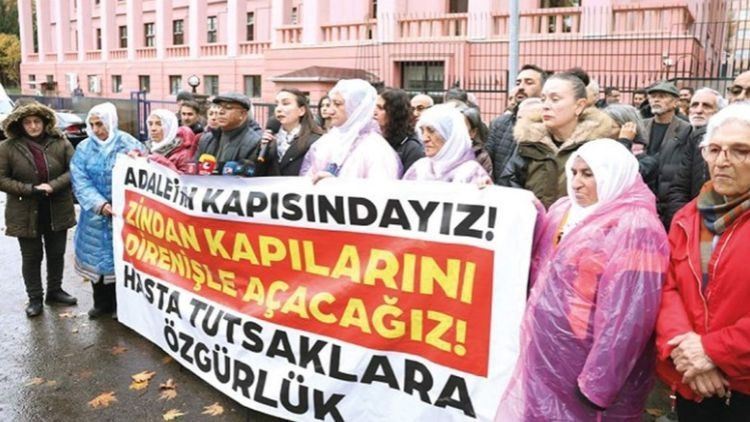
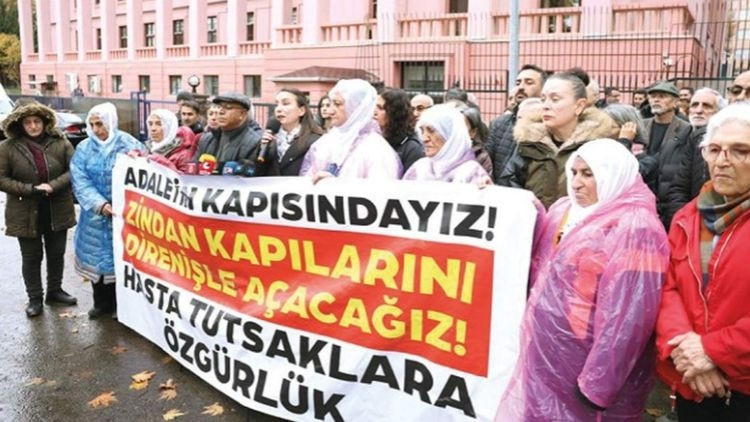
ANKARA — In a move that highlights the intersection of human rights and political reconciliation in Turkey, Tülay Hatimoğulları, the Co-Chair of the Peoples’ Equality and Democracy (DEM) Party, made a high-profile visit to the families of sick prisoners currently staging a protest in front of the Ministry of Justice. The demonstration, held under challenging weather conditions in the capital, has become a focal point for demands regarding the release of critically ill inmates, a group the DEM Party argues is being unjustly detained despite deteriorating health.
The gathering took place on November 22, 2026, amidst heavy rainfall in Ankara. Despite the downpour, families of prisoners have remained steadfast in their presence outside the Ministry, seeking an audience or a policy shift that would allow their ailing relatives to receive medical care outside of the prison system. Hatimoğulları joined these families to offer her party’s solidarity, framing the issue not merely as a legal technicality, but as a fundamental test of the state’s commitment to human rights and the ongoing efforts toward social peace.
During the visit, Hatimoğulları delivered a comprehensive statement alongside the families, providing a statistical breakdown of the current crisis within the Turkish penal system. According to the data cited by the Co-Chair, there are currently 1,412 sick prisoners across the country. Of this total, 335 are classified as being in "serious" condition, while 230 are reported to be in such a state of physical decline that they are unable to maintain their lives independently or perform basic self-care within a cell environment.
A Call for Institutional Fairness and Transparency
A central theme of Hatimoğulları’s address was the role of the Forensic Medicine Institute (ATK) and the various prison observation boards. These institutions are responsible for evaluating the health status of inmates and determining whether they are fit to remain in incarceration. However, the DEM Party and the protesting families have long criticized these bodies for what they describe as a lack of impartiality and a failure to apply objective medical criteria.
Hatimoğulları emphasized that the families are not asking for special favors, but rather for a "fair evaluation" that aligns with both domestic law and international human rights standards. She noted that the delay in releasing prisoners who are clearly at the end of their lives, or who require specialized medical intervention unavailable in a prison setting, is often perceived as a political decision rather than a medical one.
"We expect a fair evaluation from the Forensic Medicine Institute and the prison boards," Hatimoğulları stated. She argued that the current approach, which often sees release requests denied despite documented medical emergencies, serves as a barrier to justice. By ensuring that these boards act with transparency and medical integrity, the government could demonstrate a genuine adherence to the rule of law.
The Link Between Justice for Prisoners and the Peace Process
The Co-Chair’s remarks also touched upon the broader political climate in Turkey, specifically referencing the "peace and democratic society process" that she noted has been the subject of dialogue and discussion for the past two years. Hatimoğulları linked the treatment of sick prisoners directly to the success of these peace efforts, suggesting that the state’s handling of vulnerable inmates is a barometer for its sincerity in seeking reconciliation.
She recounted her interactions with the public and party constituents, noting that the question of sick prisoners is a recurring theme in local meetings. "Our mothers ask us at every public meeting we attend, and our administrators ask us when we go to the local regions: ‘While sick prisoners are still being held in jail, while seriously ill prisoners are virtually left to die in prisons, how can they think about making peace with the Kurds?’" Hatimoğulları shared.
This rhetorical question underscores the DEM Party’s position that a "peace process" cannot be divorced from the daily realities of the judicial and penal systems. From the perspective of the families and the party, the continued detention of individuals who are medically unfit for prison serves as an obstacle to building the trust necessary for any long-term democratic solution. Hatimoğulları suggested that addressing this humanitarian issue would be the single greatest contribution the government could make to the ongoing dialogue.

An Appeal to the Highest Levels of Government
Addressing the state leadership directly, Hatimoğulları called upon President Recep Tayyip Erdoğan, the Minister of Justice, and the broader state bureaucracy to take immediate action. She framed the release of sick prisoners as an urgent necessity that transcends partisan politics, characterizing it as a matter of "conscience, humanity, and law."
"I am calling out once again to the government, to the Honorable President, to the Minister of Justice, and to those who manage this process within the state bureaucracy: Fulfill these demands of the families and the relatives of the sick prisoners," she urged. She argued that ending the "torture" suffered by these inmates and their families is a moral imperative.
The Co-Chair’s language was notably sharp when describing the current conditions. She warned that prisons must not be allowed to become "tabuthaneler"—a term meaning "houses of coffins" or morgues. This metaphor reflects the dire concerns held by human rights advocates that for many seriously ill inmates, a prison sentence is effectively becoming a death sentence due to the lack of timely medical parole.

The Resilience of the Families Under the Rain
The image of the DEM Party leader standing under the rain with the families was a potent symbol of the day’s events. Hatimoğulları praised the resilience of the "mothers" and relatives who have been conducting their vigil in front of the Ministry of Justice. She assured them that the struggle for the rights of sick prisoners would continue until meaningful reforms are enacted.
"This is a matter of rights," she told the gathered crowd. "To ensure that this process reaches a successful conclusion, we will continue this struggle with you until the end. Prisons should not be morgues."
The protest in Ankara is part of a wider movement by families and legal advocacy groups who argue that the legal framework for "suspension of execution" on health grounds is being applied too restrictively. Under current Turkish law, a prisoner’s sentence can be suspended if their life is at "certain risk" due to illness, but the process requires a report from the Forensic Medicine Institute and, in many cases, a determination by the police or gendarmerie that the individual does not pose a "danger to public safety." Critics argue that this "public safety" clause is often used to keep political prisoners behind bars even when they are terminally ill.

Conclusion of the Visit
As the visit concluded, the atmosphere in front of the Ministry of Justice remained one of determined protest. The DEM Party’s involvement brings significant political weight to the families’ demands, positioning the issue of sick prisoners as a central pillar of the party’s human rights agenda and its approach to the national dialogue.
By framing the issue as a "contribution to the process," Hatimoğulları has placed the ball in the government’s court, suggesting that the path to a broader democratic society and peace begins with the treatment of the most vulnerable individuals within the state’s custody. The demand for a "fair evaluation" remains the core of the protest, as families wait to see if the bureaucratic and medical boards will respond to the growing calls for humanitarian intervention.
The DEM Party has signaled that it will continue to monitor the status of the 1,412 prisoners closely, maintaining pressure on the Ministry of Justice to ensure that the penal system reflects the values of a "democratic society" rather than the "tabuthane" conditions they so vehemently oppose. For now, the families remain in the capital, their presence a constant reminder of the human lives behind the statistics provided by the party leadership.