
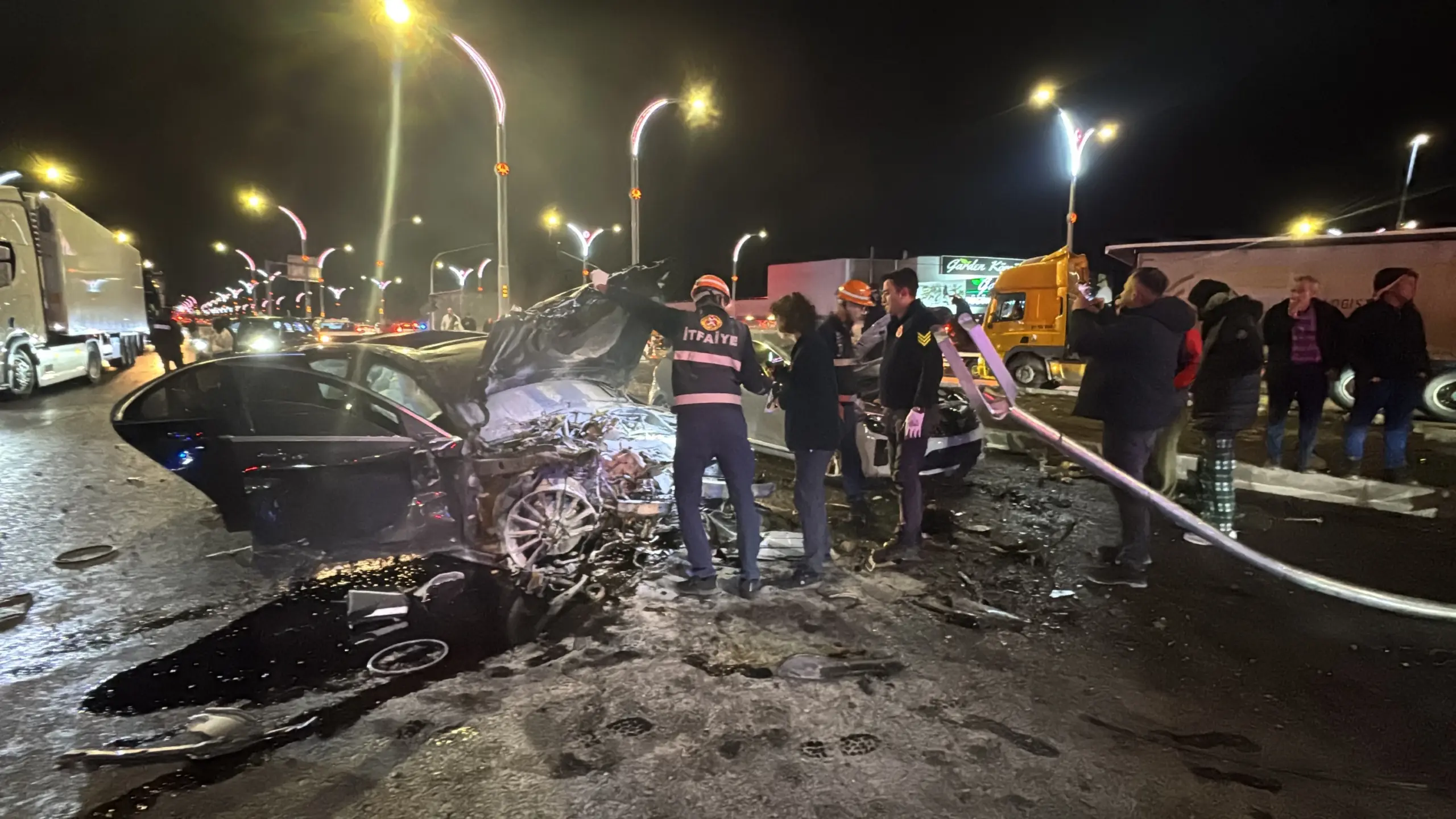
A severe traffic accident involving three automobiles and one light commercial vehicle occurred on the D-100 highway in Bolu, leaving four people injured, two of them in critical condition. The high-impact collision caused significant disruption to traffic flow, triggered a localized vehicle fire, and required a complex rescue operation by emergency response teams who had to extricate trapped passengers from heavily damaged wreckage.

The multi-vehicle accident took place at the busy Sanayi Junction along the D-100 highway, a crucial transit corridor that regularly experiences heavy traffic volumes. According to initial reports from the scene, the crash involved three separate automobiles bearing the license plates 14 ABM 774, 14 ACG 656, and 14 ADS 964. For reasons still under official investigation by traffic safety and law enforcement authorities, these three vehicles collided violently with one another at the intersection.
The kinetic force of the multi-car impact generated a chain reaction that amplified the severity of the incident. As the automobiles smashed into each other, the impact destabilized a roadside electrical utility pole. The concrete or metal pole snapped under the stress and toppled directly onto a passing light commercial vehicle, registered under the license plate 14 KR 965, which was caught in the immediate vicinity of the primary collision zone. The sudden descent of the heavy electrical pole crushed parts of the light commercial vehicle, compounding the danger for motorists traversing the area.

Upon receiving urgent notifications from passing drivers and local witnesses who witnessed the terrifying sequence of events, emergency dispatchers immediately mobilized a coordinated response. Police, fire department rescue units, and multiple ambulance crews were dispatched to the Sanayi Junction without delay to secure the perimeter and render emergency medical assistance to the victims.
Upon arrival, first responders found a chaotic scene with debris scattered across the asphalt, compromised electrical lines, and heavily deformed vehicle frames. The fire department personnel immediately focused their efforts on the most urgent life-safety threats. In addition to securing the hazardous utility lines and preventing further environmental or structural hazards, firefighters turned their attention to the badly damaged automobiles where occupants were trapped.

Specialized hydraulic rescue tools, commonly known as the "jaws of life," were deployed to cut through the mangled metal of the automobile registered under the license plate 14 ACG 656. The impact had severely compressed the cabin structure, trapping two individuals inside the wreckage. Working with precision and urgency, the rescue teams managed to safely extricate the two trapped victims from the crushed passenger compartment.
During the course of the rescue operations, a localized fire broke out in one of the wrecked automobiles due to fluid leaks and electrical short circuits triggered by the crash. Quick-thinking firefighters swiftly deployed suppression equipment to extinguish the flames before the fire could spread to the fuel tanks or engulf neighboring vehicles, thereby preventing a potentially catastrophic escalation of the emergency.

Once all four injured individuals were successfully freed from the wreckage and secured by the rescue personnel, they received preliminary trauma stabilization from emergency medical technicians directly at the accident scene. Following the initial on-site interventions, the four casualties were transferred via fleet ambulances to the İzzet Baysal State Hospital Köroğlu Unit for comprehensive medical evaluation and advanced treatment.
Hospital authorities and medical personnel evaluated the conditions of the incoming patients upon their arrival. Medical updates from the facility indicated that two of the four injured individuals sustained severe trauma and are currently being closely monitored in intensive care units, where doctors are fighting to stabilize their critical conditions. The remaining two victims are reported to have sustained lesser injuries, though they remain under observation.

In the wake of the accident, local law enforcement agencies initiated a comprehensive investigation to determine the exact sequence of events, contributing factors, and potential liability regarding how the three automobiles initially collided at the Sanayi Junction. Traffic police officers conducted forensic measurements, gathered physical evidence from the pavement, and took statements from available witnesses to construct an accurate reconstruction of the crash.
The accident had an immediate and severe impact on regional transportation. The physical blockage caused by the wrecked vehicles, debris, and fallen utility pole forced authorities to temporarily close the affected section of the D-100 highway to all vehicular traffic. This closure created significant traffic congestion along the vital route, leading to long queues of stranded vehicles as commuters and freight transporters waited for the roadway to be cleared.

Road maintenance crews, heavy-duty tow trucks, and municipal sanitation workers labored at the site to remove the disabled automobiles and the downed electrical pole from the roadway. Once the wreckage was completely hoisted onto flatbed trucks and the asphalt was cleared of hazardous debris and glass fragments, safety inspections were completed. Following the green light from traffic safety officials, the D-100 highway was officially reopened to normal traffic flow, gradually easing the transportation bottleneck in the area.