


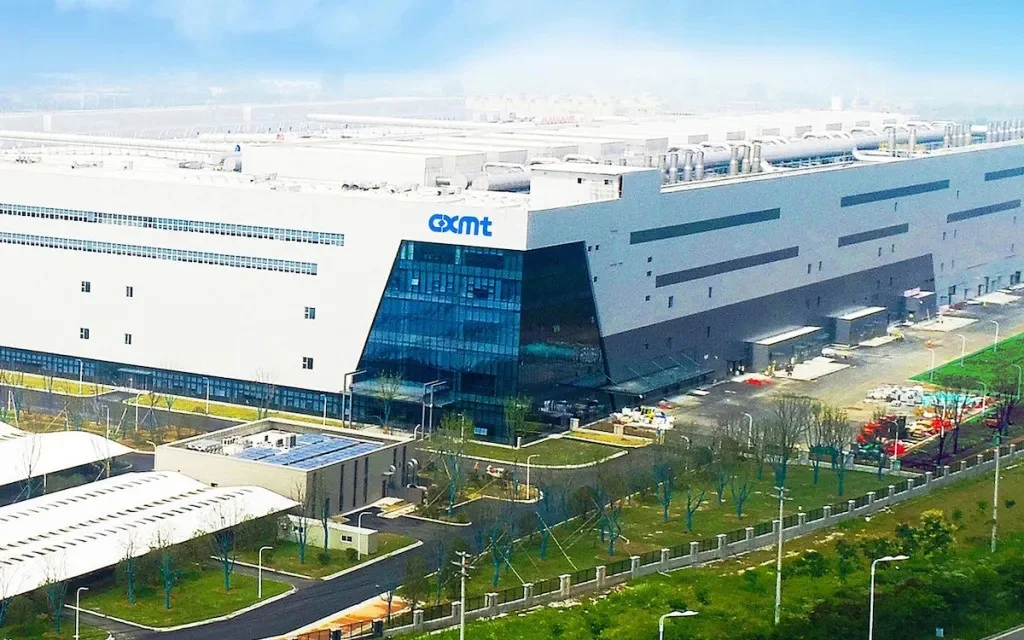
ChangXin Memory Technologies (CXMT), one of China’s leading designers and manufacturers of Dynamic Random-Access Memory (DRAM), is reportedly laying the groundwork to expand its semiconductor portfolio into the flash memory market. The Hefei-based chipmaker is evaluating plans to establish an experimental production line for 3D NAND flash memory at a proposed new facility near Beijing, signaling a major strategic expansion that could alter the landscape of the domestic and global memory industries.
According to reports citing sources familiar with the matter, the planned facility is still in its early developmental stages, with physical construction yet to begin. Because of the long lead times required to build, equip, and calibrate modern semiconductor fabrication plants, industry experts estimate that even if the project proceeds smoothly, it will take at least two to three years for the experimental 3D NAND production line to become fully operational.
While CXMT has not released an official public statement regarding these plans, the move represents a significant step forward in China’s broader push for technological self-sufficiency in the critical semiconductor sector. By entering the 3D NAND space, CXMT aims to diversify its product offerings and potentially establish itself as a multi-category memory manufacturer.
CXMT’s Strategic Transformation
To support its long-term research and development goals, CXMT has already established a dedicated research institute in Beijing focused on advancing NAND flash technologies. Despite these structural preparations, the company’s ultimate transition to high-volume, commercial mass production of 3D NAND remains unconfirmed, and the project could remain limited to research and experimental phases in the near term.
Currently, key technical specifications of CXMT’s potential 3D NAND products remain closely guarded. There are no public details regarding the target architecture, the number of vertical layers the company plans to stack, the specific manufacturing nodes, performance benchmarks, or the projected production capacity of the experimental line. Stacking layers in 3D NAND is a highly complex process, with leading global manufacturers currently producing chips with well over 200 layers to maximize storage density and write speeds. Where CXMT will attempt to enter this technology curve remains one of the industry’s open questions.

Despite the lack of public technical data, sources indicate that CXMT is already engaging in preliminary discussions with potential customers regarding its future NAND output. Among these prospective partners is a newly established startup focused on developing specialized storage solutions tailored for high-performance computing, supercomputers, and artificial intelligence (AI) infrastructure. This early-stage outreach suggests that CXMT is positioning its potential NAND products to meet the surging domestic demand for high-speed, high-capacity storage driven by the rapid expansion of AI data centers within China.
Should CXMT successfully transition from an experimental line to commercial manufacturing, it would mark a departure from its historical specialization. Since its founding, CXMT has focused almost exclusively on DRAM, the volatile memory used for temporary data processing in computers, servers, and mobile devices. Expanding into non-volatile 3D NAND flash memory—used for permanent data storage in solid-state drives (SSDs) and consumer electronics—would bring CXMT into direct domestic competition with Yangtze Memory Technologies Corp (YMTC), which has served as China’s primary champion in the 3D NAND space.
Sectoral Competition and Government Support
Historically, China’s domestic memory chip strategy appeared to rely on a clear division of labor between its two primary state-backed champions. CXMT was tasked with advancing domestic DRAM capabilities, while YMTC focused its resources on pioneering advanced 3D NAND flash architectures. This separation allowed both companies to concentrate their capital and engineering talent on mastering distinct and highly complex manufacturing processes without competing for the same market share.
However, recent developments suggest a shift in this dual-track strategy, with both companies beginning to cross over into each other’s traditional domains. While CXMT is exploring the limits of 3D NAND, reports have also emerged indicating that YMTC is conducting preliminary research into DRAM development.
This mutual expansion suggests that both Chinese chipmakers may eventually seek to offer unified, full-suite memory portfolios. This business model aligns with the strategies of established global memory giants such as Samsung Electronics, SK Hynix, and Micron Technology. These tier-one manufacturers have long operated diversified business models, producing both DRAM and NAND flash under one corporate umbrella. Offering both types of memory allows these companies to capture a larger share of the bill of materials in consumer electronics and enterprise servers, while also hedging against the cyclical downturns that frequently affect individual memory markets.
For CXMT, however, the decision to invest heavily in 3D NAND is not without commercial risk. The company currently enjoys significant growth opportunities within its core DRAM business. The global explosion of AI workloads has generated unprecedented demand for advanced DRAM solutions, particularly High Bandwidth Memory (HBM) and low-power, high-density DDR5 modules. Many industry analysts argue that focusing resources on scaling up advanced DRAM nodes and developing domestic HBM alternatives would yield more immediate strategic and financial rewards for CXMT.
Furthermore, manufacturing 3D NAND requires entirely different production processes, specialized equipment, and engineering expertise compared to DRAM. While DRAM relies on precise, ultra-fine lithography to shrink horizontal cell structures, 3D NAND manufacturing is characterized by vertical stacking, which demands highly advanced high-aspect-ratio etching and chemical vapor deposition technologies to build stable, uniform vertical structures. Consequently, diverting capital, equipment, and engineering talent to establish a parallel 3D NAND division could impose a heavy financial burden on CXMT in the short to medium term.
Despite these commercial and technical hurdles, CXMT’s strategic choices are heavily influenced by factors beyond immediate market profitability. As a cornerstone of China’s domestic semiconductor ecosystem, the company’s expansion plans are closely aligned with national policies aimed at mitigating vulnerability to foreign supply chain disruptions and export controls.
CXMT’s growth has been heavily subsidized and guided by state-aligned entities since its inception. The company was founded with substantial financial backing from the municipal government of Hefei, a city in Anhui province known for its strategic investment model in high-tech industries. Additionally, CXMT has received major capital injections from China’s National Integrated Circuit Industry Investment Fund, commonly referred to as the "Big Fund." This state-backed investment vehicle is tasked with funding high-risk, long-term semiconductor projects that are vital to national security and technological independence.
Because the Chinese government views self-sufficiency in both volatile and non-volatile memory as a critical national priority, the decision to develop a second domestic source of 3D NAND may be a calculated strategic redundancy. If CXMT successfully navigates the technical challenges of 3D NAND fabrication, it would provide China with a resilient, secondary domestic supplier of flash memory, reducing the country’s reliance on foreign manufacturers and ensuring a stable supply of storage components for its domestic technology sector.