
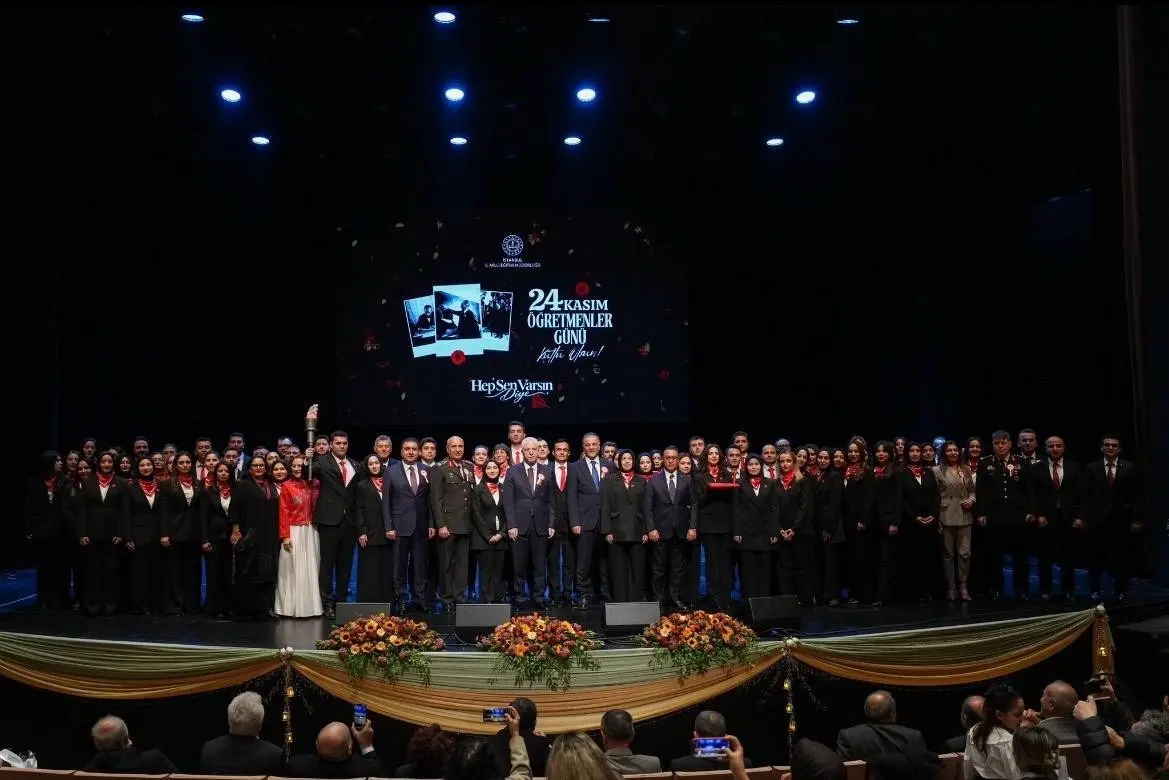
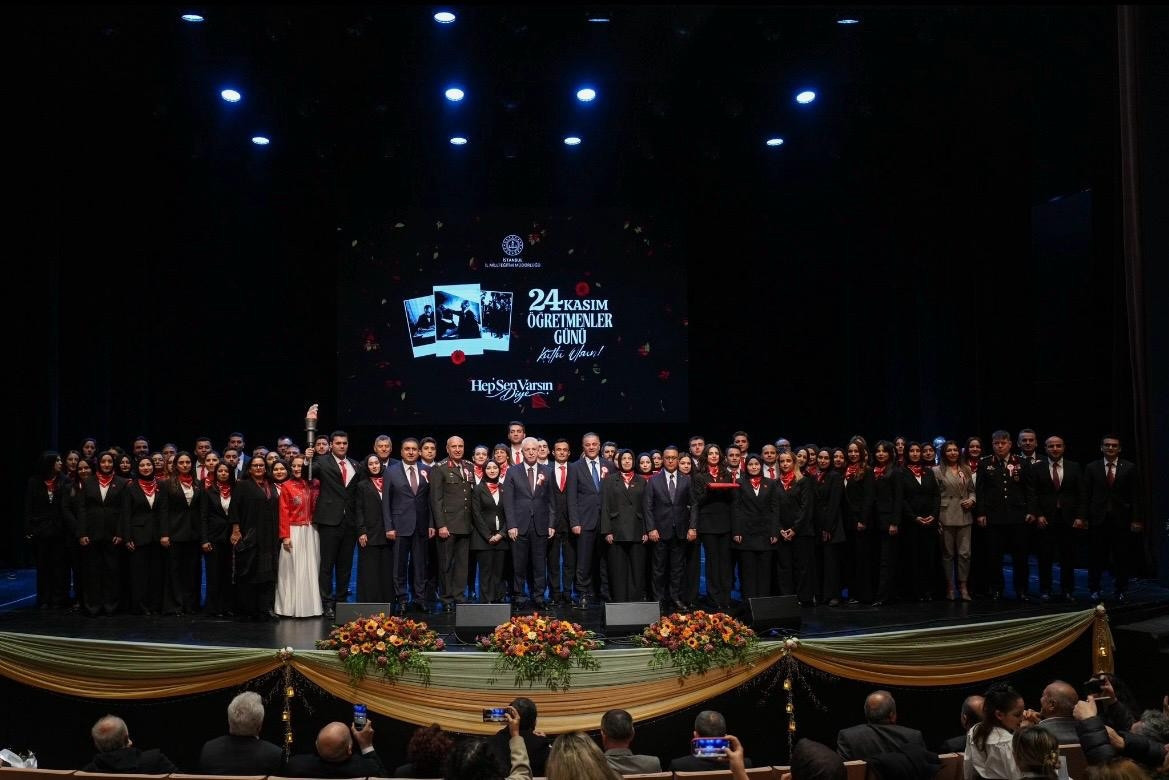
ISTANBUL — The Istanbul Provincial Directorate of National Education commemorated November 24 Teachers’ Day with a series of high-profile events and ceremonies across the city, organized under the central theme “Because You Are Always There” (Hep Sen Varsın Diye). Bringing together active educators, retired teachers, students, and senior government officials, the annual observance paid tribute to the teaching profession’s role in shaping the nation’s past, present, and future.
The celebrations commenced with a formal wreath-laying ceremony at the historic Taksim Republic Monument, honoring the legacy of education in Turkey. Following the morning tributes, the main official program moved to the Atatürk Cultural Center (AKM), where attendees gathered for speeches, commemorative performances, and tributes to fallen educators. Throughout the day’s proceedings, high-ranking officials—including Minister of National Education Yusuf Tekin, Istanbul Governor Davut Gül, and Istanbul Provincial Director of National Education Murat Mücahit Yentür—emphasized the indispensable contribution of teachers to social development, national sovereignty, and economic modernization.
Commemorative Ceremonies and Tributes at Atatürk Cultural Center
The formal proceedings in Istanbul began at the landmark Taksim Republic Monument, where representatives of the education sector, civic leaders, and students gathered for the traditional wreath-laying ceremony to mark November 24 Teachers’ Day. The ceremony at Taksim set a solemn and reflective tone for the day’s observances, symbolizing the foundational role of education in the Republic of Turkey.
Following the gathering at Taksim Square, the official commemoration shifted to the Atatürk Cultural Center (AKM), one of Istanbul’s premier cultural venues. The AKM program featured a diverse audience comprising veteran educators who have devoted decades to the school system, early-career teachers, high school and primary students, and local administrative authorities.
A centerpiece of the AKM program was an original artistic performance titled “A Lifetime, A Pen” (Bir Ömür Bir Kalem). The special oratorio was written, produced, and performed collaboratively by the students and faculty of the Istanbul University Itri Fine Arts High School. Through music, poetry, and dramatic recitation, the performance depicted the lifelong dedication required of educators and the transformative impact a single teacher can have on generations of students.
The event at the Atatürk Cultural Center also served as a solemn moment of remembrance for martyr teachers—educators who lost their lives in the line of duty, often while serving in remote or challenging regions across the country. Attendees observed moments of tribute honoring their memory, reaffirming the state’s and society’s lasting gratitude for their ultimate sacrifice in the service of public education.
Prioritizing Teachers’ Needs and the ‘Century of Türkiye Education Model’
Although unable to attend the Istanbul gathering in person, Minister of National Education Yusuf Tekin delivered a comprehensive message directly to the assembled educators, expressing the government’s appreciation and outlining structural policy priorities for the country’s educational framework.
In his message, Minister Tekin praised teachers for their selfless dedication, pointing out that their work extends far beyond the boundaries of scheduled classroom instruction. He emphasized that educators serve as mentors, guides, and source points of support for millions of children across the nation, tailoring their approach to the unique background and needs of each individual student.
“You have shared the joy, the strength, and the excitement of our students, knowing that every single student of ours carries a unique personal story,” Minister Tekin stated in his written address. “You have taken on the immense responsibility of being a teacher—a responsibility that is never limited merely to lesson hours. The determination you demonstrate finds its true response and value in the individuals you raise across all four corners of our country.”
Minister Tekin highlighted that the contributions of educators are directly linked to the nation’s ongoing stability and advancement. “With the students you have raised, you have contributed to our country’s present day, and you continue to shed light on its tomorrows,” he stated, reiterating that the state regards the teaching corps as the cornerstone of national progress.
Addressing systemic support for the profession, the Minister reiterated that the Ministry of National Education is actively designing and implementing educational policies that place teachers at the absolute center of decision-making processes. He noted that addressing the practical, administrative, and professional requirements of teachers remains a top priority for the ministry.
“We are developing policies that prioritize the needs of our teachers and place them at the very center of our decision-making processes,” Tekin declared. “With the Century of Türkiye Education Model (Türkiye Yüzyılı Maarif Modeli), our goal is for our children to become well-educated, value-oriented, reflective, and productive individuals. We view it as our fundamental responsibility to strengthen your professional prestige and to continuously improve your working conditions.”
The Minister’s remarks underscored the ongoing implementation of the "Century of Türkiye Education Model," a comprehensive curricular and pedagogical reform framework designed to harmonize modern analytical skills with traditional core values. According to Tekin, the success of this strategic vision relies entirely on the commitment, expertise, and moral leadership of Turkey’s teaching workforce.
Education as the Foundation of Economic Growth and Human Capital
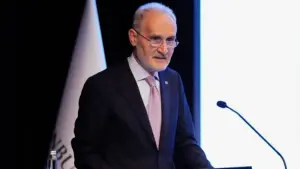
Speaking to the audience at the Atatürk Cultural Center, Istanbul Governor Davut Gül framed the teaching profession within the broader context of Turkey’s historical trajectory and its modern economic standing. Governor Gül highlighted the direct relationship between educational investment, human capital development, and the nation’s transformation over its century-long republican history.

Governor Gül observed that teaching is a uniquely impactful profession because its influence spans every stage of human life and every era of societal development. He noted that the Republic of Turkey owes its modern achievements in large part to the foundational work carried out in classrooms over the decades.
“Teaching is an essential profession that touches human life at every age and in every period,” Governor Gül stated during his address. “As the Republic of Turkey, we owe a tremendous debt of gratitude to our teachers. Throughout our 103-year republican history, we have transformed from a nation that once struggled against poverty and widespread disease into a country boasting $300 billion in exports and standing as the 16th largest economy in the world.”
The Governor emphasized that Turkey’s rapid rise into the upper ranks of global economic powers was not an accidental occurrence, but rather the direct product of sustained investment in human capital—a process driven primarily by educators working in schools across the country.
“Behind the narrowing of this historical gap lies our human capital,” Governor Gül explained. “And at the very core of this human capital lies education. Therefore, because our human capital is strong, we have closed this development gap, and we continue to close it. Those who are raised within our education system, through the vital contributions of our teachers, are making massive contributions to the ongoing development of our country.”
Governor Gül concluded his remarks by reassuring educators that the provincial administration and state institutions remain fully committed to supporting educational infrastructure in Istanbul, ensuring that teachers possess the resources necessary to continue cultivating skilled, competitive, and civic-minded generations.
Teaching as a Journey of Hope and Dedication
In his speech at the ceremony, Istanbul Provincial Director of National Education Murat Mücahit Yentür offered a deeply reflective perspective on the moral and philosophical dimensions of the teaching profession. Yentür described teaching not merely as an employment category or an administrative duty, but as a persistent, compassionate journey undertaken on behalf of every child in the nation.
Yentür addressed the systemic and personal challenges that educators often face, noting that true teaching is characterized by an unwavering resolve to educate every student regardless of external circumstances or material constraints.

“Teaching is a long walk,” Yentür said to the assembled crowd. “It is the persistent walk of being able to say ‘there is still one more child,’ despite poverty, despite physical impossibilities, and despite hopelessness. You are the most effective architects of the ‘Century of Türkiye’ ideal. It is you who plant the seed that sprouts in the hearts of our children, and it is you who nurture them as they grow.”
Director Yentür also highlighted the vital human element that teachers bring to the educational enterprise, pointing out that official curricula, textbooks, and policy documents remain static tools until they are animated by an educator’s personal devotion and empathy.
“All curricula written on paper can only gain true meaning when they meet your heart and your spirit,” Yentür stated. “Without the heart of a teacher, educational frameworks remain empty concepts. It is your passion and devotion that translate educational policies into living realities for our youth.”
A Nationwide Reflection on the Role of Educators
The Teachers’ Day observances in Istanbul reflected a broader national consensus on the central role of education in national development and social cohesion. By bringing together civic leaders, educational administrators, active teachers, and students under the unifying theme of “Because You Are Always There,” the event served as both a celebration of individual educators and a policy reaffirmation by state leadership.
From the solemn morning tributes at the Taksim Republic Monument to the artistic performances and policy addresses at the Atatürk Cultural Center, the November 24 celebrations underscored a dual narrative: honoring the historic sacrifices of past generations of teachers—including those who lost their lives in service—while setting a clear, forward-looking agenda for the future of education in Turkey.
As the formal events at the Atatürk Cultural Center concluded, officials re-emphasized their commitment to advancing the "Century of Türkiye Education Model," enhancing working conditions for teachers across Istanbul’s expansive school network, and continuing to position educational investment as the primary engine of the nation’s human capital and economic strength.