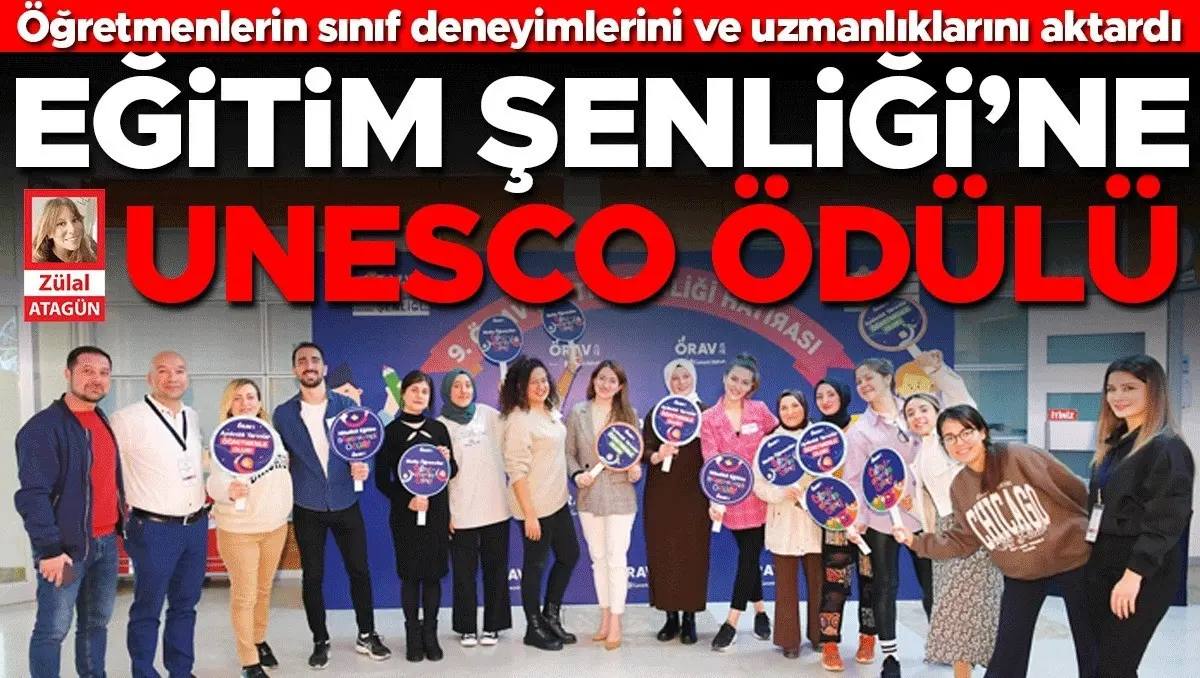
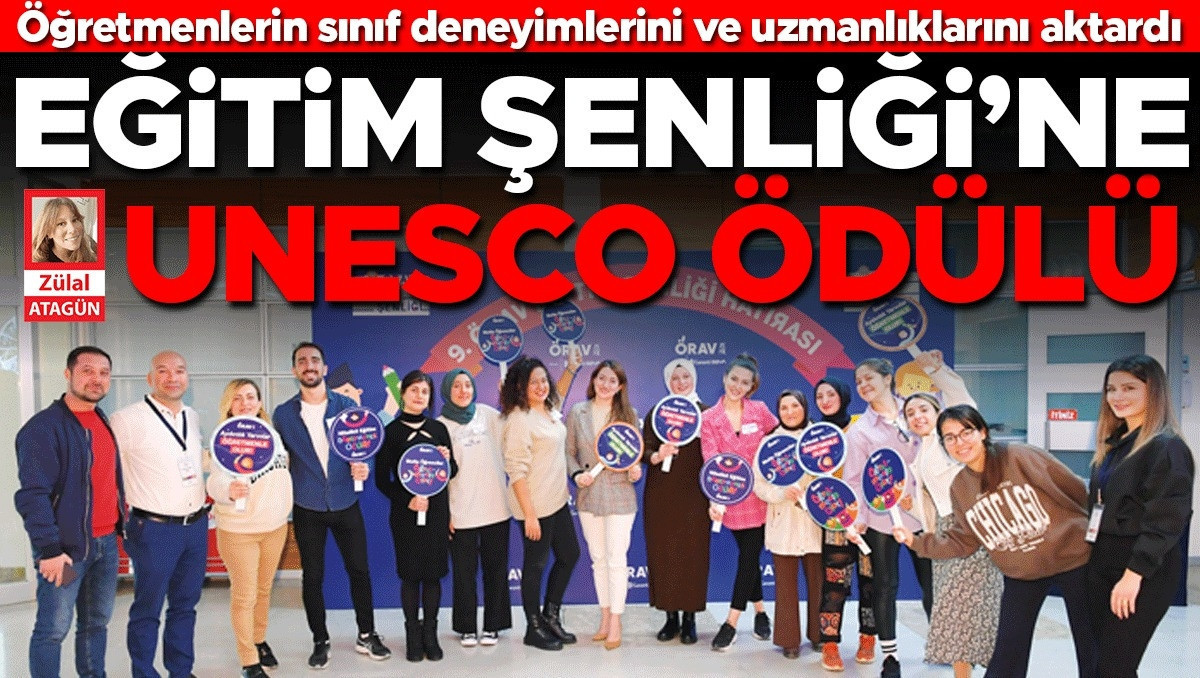
A pioneering Turkish educational initiative that transforms classroom teachers into voluntary workshop leaders and peer mentors has achieved major international acclaim. The "Education Festival" (Eğitim Şenliği), designed and implemented by the Teachers Academy Foundation (Öğretmen Akademisi Vakfı – ÖRAV), has been named one of the winners of the prestigious UNESCO-Hamdan Prize for Teacher Development.
The award was presented during an official ceremony hosted at UNESCO Headquarters in Paris. The recognition places ÖRAV’s flagship initiative among the top three teacher development programs worldwide, selected after an extensive international evaluation process that examined initiatives dedicated to enhancing teacher performance, effectiveness, and pedagogical practices across the globe.
Global Distinction for Grassroots Teacher Empowerment
The selection process for the UNESCO-Hamdan Prize for Teacher Development was intensely competitive, reflecting a broad international search for exemplary models in educator training. A total of 169 applications submitted from 64 countries were rigorously evaluated by an international jury of educational experts. Out of this global pool, only ten initiatives advanced to the finalist stage, with three ultimate laureates selected to receive the top honor in Paris.
Turkey made a remarkably strong showing in the global evaluation, securing two spots among the ten international finalists. Alongside ÖRAV’s winning Education Festival, the "Teacher Communities Program" (Öğretmen Toplulukları Programı)—developed by the Village Schools Change Network (Köy Okulları Değişim Ağı – KODA)—was also selected as a top-ten finalist. KODA’s program focuses specifically on unifying, supporting, and professionalizing educators serving in rural and village schools across Turkey.
The dual recognition of ÖRAV and KODA on UNESCO’s international platform highlights the growing global impact of Turkish non-governmental organizations in championing peer-led, equitable, and community-driven teacher development models.
Rethinking Professional Growth Through Peer-to-Peer Learning
Launched in 2015, ÖRAV’s Education Festival was built around a fundamental shift in how professional development is delivered to teachers. Rather than relying solely on top-down, traditional lecture formats led by external experts, the initiative centers entirely on peer-to-peer knowledge sharing—an approach summarized as teachers learning directly from teachers.
Under the Education Festival framework, participating teachers do not remain passive attendees. Instead, they take active ownership of the learning environment by designing interactive workshops, facilitating hands-on activities, and organizing local events within their respective provinces.
This model establishes a dynamic, self-reinforcing learning cycle. A teacher who attends a festival gathering to acquire a new pedagogical technique or classroom strategy can subsequently test that method in their own school. Once perfected, that same educator returns in a subsequent gathering as an active workshop leader, passing on their practical, classroom-tested experience to a new group of colleagues.

By creating a platform where educators voluntarily share their expertise, classroom challenges, and innovative practices, the program fosters a collaborative culture across the teaching profession.
Democratizing Access and Fostering Educational Equity
A core tenet of the Education Festival is its commitment to inclusivity and equity. All activities, workshops, and gatherings conducted under the program are offered completely free of charge to participants.
This zero-cost model is specifically designed to eliminate financial and geographic barriers that frequently hinder educators working in under-resourced, rural, or socioeconomically disadvantaged environments. By offering equal access to professional and personal development opportunities, the program helps level the playing field for teachers regardless of their location or the resource constraints of their schools.
To ensure broad reach, the Education Festival operates through a hybrid delivery model incorporating both in-person and online events. Physical gatherings allow teachers within specific provinces to build local professional networks, exchange ideas, and collaborate on shared regional challenges. Meanwhile, digital workshops break down regional boundaries, enabling educators from distant geographic areas to connect, share resources, and participate in interactive learning sessions that would otherwise be inaccessible.

This dual structure ensures that classroom teachers, regardless of whether they serve in major urban centers or isolated rural communities, can systematically access tools, methodologies, and peer support networks to enhance their instructional practices.
A Track Record of Impact: 39,000 Educators and 1,700 Workshops
Since its inception in 2015, the Education Festival has built a substantial track record of quantitative and qualitative impact across Turkey’s educational system. Over its years of operation, the initiative has directly reached 38,934 teachers and facilitated approximately 1,700 distinct workshops.
These numbers reflect more than mere participation statistics; they represent an expanding network of educators actively engaged in professional self-improvement and peer mentorship. The realization of nearly 1,700 workshops demonstrates a vast compilation of practical knowledge, ranging from classroom management techniques and active learning strategies to digital tool integration and creative pedagogical approaches.
By maintaining a continuous schedule of events across multiple provinces and online channels, the Education Festival has succeeded in establishing an ongoing, sustainable community of practice that supports teachers throughout their professional careers.

Cultivating Continuous Leadership: From Local Organizers to Mentors
Beyond immediate skill-building and workshop participation, the Education Festival functions as a long-term leadership pipeline for educators. The operational structure of the program is deliberately designed to nurture organizational capacity, project management skills, and leadership qualities among teachers.
Dr. Cansu Özpir, ÖRAV Expert Trainer and Project Coordinator, highlighted the structural mechanics that sustain this leadership transition from year to year.
"A teacher who leads activities in their province for one year supports their colleague taking over the role the following year as a mentor," Dr. Özpir explained. "In this way, organizational experience is transferred directly from teacher to teacher, opening space for the cultivation of new leaders."
Dr. Özpir emphasized that receiving international validation through the UNESCO-Hamdan Prize underscores the significance of this collective, teacher-driven model.
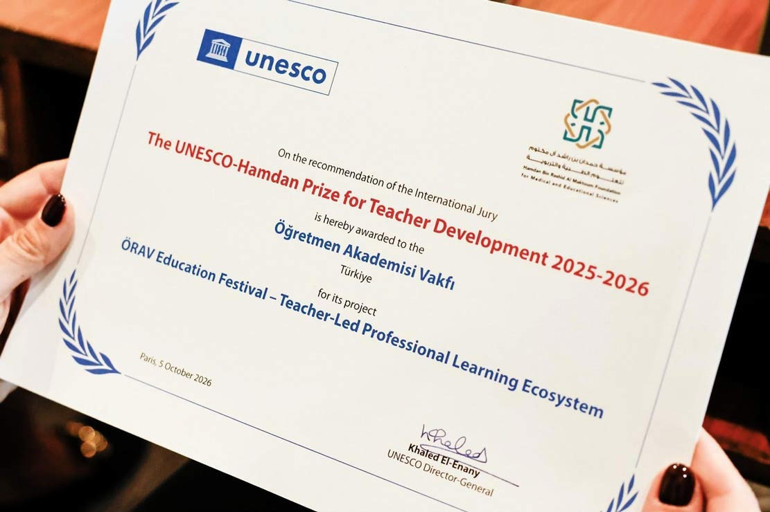
"We attached great importance to the international recognition of this joint effort," Dr. Özpir noted. "We wanted to demonstrate how teachers contribute meaningfully to professional development by learning together and taking on shared responsibilities."
This structured mentorship system ensures that institutional memory and local leadership skills are preserved and handed down continuously. As experienced festival leaders step into advisory and mentorship roles, incoming educators receive structured guidance as they assume responsibility for planning, executing, and leading local festival activities.
By combining peer-to-peer pedagogical instruction with a formal leadership succession framework, ÖRAV’s Education Festival offers a scalable, sustainable model for teacher empowerment. The UNESCO-Hamdan Prize recognition in Paris validates this grassroots approach, offering a global template for how educational communities can build durable, teacher-led ecosystems of continuous professional growth.