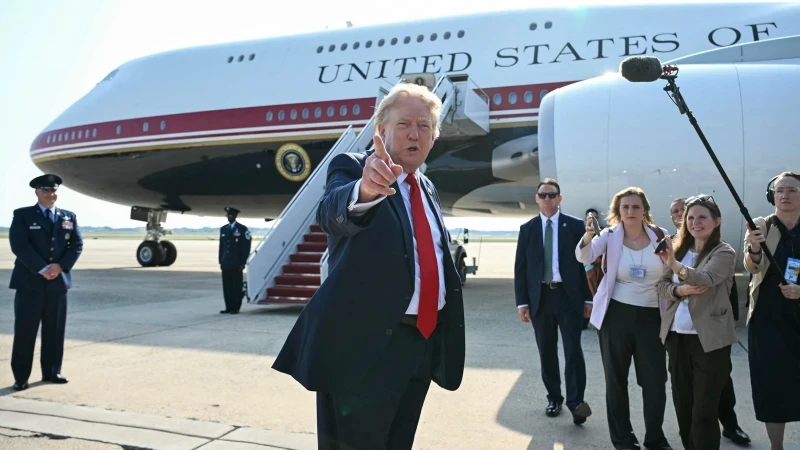
The long-standing and often volatile friction between United States President Donald Trump and major mainstream media outlets has entered a brand-new and contentious phase. Following a series of legal battles over White House press access and administrative restrictions, the Trump administration has once again targeted critical news organizations. This time, the friction has manifested in the skies, as the White House opted to exclude reporters from CNN and several other prominent outlets from the official press pool aboard the presidential aircraft, Air Force One, during a domestic trip to Tennessee.

The latest escalation became public late Friday evening when the White House released its official travel manifest and media schedule for the upcoming presidential visit. Journalists and media observers quickly noticed a glaring omission: CNN, an organization that has frequently found itself at odds with the current administration, was entirely absent from the list of accredited reporters permitted to board Air Force One. In addition to CNN, the newly updated press roster noticeably omitted several other mainstream media organizations that have previously been subjected to administrative limitations.
According to details surrounding the revised travel arrangements, the administration’s decision reshapes the composition of the traveling press corps that traditionally accompanies the commander-in-chief to regional events. In place of reporters from traditional networks and major newspapers, the media pool for the Tennessee journey was notably altered to include alternative media representatives. Specifically, reports confirmed that the travel roster welcomed a reporting team from Lindell TV, a digital media outlet owned by prominent business figure Mike Lindell, who is widely recognized for his vocal and steadfast support of President Trump and his political agenda.

This recent exclusion is far from an isolated incident, fitting into a broader, ongoing pattern of strained relations between the executive branch and large segments of the American press. Previously, the Trump administration drew sharp criticism and sparked fierce legal battles by implementing restrictions that limited the physical access of journalists from organizations such as CNN, MS NOW, and Politico to the White House complex. President Trump and his administration have consistently defended these restrictive measures by publicly accusing the affected outlets of producing continuous and deliberate biased coverage, frequently labeling their reporting as "fake news."
However, these administrative measures have not gone unchallenged. The attempts by the Trump administration to restrict access for specific media outlets previously escalated beyond political sparring and entered the judicial system. Press freedom advocates and affected news organizations took the matter to court, arguing that blanket bans and selective restrictions violate constitutional protections regarding freedom of the press and equal access to government proceedings. During those preceding legal proceedings, the courts intervened and effectively blocked several of the administration’s attempts to curtail press privileges within federal spaces, setting up a tense and legally fraught dynamic between executive authority and journalistic institutions.

The decision to omit critical news organizations from the Air Force One press pool during the Tennessee itinerary demonstrates that the administration remains resolute in its approach to media management, despite previous setbacks in the judicial arena. By altering the makeup of who gets physical access to the president during official travel—favoring alternative digital outlets over legacy media institutions—the administration continues to redefine how information is disseminated from the highest office in the United States.
As the legal and political repercussions of these ongoing press restrictions continue to unfold, media analysts and legal experts are closely monitoring the situation to see how the courts and journalistic organizations will respond to these evolving constraints on presidential reporting. For now, the latest developments aboard Air Force One underscore a deeply polarized media landscape where access to power remains a central battleground between the executive branch and the press.