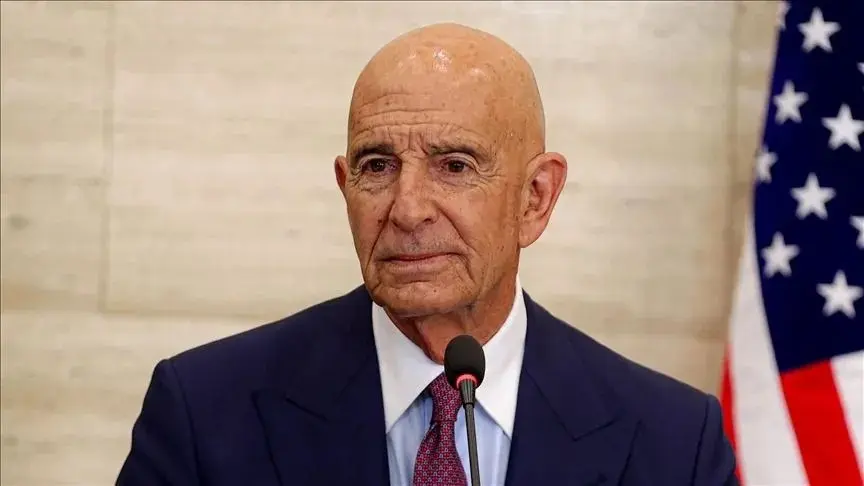
ANKARA — In a significant diplomatic gesture coinciding with the 103rd anniversary of the founding of the Republic of Turkey, United States Ambassador to Ankara and Special Representative for Syria and Iraq, Tom Barrack, has underscored the deepening strategic alignment between Washington and Ankara. In a detailed assessment shared via social media, Barrack characterized the burgeoning partnership among Turkic states as a cornerstone of the shared geopolitical vision held by U.S. President Donald Trump and Turkish President Recep Tayyip Erdoğan.
The remarks, which were released late on the evening of October 29, 2026, followed a high-level telephone conversation between the two presidents. The timing of the call was particularly symbolic, occurring as Turkey celebrated its Republic Day and prepared to host the 13th Summit of the Organization of Turkic States (OTS). According to Ambassador Barrack, the dialogue between the two leaders reflects a robust "spirit of cooperation" that has become a defining feature of the bilateral relationship in recent years.
A Shared Vision for Regional Prosperity
Ambassador Barrack, writing on the social media platform X, emphasized that the partnership between Turkic nations is not merely a regional matter but a central element of the broader international strategy pursued by both President Trump and President Erdoğan. He noted that the recent telephone exchange served as a natural extension of the rapport established during a recent dinner where the leaders gathered ahead of the 13th OTS Summit.
"The partnership between Turkic states is at the heart of the vision shared by both leaders," Barrack stated. He elaborated that this vision is built upon the premise of prioritizing economic integration and trade over traditional geopolitical conflict. By fostering strong, sustainable partnerships, the U.S. and Turkey aim to construct a regional framework that promotes peace, stability, and long-term prosperity for all involved parties.
The Ambassador’s comments suggest that the U.S. administration views the Organization of Turkic States as a vital vehicle for regional stability. In the eyes of Washington, the unity of these states—stretching from the shores of the Caspian Sea to the Mediterranean—represents a formidable stabilizing force in a traditionally volatile part of the world.
The Geopolitical Pivot: From the Caspian to the Mediterranean
A significant portion of Barrack’s assessment focused on the unique geographical and economic position of the Turkic states. He pointed out that these nations sit at the critical intersection of Europe, Asia, and the Middle East, acting as a bridge between diverse markets and political blocs. This geographic advantage, Barrack argued, places the Turkic world at the helm of the most important energy, trade, and connectivity corridors of the 21st century.
"These states are located on the energy, trade, and connectivity corridors that will shape the prosperity of future generations," Barrack noted. The mention of "connectivity corridors" is widely interpreted as a nod to the "Middle Corridor" (the Trans-Caspian International Transport Route), which has gained immense strategic importance as a reliable alternative to northern trade routes. By linking China and Central Asia to Europe via Turkey, these corridors are expected to revolutionize global supply chains.
Furthermore, the emphasis on energy reflects Turkey’s growing role as a regional energy hub. With pipelines carrying natural gas from the Caspian region and Central Asia through Anatolia to European markets, the stability and cooperation of Turkic states are viewed as essential for global energy security. Barrack’s comments reinforce the idea that the U.S. is committed to supporting these infrastructure projects as a means of ensuring economic resilience and reducing regional dependencies on single-source energy providers.
Commemorating the Republic and the 13th OTS Summit
The telephone call between President Trump and President Erdoğan was not solely focused on long-term strategy; it also served as a moment of personal and national significance. According to a statement issued by the Turkish Presidency’s Directorate of Communications, President Trump called his Turkish counterpart specifically to extend his congratulations on the occasion of October 29, Republic Day.
The call took place while President Erdoğan was attending a dinner with other leaders who had arrived in the country for the 13th Summit of the Organization of Turkic States. During the conversation, President Trump reportedly expressed his best wishes for the success of the upcoming summit, acknowledging the growing influence of the OTS on the global stage.

The Directorate of Communications highlighted that the call was characterized by a warm and constructive tone, reflecting the "dialogue and cooperation" that Barrack later praised in his public statements. For Ankara, the recognition of Republic Day by the U.S. President, coupled with his support for the OTS Summit, is seen as a validation of Turkey’s "Century of Turkey" vision—a policy framework aimed at elevating the nation’s standing as a leading global power and a pivotal player in the Turkic world.
Trade Over Conflict: A New Diplomatic Paradigm
One of the most striking elements of Ambassador Barrack’s message was the explicit shift in rhetoric toward "trade-based" diplomacy. By stating that the Trump-Erdoğan vision seeks to replace conflict with commerce, Barrack signaled a pragmatic approach to regional challenges. This philosophy suggests that economic interdependence is viewed as the most effective tool for preventing regional wars and fostering a climate where "sustainable cooperation" can thrive.
This approach aligns with President Trump’s broader "America First" economic policy, which often prioritizes bilateral trade agreements and tangible economic outcomes over traditional multilateral entanglements. For Turkey, this provides an opportunity to leverage its growing industrial base and its role as a logistics powerhouse to secure a more prominent position in the global economy.
The Ambassador’s emphasis on "future generations" indicates that the current administration in Washington views the U.S.-Turkey-Turkic State triad as a long-term investment. The goal is to build an architecture of prosperity that can withstand the shifts of political cycles, grounded in the hard realities of energy pipelines, fiber-optic cables, and rail networks.
The Role of the Special Representative
As the U.S. Special Representative for Syria and Iraq, Tom Barrack’s involvement in this announcement also carries weight regarding the security dimensions of the Turkic partnership. While the public statements focused heavily on trade and connectivity, the stability of the Turkic corridor is inextricably linked to the security situation in the Middle East and the Levant.

By framing the Turkic partnership as a "central vision," the U.S. appears to be integrating its Central Asian and Middle Eastern policies into a more cohesive strategy. A stable, prosperous, and united Turkic world provides a northern anchor of stability that can help mitigate the spillover of conflicts from neighboring regions. Barrack’s dual role as Ambassador and Special Representative suggests that the U.S. sees the economic success of the Turkic states as a prerequisite for the long-term resolution of security crises in Syria and Iraq.
Looking Ahead to the Summit
As the 13th Summit of the Organization of Turkic States commences, the eyes of the international community are on Ankara. The summit is expected to produce a series of landmark agreements on customs simplification, digital trade, and joint energy ventures. With the explicit backing of the United States, as articulated by Ambassador Barrack, the member states of the OTS are likely to move forward with increased confidence.
The partnership described by Barrack—one based on a shared vision of prosperity, trade, and strategic connectivity—marks a new chapter in the complex history of U.S.-Turkish relations. By centering the "Turkic World" in this relationship, both leaders appear to have found a common ground that transcends bilateral friction and focuses on the vast potential of the Eurasian heartland.
As the celebrations for the Republic of Turkey conclude and the diplomatic work of the OTS Summit begins, the message from the U.S. Embassy remains clear: the bond between the United States and Turkey, and the collective future of the Turkic states, is a priority of the highest order for both the White House and the Presidential Complex in Ankara. The "spirit of dialogue" established during this Republic Day phone call is expected to set the tone for regional diplomacy for years to come.