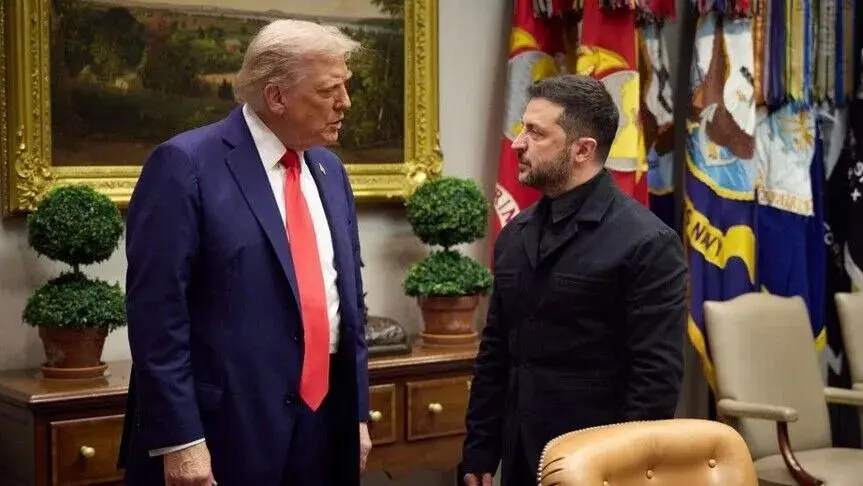
WASHINGTON — U.S. President Donald Trump addressed a wide array of domestic and foreign policy matters during an extensive question-and-answer session with journalists at the White House, declaring that Ukrainian President Volodymyr Zelensky and Russian President Vladimir Putin do not necessarily need to be in the same room to sign a peace accord to end their protracted war.
During the press availability, Trump spoke bluntly about the heavy human and financial toll of the war in Eastern Europe, pressed Kyiv to negotiate an end to the fighting, and offered wide-ranging observations on civil unrest and migration in Western Europe, prospective trade negotiations with India, and the domestic economic consequences of ongoing security conflicts involving Iran.
Asked directly by reporters whether a definitive peace treaty would require Zelensky and Putin to sit face-to-face across a negotiating table, Trump dismissed protocol concerns, stating that the format of any eventual signing ceremony was secondary to stopping the bloodshed.
"It depends on the situation. They don’t need to be in the same room. They can do it another way," Trump said. "It’s tough for them to be in the same room. I don’t care how it gets done."
Trump emphasized that the primary imperative must be halting the staggering casualty figures on the battlefield. "I don’t want to see 32,000, 25,000 people dying every month," he told reporters, underscoring his desire for swift diplomatic resolution regardless of ceremonial formalities.
‘Zelensky and Putin Do Not Need to Be in the Same Room’
The question of direct engagement between the leaders of Ukraine and Russia follows diplomatic contacts held in Oslo, Norway, where President Zelensky met with Trump’s Special Envoy for the Middle East, Steve Witkoff. When questioned about the viability of the peace process emerging from those high-level discussions, Trump maintained that the logistical arrangements between the two belligerents should not stand in the way of ending hostilities.
Trump suggested that the deep animosity and the political realities between Moscow and Kyiv make a shared stage improbable, but argued that modern diplomacy offers alternative mechanisms for formalizing an accord. For the White House, Trump indicated, the procedural details of how signatures are affixed or how agreements are brokered matter far less than putting an end to the monthly losses of thousands of soldiers and civilians.
The remarks highlighted Trump’s transactional approach to foreign diplomacy, portraying procedural rigidity as an obstacle to pragmatic conflict resolution. Rather than insisting on direct bilateral summits between the two heads of state, Trump expressed indifference toward traditional diplomatic decorum, reiterating that any functional framework enabling both parties to formalize terms would suffice.
‘Russia Has Unlimited Manpower and Keeps Moving Forward’
Assessing the strategic balance on the ground, Trump offered a sober view of Ukraine’s battlefield trajectory, warning that Moscow’s military machinery possesses structural advantages in scale and reserves that Kyiv cannot indefinitely counter.
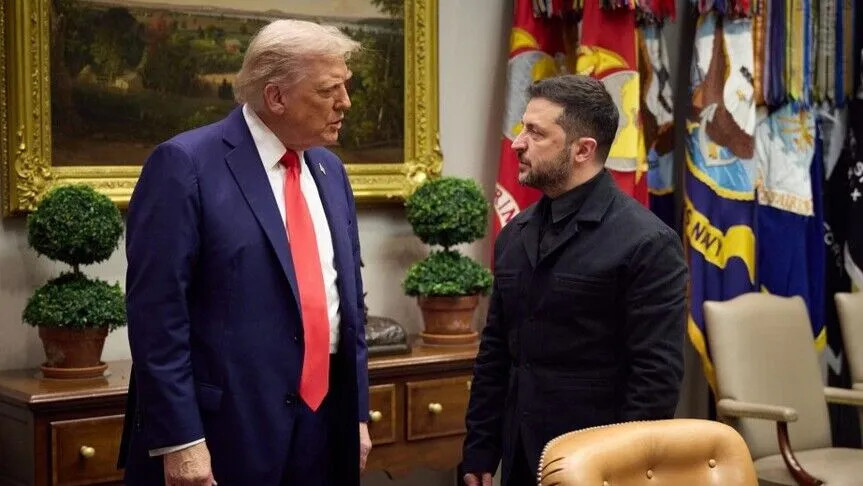
"I think Russia wants to finish this," Trump said. "Russia is a big machine, and it keeps rolling forward. They took a very large piece of land. You can say Ukraine is in a good or bad situation, but the territory Russia seizes grows larger every week. Russia has unlimited human resources and never stops advancing."
Reflecting on the early phases of the invasion, Trump argued that Moscow had initially stumbled because of tactical errors made by military commanders rather than an inherent lack of force. He claimed Russia failed to capture Ukraine within four hours because a Russian general acted foolishly by directing armored columns away from primary transit corridors.
"A general made a stupid move by driving tanks into agricultural fields instead of moving at maximum speed along the highway," Trump said. "They sank into the mud. It was like a swamp. The night before, there had been the heaviest rainfall in ten years. The ground was completely wet. Most people don’t remember, but I remember. That is how war is; you never know what will happen. They got stranded, and the Ukrainians used the Javelin anti-tank weapons that I gave them."
Despite those early setbacks, Trump maintained that the sheer demographic and industrial scale of the Russian Federation has reasserted itself along the front lines, creating a grinding war of attrition that works against Ukraine over time.
‘We Want Zelensky to Make a Deal’
Trump reiterated his longstanding position that Ukraine must enter negotiations to bring an end to the war, asserting that while Russia has sustained massive losses, its size allows it to absorb shocks in ways Ukraine cannot replicate. He explicitly called on Zelensky to show an active willingness to negotiate.
"Zelensky needs to want to end this war. If he doesn’t want to, I think it will be very bad," Trump warned. "We gave tremendous aid to Ukraine, but in return we got nothing except rising diesel prices. We probably gave Ukraine more money than almost anyone else—hundreds of billions of dollars. And we received nothing in return. American taxpayers are tired of this. We want Zelensky to make a deal."
Trump asserted that the Ukrainian leadership had an opportunity to conclude a favorable arrangement during bilateral talks held in the Oval Office two years ago. He argued that the prolonged duration of the conflict has strained Ukrainian society to its limits.
"I don’t think their people can endure this much longer. They are fighting a war. Last month, the two sides lost a total of 32,000 people," Trump said.
Broadening his critique to include international partners, Trump noted that the United States and European allies have spent fortunes underwriting the defense of Ukraine, arguing that exhaustion has set in across European capitals.

"Europe has spent a fortune, and they are really tired," Trump continued. "If they don’t make an agreement, I think the situation will get worse and worse. Russia is a huge country with immense human manpower they can tap into. Ukraine doesn’t have that manpower. It is time to make a deal."
‘If Things Continue Like This, Soon There Won’t Be a Europe Left’
Beyond Eastern Europe, Trump turned his attention to Western Europe, delivering a scathing critique of the continent’s economic management, border controls, and internal stability, with a particular focus on France.
Asked whether the economic grievances driving widespread civil protests in France could spill over into the United States, Trump rejected the comparison, contrasting American economic metrics with those of Western European states.
"We are experiencing growth unprecedented in the country’s history. Right now, we are growing faster than any country in the world," Trump asserted. "In France, there is no growth. Quite the opposite. The reason for this is that their social programs are too heavy. No matter what you do, it isn’t enough."
Trump argued that the unrest shaking French cities is fundamentally rooted in uncontrolled migration policies rather than routine economic friction. Drawing parallels to domestic U.S. politics, he blamed previous administrative practices for similar vulnerabilities at home.
"There are people pouring into France. Just like in our country during the [former President] Biden era, these people were not vetted. Their backgrounds were not investigated," Trump said. "We don’t do that. We removed most of them from the country, and we continue to remove more. We removed the worst ones. There are still some individuals we are pursuing. Europe needs to change this attitude. Otherwise, there will be no Europe left."
Addressing the upcoming presidential election in France and the political prospects of right-wing figure Marine Le Pen, Trump noted: "I don’t know her personally, but I think she has been treated very poorly."
Trump lamented what he described as a lack of European cooperation on Middle Eastern security issues, while noting diplomatic transactions regarding territories in the North Atlantic.
"Europe didn’t help us regarding Iran, but they were polite enough to give Greenland to the United States," Trump said. "We got Greenland. Frankly, our relations with Europe are great. But they need to get their act together. Otherwise, there won’t be a Europe left—not even a Europe we can be friends with."

Describing the unrest in France as something far more severe than localized civil disobedience, Trump added: "Look at what is happening in France. I have been involved in these matters for a long time, and I watch other countries. I have never seen anything like this. This is not a small uprising. It is literally a revolution, and it is ongoing. We want to help; we want to stand with them. But if things continue like this, soon there won’t be a Europe left."
Citing his personal heritage, Trump argued that European nations must enforce stringent border expulsions to prevent the collapse of continental institutions. "My roots go back to Europe, and I love Europe," he said. "They need to deport these people. Get them the hell out. Otherwise, there will be no European Union left."
He pointed to southern Europe as evidence of lax border enforcement: "You have to remove the rioters from the country. This issue cannot be solved merely by saying, ‘We will not take any more people.’ And they continue taking them. Look at Spain. Just a few weeks ago, over a hundred thousand people poured into the country in a matter of minutes. They do nothing about it. I don’t even know where they are living. It’s an insane situation."
Trade Relations with India and U.S. Domestic Energy Costs
Turning to international commerce, Trump was asked about the status of ongoing trade negotiations between Washington and New Delhi. While declining to provide specific technical clauses, the president expressed strong optimism about reaching a formal agreement.
"We are very close to a deal," Trump said. "It will be a different kind of deal than what we’ve done before. I think it is going to be tremendous."
Addressing domestic concerns regarding voter sentiment—particularly among rural Americans grappling with the broader economic environment and higher energy expenses—Trump linked current domestic economic pressures directly to military tensions involving Iran. He insisted that economic conditions would stabilize as soon as the confrontation with Tehran is resolved.
"We have tremendous support," Trump said, dismissing suggestions that rural constituencies were turning away from his administration. "When people complain about fuel prices, as simple as it might sound, what the people themselves say is: ‘This is a big cost, but actually it is a small price to pay to stop Iran from getting a nuclear weapon.’ And they will never have a nuclear weapon."
Concluding his remarks on the conflict with Tehran, Trump asserted that while the United States holds the military capability to withdraw immediately, long-term strategic commitments require a durable framework that prevents a resurgence of nuclear capabilities down the road. The administration, Trump stated, wants to ensure that the United States does not find itself facing the exact same national security crisis five or ten years into the future.