ANTALYA — In the ongoing effort to enhance disaster response capabilities and save lives trapped beneath collapsed structures, Muratpaşa Mayor Ümit Uysal recently conducted a comprehensive, on-site inspection of the pioneering "Hero Rats Project." The innovative initiative trains specialized rodents to navigate complex rubble fields, locate trapped survivors, and transmit vital signals to rescue teams. During his visit to the training facility, Mayor Uysal closely monitored a live simulation within a specially constructed debris setup, receiving detailed briefings from the project team regarding the latest operational milestones and technological integrations.
The project, which represents a cutting-edge fusion of animal behavior training and modern search and rescue technology, is being conducted collaboratively by the Muratpaşa Municipality, the GEA Search and Rescue Association, and the Belgium-based partner organization APOPO. As climate change increases the frequency of extreme weather events and seismically active regions face persistent earthquake threats, municipalities worldwide are increasingly looking toward creative, non-traditional methodologies to supplement human and canine rescue operations. The use of rodents, particularly in tight, inaccessible spaces where neither humans nor larger search dogs can safely venture, marks a significant paradigm shift in urban search and rescue operations.
Hero Rats Successfully Locate Survivors in Debris Simulation
The focal point of Mayor Uysal’s inspection was a rigorous test conducted within the specially constructed debris simulation area on the training grounds. Designed to replicate the harrowing and unpredictable conditions of a real-world structural collapse, the makeshift disaster zone featured dense tangles of simulated concrete, twisted metal reinforcement bars, and narrow, dark crevices that typically hinder rescue efforts.
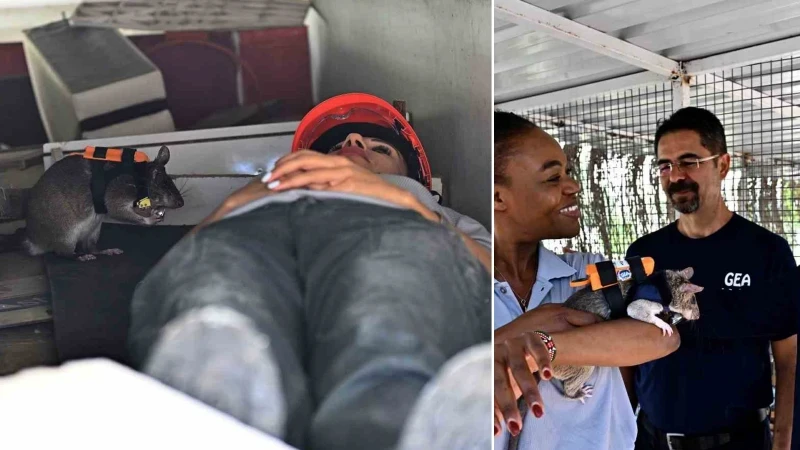
To test the readiness and precision of the trained rodents under realistic conditions, a volunteer from the rescue team participated as a simulated victim, taking a position deep within the interior of the rubble arrangement. Observers and project coordinators watched closely as the trained hero rat was introduced to the access point of the debris field.
Demonstrating remarkable composure, agility, and focus, the rat successfully navigated the labyrinthine interior of the wreckage, ignoring distractions and efficiently exploring the dark passages until it reached the location of the hidden volunteer. Upon making contact with the simulated casualty, the rat triggered a specialized technological system mounted securely on its back. This integrated device immediately transmitted a distinct signal to the waiting rescue command team outside. Simultaneously, an onboard GPS tracking system allowed project coordinators to monitor the precise, real-time coordinates of the rodent from deep within the structure, ensuring that human rescue teams would know exactly where to direct their heavy extraction equipment once stabilization procedures were underway.
The seamless execution of the simulation underscored the practical viability of the project. Rather than relying solely on acoustic listening devices or thermal imaging cameras—which can sometimes be obstructed by thick layers of rubble or ambient noise—the incorporation of trained rodents provides a biological detection mechanism capable of squeezing through narrow voids to confirm the exact location of a living human being.
"We Are Achieving Successful Results from All Tests"
Reflecting on the progress observed during the simulation, Mayor Ümit Uysal emphasized the remarkable consistency and reliability demonstrated by the animals throughout the developmental phases of the program. He noted that the hero rats have successfully passed every rigorous test administered by the project coordinators, showcasing an impressive aptitude for high-stress disaster scenarios.
Addressing the media and the assembled team of trainers, researchers, and rescue professionals, Mayor Uysal highlighted that the initiative has officially progressed into a second and more advanced phase of development.
"We pray that we never experience an earthquake, and we pray that we never have to face the grim reality of collapsed buildings," Mayor Uysal stated during his evaluation of the training grounds. "However, should such a tragic situation ever occur, our rats have proven time and time again during these rigorous tests that they can successfully locate trapped individuals under the rubble. They pinpoint the exact visual and geographical location of the victim, and they demonstrate the absolute maximum performance required to facilitate a successful rescue operation."
Elaborating on the expansion of the project, Mayor Uysal confirmed that the municipality and its partners are actively scaling up their operations. "Right now, we have reached a second and higher level in our ongoing work. We are currently preparing the necessary conditions and frameworks for this advanced stage alongside our academic experts and project partners. I extend my heartfelt wishes for the continued success of everyone involved in this vital endeavor."
The transition into this advanced operational phase reflects a growing confidence among municipal leaders and rescue specialists in the reliability of the system. While initial trials focused primarily on basic navigation and scent tracking within controlled environments, the current phase involves more complex debris topographies, prolonged simulation times, and tighter integration with municipal emergency response protocols.
Training Reaches New Milestones Under Expert Guidance
Providing further technical insight into the daily operations and pedagogical methods employed at the facility, Hero Rats Project Leader Dr. Danielle Giangrasso detailed the comprehensive training regimens that prepare the animals for their high-stakes roles. According to Dr. Giangrasso, the rats conduct their continuous training sessions within specialized simulation zones meticulously built in partnership with the GEA Search and Rescue Association.
The training philosophy relies on positive reinforcement and natural behavioral conditioning, shaping the animals’ exploratory instincts into disciplined, mission-oriented tasks. Dr. Giangrasso explained that the rodents are systematically taught how to move safely and efficiently across unstable and hazardous debris fields without triggering secondary collapses or injuring themselves on sharp materials. Crucially, the training ensures that the animals can distinguish between various environmental stimuli, successfully identify human presence, and—just as importantly—return to their designated base station upon the completion of their task.
"The animals learn how to navigate the complex environment of a disaster site safely, how to identify and locate a trapped survivor, and how to return to their base camp once their assigned mission is successfully completed," Dr. Giangrasso noted, emphasizing the rigorous discipline instilled in the animals. She expressed profound satisfaction with the trajectory of the program, pointing out that the seamless coordination between local municipal leadership, specialized NGOs like GEA, and international partners like APOPO has created an ideal environment for scientific and humanitarian innovation.
As the Muratpaşa Municipality and its collaborative partners continue to refine the Hero Rats Project, the initiative stands as a testament to the power of cross-border cooperation and forward-thinking disaster preparedness. By combining Belgian technological and zoological expertise with Turkish municipal support and hands-on search and rescue experience from organizations like GEA, Antalya is positioning itself at the forefront of urban search and rescue innovation. The ongoing advancements in the project offer a hopeful glimpse into the future of emergency response, where every available tool—no matter how unconventional—is harnessed to protect human life and reduce the catastrophic toll of natural disasters.