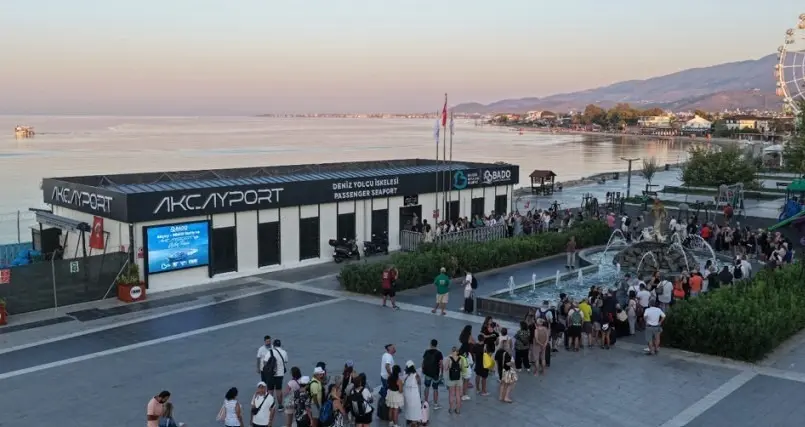
AKÇAY, Turkey — The recently revived sea bus line connecting the coastal district of Akçay in Balıkesir to the Greek island of Lesbos (Midilli) has experienced an extraordinary surge in demand during its inaugural month of service, marking a major success for regional maritime transport after a 27-year hiatus.
Operated under the umbrella of the Balıkesir Metropolitan Municipality by Balıkesir Toplu Taşıma A.Ş. (BTT) under the brand BADO (Balıkesir Deniz Otobüsü), the sea bus connection reached a peak occupancy rate of 95 percent within its first four weeks of operation. Demonstrating strong regional interest and high traveler volume, the line recorded a single-trip peak of 412 passengers on a single one-way voyage, setting an initial record for the newly restored route.
The resumption of direct maritime transit between Akçay and Lesbos comes after nearly three decades during which passenger service along this specific cross-border route remained inactive. The overwhelming initial demand highlights a growing appetite for international coastal travel across the Northern Aegean Sea, underscoring the strategic role of public transport initiatives in driving local tourism and cross-border connectivity.
Feasibility Expectations Exceeded in Opening Month
Commenting on the initial performance figures of the BADO service, Mustafa Ömür Boyuer, General Manager of Balıkesir Toplu Taşıma A.Ş., noted that extensive planning and research had taken place prior to launching the service. According to Boyuer, while municipal planning anticipated healthy interest, the speed and scale of passenger adoption surpassed initial forecasts.
"In the feasibility studies we conducted prior to putting the service into operation, we believed that this location had the potential to become a center of attraction, but the level of interest we have observed has exceeded even our optimistic projections," Boyuer stated.
Boyuer emphasized that municipal authorities view the marine line as much more than a routine point-to-point transit connection. Instead, the service forms a core component of a broader economic and regional development vision designed to elevate the profile of Balıkesir on the international tourism map.
"We do not view this line merely as a maritime waterway providing transportation between two points, but rather as a critical connection that strengthens Balıkesir’s overall tourism potential," Boyuer added.
The positive performance during the first month reflects both the operational efficiency of the sea bus service and a broader strategy by local authorities to maximize the economic utility of the region’s extensive coastline. By providing a direct, high-capacity marine link, the municipality aims to integrate the Gulf of Edremit more closely into Aegean tourist circuits.
Relaunching a Maritime Connection After 27 Years
The establishment of the BADO Akçay-Lesbos route resolves a 27-year period during which direct public passenger sea buses did not operate between Akçay and the nearby island. Historically, travelers in the Northern Aegean seeking to cross between Turkey and Lesbos primarily relied on departure points situated further south, such as the port of Ayvalık.
By re-establishing Akçay as an active international maritime gateway, Balıkesir Metropolitan Municipality has diversified transport options for both domestic residents and visiting tourists. The move provides a direct sea route for travelers based in the northern parts of the Edremit Gulf, including Edremit, Akçay, Güre, Altınoluk, and neighboring coastal settlements.
The 27-year gap had long been identified by local commercial leaders and tourism operators as a missed opportunity for the region. The Gulf of Edremit, framed by the slopes of Mount Ida (Kazdağları), is one of Turkey’s most popular domestic holiday destinations, renowned for its natural landscapes, thermal springs, and olive cultivation. However, its direct physical connection to the neighboring Greek islands remained limited until the recent municipal initiative.
The reintroduction of sea bus voyages provides a swift, convenient crossing, opening up cross-border excursions for visitors spending holidays along the Balıkesir coast. Simultaneously, it allows residents of Lesbos and international visitors arriving on the island to access the northern shore of Balıkesir directly, creating a balanced, two-way corridor for international movement.
High Occupancy Rates and Operational Efficiency
Achieving a 95 percent occupancy rate within the first month of operation underscores the immediate commercial viability of the BADO service. Reaching a peak of 412 passengers on a single one-way trip demonstrates that the vessel capacities deployed by Balıkesir Toplu Taşıma A.Ş. are well-suited to handle large passenger surges, particularly during peak summer travel periods.
The operational success of the route is attributed to several key factors:
- Strategic Geographic Positioning: Departing from Akçay drastically reduces travel times to Lesbos for holidaymakers staying in the northern Edremit Bay area, sparing them lengthy land transport journeys to alternative ferry terminals.
- Integrated Public Transport Infrastructure: Operated by Balıkesir Toplu Taşıma A.Ş., the sea bus operations are linked with broader municipal transit networks, allowing passengers to seamlessly transition between urban buses, regional shuttles, and marine transport.
- High-Capacity Vessel Operations: The ability to transport up to 412 passengers on a single voyage allows the service to handle tour groups, family travelers, and independent commuters efficiently.
- Streamlined Border Processing: Coordinated municipal and maritime border operations at the port facilities in Akçay facilitate orderly boarding and passport control procedures, enhancing the overall passenger experience.
The consistent high occupancy rates also validate the municipal decision to invest in marine transit infrastructure, proving that well-timed public investments in waterborne transport can quickly yield high operational utilization.

Boosting the Regional Tourism Economy
The launch and immediate success of the BADO sea bus line carry significant implications for the local economies on both sides of the Gulf of Edremit. Tourism stakeholders in Balıkesir have noted that establishing direct maritime access to Lesbos increases the overall competitiveness of the region as a multi-destination holiday spot.
For local businesses in Akçay and the wider Edremit district—including hotels, restaurants, retail shops, and local tour agencies—the presence of an active international port terminal generates increased foot traffic and commercial activity. Tourists extending their stays in the area often seek day-trip opportunities to Europe, and the direct BADO connection makes such itineraries easily accessible.
Conversely, the influx of sea bus passengers offers commercial benefits to Lesbos, encouraging cross-border trade, dining, and cultural visits. The reciprocal nature of island-mainland maritime connections fosters closer ties between local communities across the Northern Aegean, building a shared regional framework for tourism development.
Furthermore, the expansion of municipal maritime services aligns with broader environmental and urban planning objectives. By encouraging waterborne transit across the gulf, the service offers an energy-efficient transport alternative that alleviates pressure on coastal highway corridors during the busy summer months.
Strategic Vision for Balıkesir’s Transport Network
The success of the Akçay-Lesbos route represents a pivotal milestone in the strategic master plan of Balıkesir Toplu Taşıma A.Ş. As the entity responsible for managing public transportation across Balıkesir Province, BTT has continually sought to diversify transport modes, balancing land-based bus systems with coastal marine initiatives.

Under the leadership of the Balıkesir Metropolitan Municipality, the expansion of BADO operations signals a long-term commitment to enhancing the province’s maritime identity. Situated with coastlines along both the Sea of Marmara and the Aegean Sea, Balıkesir possesses unique geography that relies heavily on effective marine logistics.
The rapid achievement of record passenger numbers on the Akçay-Lesbos line provides a strong empirical foundation for future planning. Municipal officials and transit authorities are expected to evaluate the opening season’s data to optimize sailing schedules, assess seasonal demand fluctuations, and explore potential options for expanding frequency or expanding maritime links across the region.
As the BADO Akçay-Lesbos sea bus service continues its inaugural season, the project stands out as a clear demonstration of how target-driven public transit infrastructure can reactivate historical maritime corridors, stimulate regional economic growth, and redefine regional tourism dynamics across the Aegean Sea.