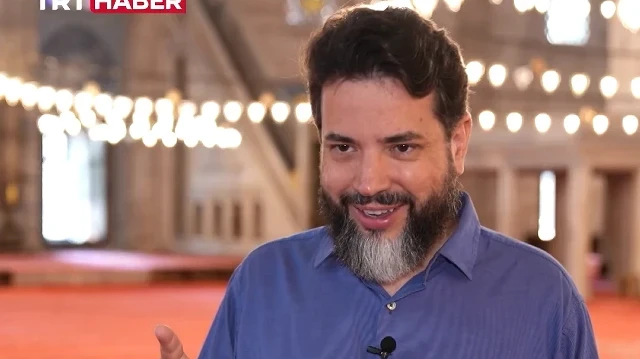
For years, Valter Joao da Silva Junior stood before congregations as a Protestant pastor in Brazil, delivering sermons and guiding members through their faith. Yet, beneath his dedication to his pastoral duties, he found himself grappling with profound theological questions, most notably concerning the doctrine of the Trinity in Christianity. As he sought answers to the complex theological puzzles that weighed on his mind, an unexpected encounter set him on a transformative spiritual journey that would ultimately lead him away from the pulpit and into the fold of Islam.
The turning point in Da Silva’s life came during a period of intense personal research into various religious texts and traditions. While his search for truth took him to various places, his path eventually crossed with a local mosque. It was there that he received a life-altering gift: a copy of the Holy Quran, presented to him by a member of the Palestinian community. This simple act of cross-cultural and interfaith exchange would become the catalyst for a radical shift in his worldview and spiritual identity.
Intriguingly, the moment he began reading the Quran, Da Silva found that many of the theological inconsistencies and questions he had harbored regarding the nature of God began to dissolve. The text’s absolute monotheism, clarity of message, and direct relationship between the Creator and the created resonated deeply with his own spiritual inquiries. Moved by the profound truths he discovered within its pages, Da Silva made the momentous decision to embrace Islam. He pronounced the Shahada, the Islamic declaration of faith, officially marking his transition from a Christian minister to a Muslim.
Reflecting on his journey, Da Silva, now twelve years into his life as a Muslim, vividly remembers the milestones of his early days in Islam. He notes that certain foundational experiences remain etched in his memory with extraordinary clarity—specifically, the profound serenity of performing his first formal Islamic prayer, the physical and spiritual discipline of the prostrations (secde), and the spiritual endurance required to complete his first Ramadan fast. These memories continue to serve as emotional touchstones for a man whose entire life trajectory was redefined by a single book.
Spreading the Message of Islam Across Brazilian Schools and Universities
Today, Da Silva’s life is dedicated to education, interfaith dialogue, and sharing the message of Islam across his native Brazil. Operating primarily within the state of Santa Catarina, he conducts extensive outreach programs, delivering informative seminars and lectures in universities, schools, and various public and private institutions. His efforts are designed to bridge cultural divides and clear up misconceptions about a faith that is often misunderstood in South America.
According to Da Silva, his academic and community outreach is remarkably active. He manages to reach approximately 2,000 students and community members every month through his speaking engagements and educational presentations. Through these interactions, he has witnessed firsthand the curiosity, and occasionally the skepticism, of the Brazilian public regarding Islamic traditions and theology. He notes that the inquiries he receives most frequently center on core Islamic beliefs, the global phenomenon of terrorism, the socio-political realities of Muslim-majority countries, and the rulings concerning marriage and family structures within Islamic jurisprudence.
Da Silva observes that these questions are largely shaped by lifelong conditioning. Growing up in a predominantly Christian society, he was himself taught from childhood that Muslims worshipped a fundamentally different God and followed a tradition entirely detached from the Abrahamic roots shared by Judaism and Christianity. Because of this personal background, he approaches his audience with deep empathy and patience. Rather than engaging in aggressive debates, Da Silva consistently urges people to conduct thorough, independent research and to read the Quran for themselves before forming opinions or engaging in discussions about Islam. His tireless work as an educator and bridge-builder has yielded tangible results within his community, with an estimated ten individuals having embraced Islam directly through his guidance and institutional lectures over the years.
A Profound Spiritual Connection During Visits to Türkiye
In addition to his domestic outreach efforts in Brazil, Da Silva has sought to broaden his perspective by engaging with the broader Islamic world, most notably through travel. During a visit to Türkiye, he experienced a series of deeply moving spiritual moments that left an indelible mark on his heart and reinforced his connection to the global Muslim community.
Of all the historical and cultural landmarks he encountered during his travels in Istanbul, it was the historic Süleymaniye Mosque that captured his spirit most deeply. Da Silva recalls the overwhelming emotional impact of hearing the melodic call to prayer (ezan) echoing through the historic courtyards of the city and subsequently standing shoulder-to-shoulder in congregational prayer inside the magnificent architectural masterpiece.
For Da Silva, the physical formation of the prayer rows inside the mosque offered a powerful visual and spiritual testament to the core principles of Islamic egalitarianism. He was particularly struck by the observation that within the sacred space of the mosque, social hierarchies vanish entirely. In the rows of prayer, a head of state and a humble person in need stand side-by-side, turning in absolute devotion to the exact same Creator. This profound sense of shared humanity and spiritual equality left him deeply humbled. As he prepared to depart from Istanbul at the conclusion of his visit, Da Silva expressed that his heart remained tied to the historic city, noting that he offered personal prayers for the opportunity to return to Türkiye and experience its spiritual atmosphere once more.