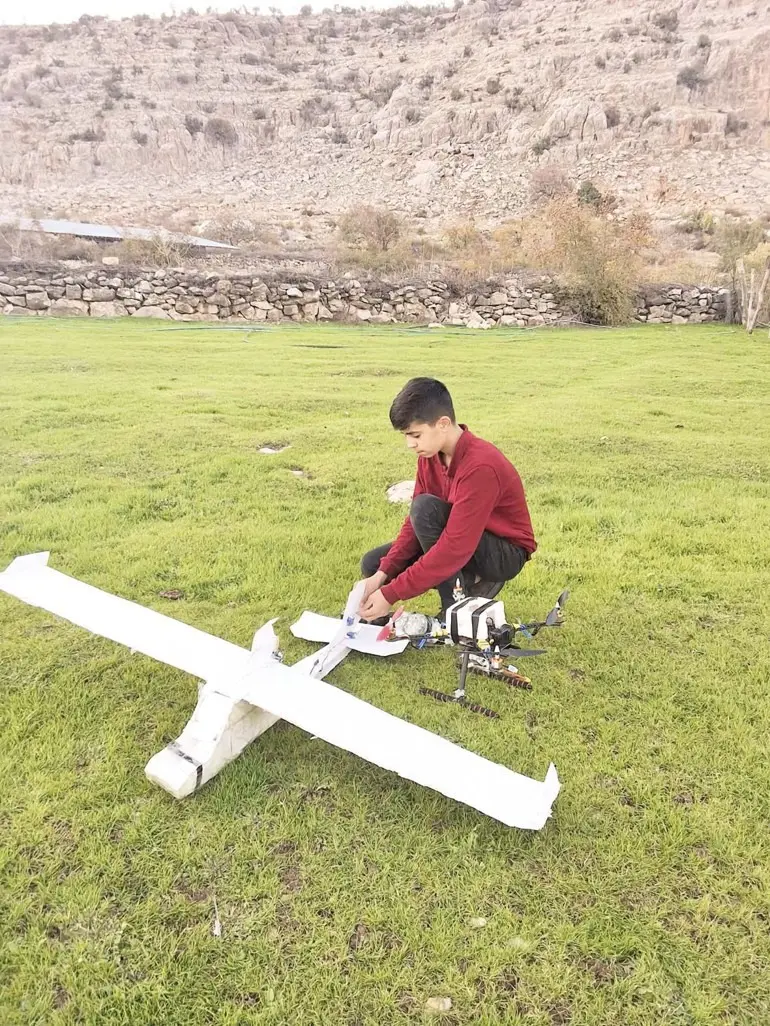
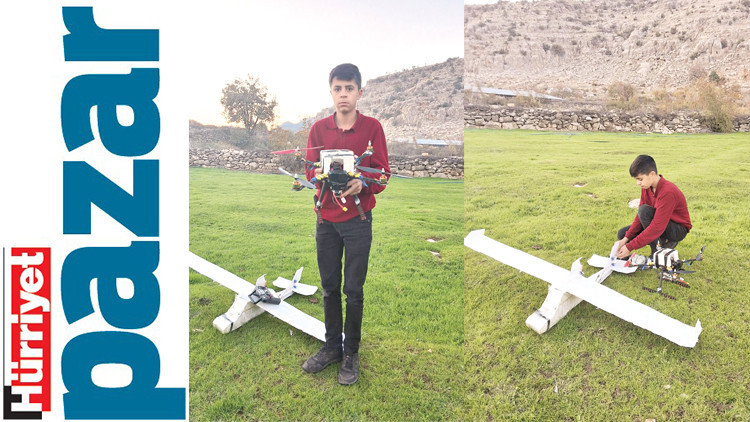
Living in the Derecik district of Hakkâri, 16-year-old Aram Kaynak refused to let financial hardship ground his dreams, turning discarded plastics and salvaged batteries into flying aircraft and agricultural solutions.
In the rugged borderlands of southeastern Türkiye, where jagged peaks meet steep valleys and winter arrives with an unforgiving chill, a young high school student is proving that engineering ingenuity does not depend on state-of-the-art laboratories. Aram Kaynak, a 16-year-old tenth-grader living in the remote Gökçetaş hamlet of Anadağ village in Hakkâri’s Derecik district, spends his days split between traditional pastoral labor and building functioning unmanned aerial vehicles entirely on his own initiative.
A student at Seyyid Taha Anatolian Imam Hatip High School, Kaynak belongs to a household of eight, growing up alongside five siblings. His daily life is deeply rooted in the agricultural rhythms of his hometown. During the warm months, he helps drive the family cattle up into the highland pastures, and when the snows begin to blanket the mountains, his responsibilities shift to feeding and caring for the livestock inside the family barn. Balancing the exhausting physical demands of livestock farming with rigorous academic studies is a formidable challenge, yet Kaynak finds his greatest intellectual solace in the laws of physics and the reactions of chemistry.
Driven by a fascination with technology that took root in early childhood, Kaynak’s journey began at the age of 11 through routine school science assignments. When commercial drones proved entirely unaffordable for his family, he refused to abandon his ambition. Instead, he gathered broken household appliances, scavenged discarded electronics, and began reverse-engineering functional flying machines. His dedication eventually produced fully operational model airplanes and remote-controlled quadcopters. Connected remotely over the internet, Kaynak spoke about his creative process, the everyday realities of village life, and his steadfast determination to become an engineer.
How did the idea of building your own drone first come to you?
Aram Kaynak: It all started when I was around 11 years old with project assignments given to us at school. Even before that, I had a habit of tinkering with things around the house. I used to repair simple items like flashlights. I would open them up, disassemble the components, and examine how they were wired. It caught my attention and sparked my curiosity. As time went on, I really wanted to fly a drone, and I dreamed of buying one, but commercial models were simply far too expensive. So I thought, why not make one myself?
I started watching tutorial videos on YouTube to see how people put them together. At first, I could not complete anything because I simply did not have access to the necessary components. That was when I sought help from the people living around me. The neighbors gave me their broken electronics and malfunctioning household appliances. I salvaged those items, took out their rechargeable batteries, and wired them into my early drone frames. However, those initial attempts were not very successful. The craft would lift off the ground, but it flew completely unevenly and without any real balance. After that, I realized I needed better parts, so I began saving whatever money I could scrape together to purchase proper electronic components.
‘I Mount the Motors Myself’
When did you successfully build and fly your very first drone?
Aram Kaynak: The very first one that actually flew properly was in December 2023.
There is a yellow model airplane hanging on the wall behind you. Did you build that one as well?
Aram Kaynak: Yes, I did. I design the structure and have the parts produced as digital 3D prints, which we order online. Once the structural airframe arrives, I build, wind, and mount the propulsion motors myself, and then I assemble the entire control system.
Did you have a teacher or mentor who guided you through these technical processes?
Aram Kaynak: No, I taught myself everything. I had the drive and the interest, so I kept experimenting. At our school, we only had a dedicated technology and design teacher during the seventh grade, so formal mentorship was not an option.
What kinds of raw materials do you prefer to use when designing these robotic vehicles?
Aram Kaynak: In the early days, I relied on basic brushed DC motors that I salvaged from small devices. I would even gather broken phone chargers and reconstruct them to build functioning charging units for my battery packs. Nowadays, I purchase some of the delicate electronic components, like controllers, through the internet.
For the physical airframes and fuselages, everyday plastic PET bottles have been a tremendous help. They are lightweight, accessible, and do the job remarkably well. I also rely heavily on construction materials—especially insulation foam, extruded polystyrene, and styrofoam that I collect from building sites. They provide rigidity without weighing down the aircraft.
What went through your mind the very first time one of your drones lifted off the ground and took flight?
Aram Kaynak: I was overwhelmed with excitement. I flew it nonstop until the battery was completely drained. The moment the power ran out, I rushed straight back inside, plugged it in to recharge, and launched it back into the sky immediately. Shortly after that, it crashed and broke down, so I had to figure out how to rebuild it. I was so full of adrenaline and enthusiasm that I stayed awake all night working on it until morning. I repaired every damaged part, tested the connections, and sent it back into the air again.

How many operational drones have you built to date?
Aram Kaynak: In terms of models that were truly airworthy and capable of sustained flight, it is not a huge number—probably around 10 to 15 in total.
Every new project seems to push your skills a bit further. What is your ultimate goal right now?
Aram Kaynak: Of course, with every build I try to make something better, more durable, and more capable. Right now, my primary goal is to enter competitions and participate in TEKNOFEST, but so far circumstances have made that impossible.
Following the initial media reports about your work, did anyone reach out to offer genuine technical or financial support?
Aram Kaynak: People reached out, yes, but most of what was promised turned out to be empty words. To be completely honest, no one has actually stepped forward with tangible support yet.
How do your family and the local community view what you are doing?
Aram Kaynak: My family has supported me, but many people in the area used to dismiss it. They would say things like, "Anyone could do that," and scoff at my efforts. In the beginning, people did not take it seriously at all; they mostly made fun of me. But after my work appeared in the news and I began producing more sophisticated, eye-catching designs, people’s attitudes changed. Now, I receive encouraging and positive comments from the community.
Has your work inspired anyone else in the village to start building aircraft?

Aram Kaynak: There is no one else here making drones. However, there are a few young people who have taken an interest in experimenting with small electric motors and basic circuits after seeing what I do.
Building functional aircraft in such an isolated location clearly demands immense creativity and resilience alongside resources. Would you agree?
Aram Kaynak: Absolutely, but above all, I believe that if you possess genuine curiosity, you will find a way to make things work regardless of the circumstances.
What other interests occupy your time outside of electronics?
Aram Kaynak: I really enjoy walking in nature. Beyond that, daily life keeps me very busy. There are six siblings in our family, and we look after our own livestock. In the warmer months, we take the cows up to graze in the high mountain meadows, and now that winter is here, our work shifts entirely to feeding and caring for them inside the barn. Trying to maintain your studies while carrying out heavy farm work makes pursuing an education here quite demanding.
What are your academic aspirations for higher education?
Aram Kaynak: My dream is to study at Yıldız Technical University, and I am actively studying toward that goal right now. Initially, my heart was set on mechatronics engineering, but securing a spot in that department is extremely difficult. In the end, I plan to choose between software engineering, electrical and electronics engineering, or mechanical engineering.
‘I Lost Control and the Village Feared a Drone Strike’
Living in Hakkâri means dealing with rugged geography and harsh seasonal shifts. How do the local climate and topography affect your flights?
Aram Kaynak: On certain days and during specific months of the year, the winds pick up quite a bit, though that alone does not stop me. Winter brings heavy snowfall and freezing rain. But the biggest challenge is the landscape itself. Because we are surrounded by steep, rocky mountains, losing visual contact or radio range often means losing the craft entirely. Drones and model planes have slammed into rock faces and shattered completely, or crashed into mountain streams where the electronics short out beyond repair.

Have you ever experienced an unusual or alarming incident while testing your aircraft?
Aram Kaynak: Yes, definitely. On one occasion, a model airplane I had constructed began flying erratically. I completely lost radio control of the craft, and it drifted off toward the center of the village. Because it was equipped with a particularly loud motor, the engine made a deep, roaring sound as it descended over the houses. People in the village panicked—they genuinely thought an unmanned combat drone or military aircraft was bearing down on them. It caused quite a fright before it finally came down.
‘These Rugged Slopes Require Aerial Spraying’
Reports mentioned that you want to adapt your drone designs for local agriculture. Is that project underway?
Aram Kaynak: Yes, that is true, and it is something our region genuinely needs. Due to our mountainous geography, much of our agricultural land consists of steep, uneven slopes where tractors and standard ground vehicles cannot safely operate. Because regular machinery cannot reach those fields, crop spraying from the air becomes essential.
Right now, there are hillside plots where wheeled vehicles simply cannot climb. My idea is to bridge that gap using a combined system: placing an aerial spraying drone directly onto a rugged ground vehicle. The ground vehicle transports the unit as far as the incline allows, and once the terrain becomes too steep or rocky to drive, the drone launches from the platform and carries out the spraying autonomously across the inaccessible slopes. It is a practical solution tailored specifically to the terrain we live on every day.