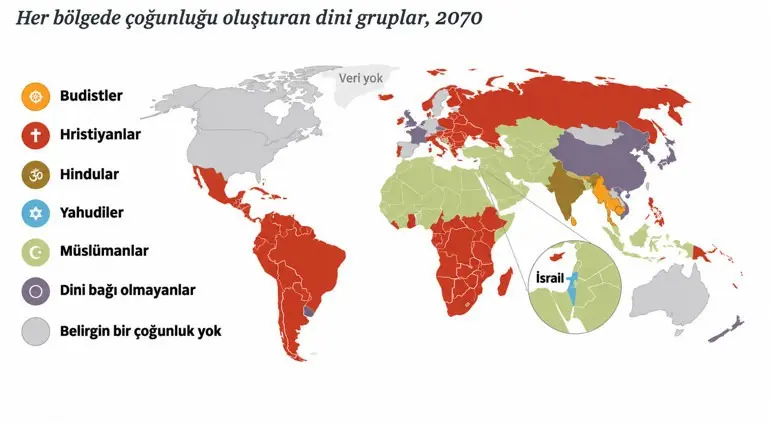
Islam is projected to overtake Christianity to become the world’s largest religious group by the year 2035, marking a historic turning point in global demographic history, according to a comprehensive study released by the Washington-based Pew Research Center. The demographic transition is driven primarily by sustained higher fertility rates and younger populations among Muslim communities worldwide, rather than individuals switching from one faith to another.
The findings, detailed in Pew’s research report titled "The Future of World Religions," draw on extensive demographic and sociological datasets compiled from 201 countries and territories. The study presents an exhaustive mathematical projection of international religious trajectories over the coming half-century, charting shifts in birth rates, mortality patterns, and regional population dynamics that are fundamentally reshaping the religious makeup of the planet.
According to the data, the global religious landscape in 2020 was characterized by approximately 2.27 billion Christians and 2 billion Muslims, maintaining Christianity’s long-standing position as the planet’s most populous faith. However, the differential in generational replacement rates between the two communities has set in motion an inevitable convergence. By 2035, the researchers project that the Muslim population will expand to 2.57 billion adherents, while the Christian population will reach approximately 2.52 billion, establishing Islam as the world’s largest religious community for the first time in modern demographic recordkeeping.

Looking further ahead to 2070, this demographic divergence is expected to widen significantly. By that point, the global Muslim population is projected to reach approximately 3.6 billion people, compared to roughly 3 billion Christians worldwide.
Conrad Hackett, a senior demographer at the Pew Research Center, underscored that the fundamental engine behind this monumental shift is biological reproduction rather than ideological realignment. "The decider is babies," Hackett noted when discussing the study’s conclusions, explaining that Muslim families consistently tend to have more children on average than adherents of any other major world religion.
The researchers emphasized that while religious switching—people abandoning their childhood faith, converting to new traditions, or leaving organized religion altogether—garners significant cultural attention, its aggregate statistical impact on global demographics remains remarkably minor when compared to the profound, compounding effects of fertility rates and generational age structures.

The new report represents Pew’s most comprehensive demographic projection of global religions since its landmark 2015 publication on the topic. Utilizing updated census records, extensive national surveys, and refined demographic modeling from 201 nations, the analysis reveals that religious identity continues to serve as an exceptionally resilient and expanding facet of global human society.
The Declining Global Share of the Unaffiliated
In striking contrast to popular perceptions across much of the Western world that religion is experiencing a terminal decline, the Pew Research Center’s analysis indicates that the world as a whole is not becoming less religious. On the contrary, while secularism and the phenomenon of religious disaffiliation continue to gain ground in select affluent nations, the proportion of the world’s population that claims no religious affiliation is projected to shrink on a global scale.
In 2020, individuals who described themselves as religiously unaffiliated—a category encompassing atheists, agnostics, and those who identify as having "no religion" in particular—accounted for 24.2 percent of the global population, representing nearly a quarter of all people on Earth. Over the next five decades, however, that proportion is projected to experience a continuous downward trajectory, dropping to approximately 17 percent of the global population by 2070.

The researchers pointed out that although the absolute number of religiously unaffiliated people may continue to rise within individual nations across parts of North America and Europe, global population mathematics tell a completely different story. The primary explanation for this global decline rests in the demographic realities of China, a country that is home to an enormous share of the world’s total unaffiliated population.
Because China is currently undergoing rapid population aging alongside severe, sustained declines in national birth rates, its overall population is contracting. As the population of China diminishes relative to the rest of the world, it exerts a disproportionate downward drag on the aggregate global count of the religiously unaffiliated. Consequently, because non-religious populations are disproportionately concentrated in regions characterized by low fertility rates and aging demographics, their collective weight within the broader human population will steadily erode over the next half-century.
Over the 50-year period examined from 2020 onward, the total global population is projected to increase by 29 percent. Within this period of international expansion, religious communities will grow at wildly divergent speeds.

The global Muslim population is projected to experience the most rapid growth, surging by an extraordinary 80 percent over the half-century. The global Christian population is expected to grow by 30 percent, keeping pace just slightly ahead of total global population growth.
Other religious traditions will also experience measurable increases in their absolute numbers over the same timeframe. The global Jewish population is projected to expand by 20 percent, while the global Hindu population is expected to grow by 17 percent. Smaller religious groups—including adherents of the Baha’i faith, Sikhism, Daoism, and Jainism, among others—are projected to see their combined numbers grow by approximately 9 percent.
In contrast, demographic projections suggest outright numerical contractions for only two broad groups across the half-century timeline: the Buddhist population, which is projected to decline by 23 percent worldwide, and the religiously unaffiliated population, which is expected to experience a 10 percent reduction in overall numbers globally. Like the non-religious, Buddhist populations are heavily concentrated in East Asian and Southeast Asian nations marked by advanced population aging and sub-replacement birth rates.
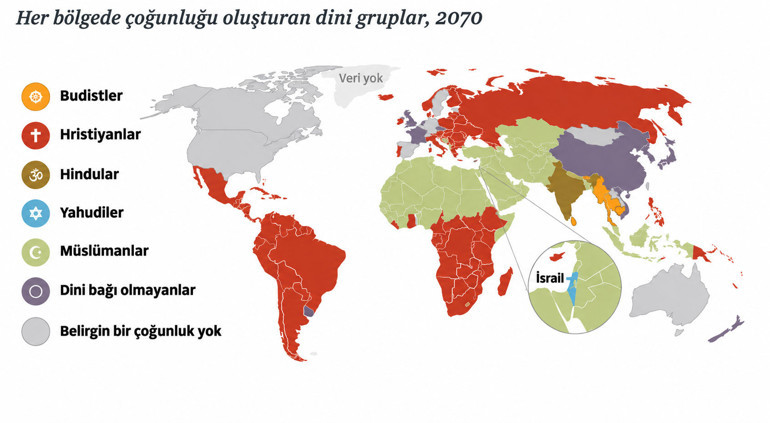
Christianity’s Center Shifts to Africa
Alongside the headline shift between Islam and Christianity, the Pew Research Center’s report documents an equally profound internal realignment within Christianity itself. Over the coming decades, the historic core of the Christian world is projected to tilt decisively away from the West and toward the African continent.
For generations, the United States has held the position of the nation with the world’s largest Christian population. However, demographic calculations indicate that this status will come to an end within the next half-century. By 2070, the Democratic Republic of the Congo is projected to surpass the United States, becoming the country with the single largest population of Christians on Earth.
This shift reflects broader demographic realities transforming the African continent. High fertility rates, expanding youth populations, and rapid overall demographic momentum across Sub-Saharan Africa stand in sharp relief against the demographic stagnation, population aging, and rising secular disaffiliation seen in North America and across Europe.
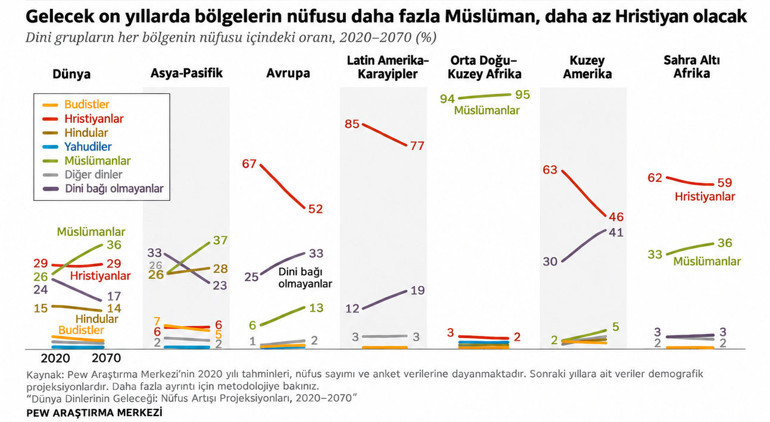
As a consequence of these geographic and demographic factors, the Pew report projects that by 2070, fully half of the world’s entire Christian population will reside in Sub-Saharan Africa. The concentration of Christian life, institutional vitality, and demographic density in the region marks the culmination of a centuries-long geographic transition, moving the faith’s primary demographic base firmly into the Global South.
By examining data across more than two hundred nations, the Pew Research Center’s analysis illustrates that the world of the late twenty-first century will be profoundly shaped by demographic realities established decades earlier. With birth rates outstripping religious switching as the primary engine of cultural change, the relentless mathematics of fertility and generational replacement are set to make Islam the planet’s largest faith by 2035, even as Christianity reorganizes around its rapidly growing African center.