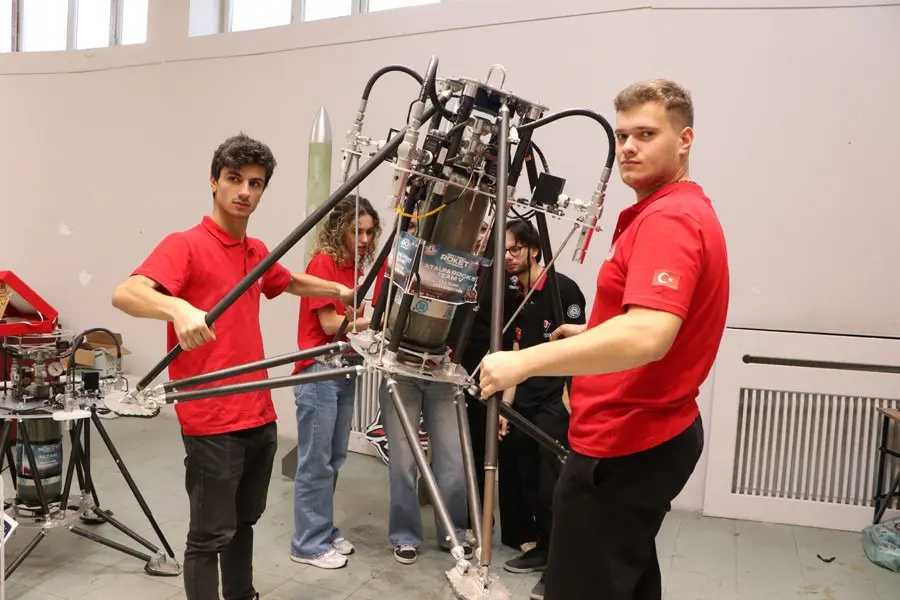
ANKARA — A team of engineering students from Atatürk University in eastern Turkey has secured first place in the TEKNOFEST 2026 Vertical Landing Rocket Competition after successfully designing, building, and launching a pressurized dry-air prototype rocket capable of executing a controlled vertical descent. The project, developed to align directly with Turkey’s national strategic goal of achieving a soft landing on the Moon, demonstrated its capabilities by carrying out a controlled 10-meter descent, earning top recognition among technical universities across the country.
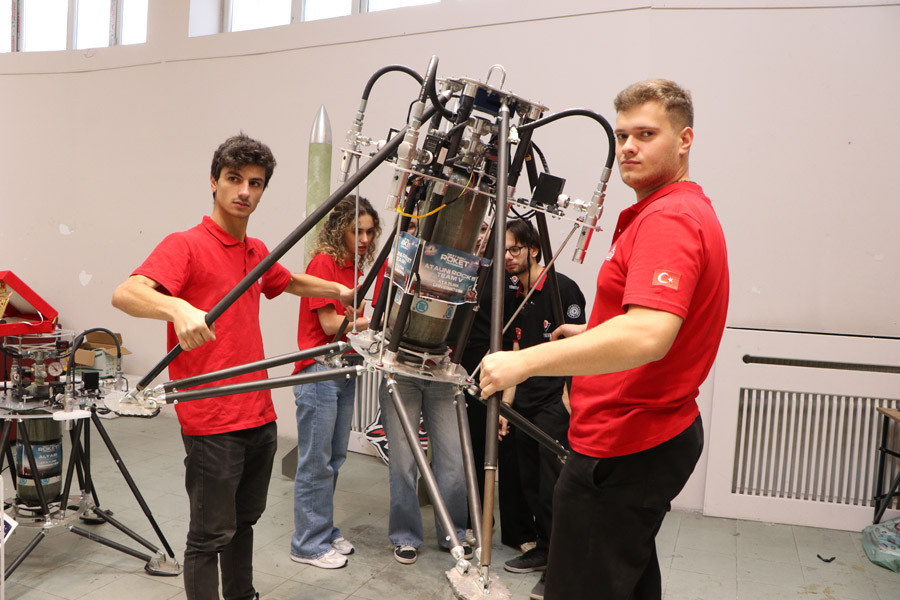
The student engineering group, designated as ATAUNI ROCKET TEAM V, comprises ten undergraduate students drawn from five core departments within Atatürk University’s Faculty of Engineering: computer engineering, industrial engineering, software engineering, mechanical engineering, and electrical-electronics engineering. Working over an extended period of development and rigorous technical validation, the interdisciplinary team engineered an original model rocket powered by a cold-gas propulsion system. The platform was built entirely using local Turkish manufacturing resources, domestic market supply chains, and custom-developed control software created within the university.
The competitive evaluation of the prototype took place during the national final rounds held between September 14 and September 18 at the TÜBİTAK SAGE (Defense Industries Research and Development Institute) campus in Ankara. During the rigorous testing phase in Ankara, where 14 finalist university teams qualified to showcase their prototypes, the Atatürk University rocket was suspended and released from an elevation of approximately 10 meters. Upon release, the vehicle engaged its autonomous flight controls, activated its cold-gas thrust distribution, controlled its speed during descent, and executed a stable landing, fulfilling all mission parameters established by the competition jury.
Following its decisive technical success at the TÜBİTAK SAGE facility, where it was named the national champion of the competition field, the team officially received the first-place trophy during the main TEKNOFEST 2026 award ceremonies held in October in the city of Şanlıurfa.
The successful flight test and award mark a significant academic and practical milestone for Atatürk University’s engineering program, highlighting the growing capability of student aerospace initiatives in contributing directly to national space technological roadmaps. The development of the rocket relied heavily on institutional backstopping provided by university leadership, with Atatürk University Rector Prof. Dr. Ahmet Hacımüftüoğlu offering essential logistical, financial, and administrative support to facilitate the design, procurement, assembly, and testing phases of the vehicle.

Supporting Turkey’s 2030 Lunar Soft-Landing Ambition
The underlying technical objective of the Vertical Landing Rocket Competition is directly tied to the broader vision of the Turkish National Space Program,
specifically the national objective to execute an uncrewed soft landing on the lunar surface planned for 2030. Developing precision control systems capable of managing deceleration and maintaining vehicle orientation during descent through a planetary body’s gravity field requires complex integration of mechanics, pneumatics, sensor systems, and real-time flight software.
Melih Şahinoğlu, a fourth-year student in the Department of Electrical-Electronics Engineering at Atatürk University and a leading member of ATAUNI ROCKET TEAM V, explained that the primary motivation behind their design choices was to build a functional hardware prototype capable of testing the precise controls required for lunar lander designs.

"The fundamental purpose of the Vertical Landing Rocket Competition is to produce operational prototypes of the vertical descent technologies that will ultimately be designed for Turkey’s 2030 soft lunar landing mission," Şahinoğlu said. "When we began designing this prototype, we intentionally prioritized clean, sustainable, and highly controllable technology, selecting compressed dry air as our propulsive medium."
The propulsion infrastructure engineered by the student team relies on a specialized high-pressure cold-gas arrangement. The vehicle carries a 9-liter vessel pressurized to 300 bar, containing compressed dry air. This high-pressure gas is routed through an intricate pneumatic regulation system and fed into four distinct thrust arms positioned around the body of the rocket to manage balanced stabilization during descent.
"With our 9-liter, 300-bar tank, we directed the pressurized dry air through four separate thrust channels to deliver controlled counter-thrust, working to bring the vehicle down to the ground as softly and stably as possible," Şahinoğlu stated. "Our rocket succeeded because of the total integration of all specialized sub-components. The software specialists, electronics engineers, and mechanical designers on our team crafted custom structural chassis frames, landing gear mechanisms, and pneumatic control assemblies. When all of these systems operated in synchronized unison after the rocket was released from a height of 10 meters, the platform successfully controlled its descent speed and touched down within the required parameters."

Şahinoğlu emphasized that a major point of emphasis for the team throughout the design and build process was maximizing the proportion of domestic components utilized in the construction of the rocket. Rather than relying on specialized imported sub-assemblies, the team made a conscious effort to source materials and specialized machining domestically to demonstrate the maturity of the local industrial ecosystem.
"In preparing this rocket for competition, our team worked under an intensive schedule with a clear mandate to maximize our localized production ratio," Şahinoğlu added. "We owe sincere gratitude to our Rector, Prof. Dr. Ahmet Hacımüftüoğlu, who provided us with crucial financial and moral support at every step of the journey. Every single physical component installed on this rocket was purchased from the domestic Turkish marketplace and fabricated locally within major domestic industrial hubs. Our ultimate goal as young engineers is to leverage the expertise gained through this prototype to actively take part in designing the actual landing vehicle that will carry out Turkey’s soft landing on the Moon in 2030."
Advancing Success Through Engineering Innovation
The successful deployment of the 32-kilogram vertical landing rocket represents the culmination of a multi-year engineering campaign initiated within Atatürk University’s academic labs, tracing its lineage back through several technical iterations and earlier competitive successes.
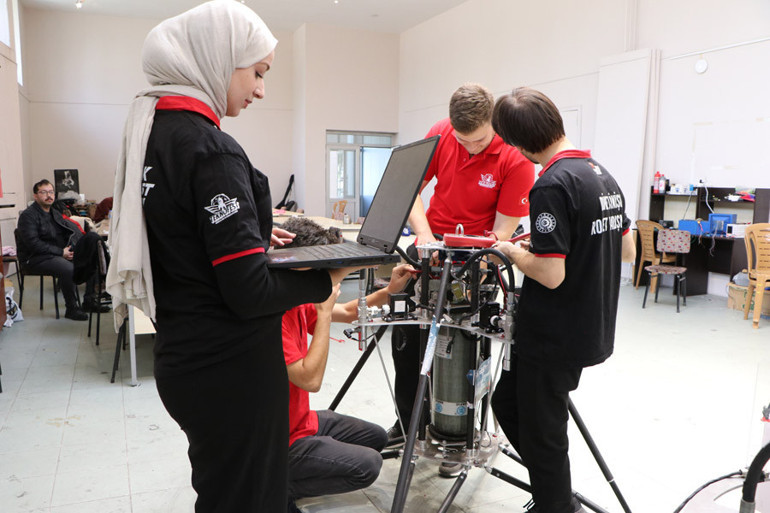
Tuba Batunoğlu, a final-year student in the Department of Computer Engineering who managed key software and control aspects of the project, pointed out that while the past twelve months involved non-stop fabrication and hardware integration, the conceptual foundations of the project stretch back several years.
"Our team is comprised entirely of undergraduate students from across the engineering faculty," Batunoğlu said. "We have been working at an exceptionally intense pace over the past year, but this effort is actually part of a continuous project line that first began back in 2022. Within the team, my specific responsibilities focused on the flight control systems, computer modeling, and systematic testing of the various rocket sub-systems."
Batunoğlu noted that rigorous modeling and simulation phases were critical in ensuring that the pneumatic hardware and autonomous control algorithms reacted quickly enough to stabilize the 32-kilogram structure immediately upon its release from the test gantry in Ankara.
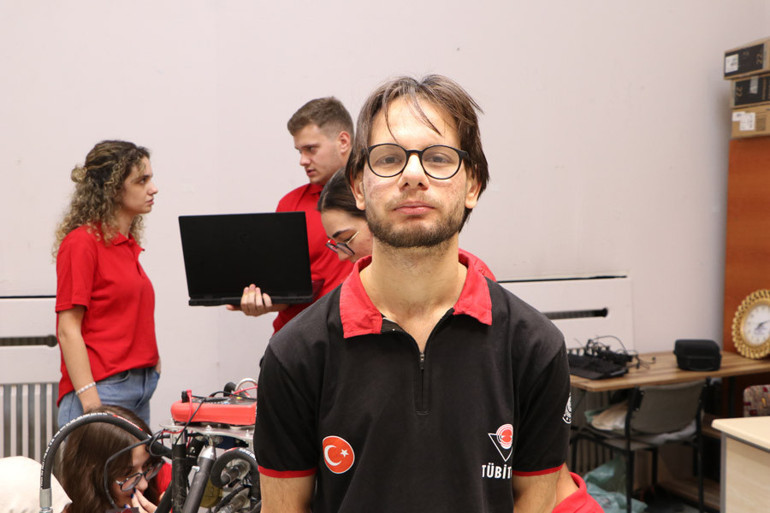
"We executed our test launch at the TÜBİTAK SAGE facilities cleanly and without error," Batunoğlu stated. "Moving forward from this achievement, our goal is not to stop here. We intend to enter new advanced engineering competitions, continue refining our control algorithms and physical chassis designs, and build systematically upon the success we have achieved."
The physical build parameters and competitive context of the victory were further detailed by Arda Gür, a student in the Department of Mechanical Engineering. Gür noted that the competitive field for the TEKNOFEST 2026 Vertical Landing Rocket Competition was exceptionally broad and highly selective, attracting hundreds of applicant teams from technical universities located across the entire country.
"Our completed rocket weighs exactly 32 kilograms and operates entirely using compressed dry air propulsion," Gür explained. "To put the competition in perspective, approximately 300 student teams from universities across all regions of Turkey initially applied to compete in this category. Out of that massive pool of applicants, Atatürk University was represented by three separate student teams in the preliminary stages, and our team ultimately secured the first-place victory."
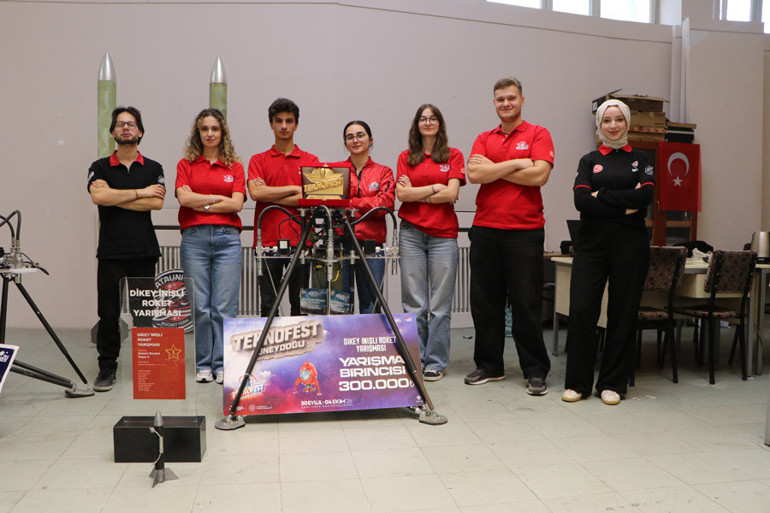
Gür emphasized the prestige of the competitive field assembled at the TÜBİTAK SAGE grounds in Ankara for the final evaluation phase, noting that the 14 finalist teams represented some of the most established engineering institutions in the country.
"During the final flight trials in Ankara, we competed side by side against highly formidable teams, including representatives from Middle East Technical University (METU) and Dokuz Eylül University, and our prototype managed to earn the highest evaluation score to take first place nationwide," Gür said. "This is not the first time our student engineering cohort has achieved top-tier recognition. Back in 2022, we participated in another national rocket competition and also secured a first-place finish for Turkey. We are immensely grateful to our university rector and faculty advisors for giving us the resources and platform to prove what our engineering students can achieve."
The first-place performance of ATAUNI ROCKET TEAM V at TEKNOFEST 2026 underscores the role of practical engineering challenges in preparing university students for complex technical roles in Turkey’s expanding aerospace sector. By translating theoretical engineering education into functional, cold-gas powered vertical descent hardware, the ten students from Atatürk University demonstrated a practical, locally sourced path toward mastering the precision descent dynamics required for future lunar exploration missions.