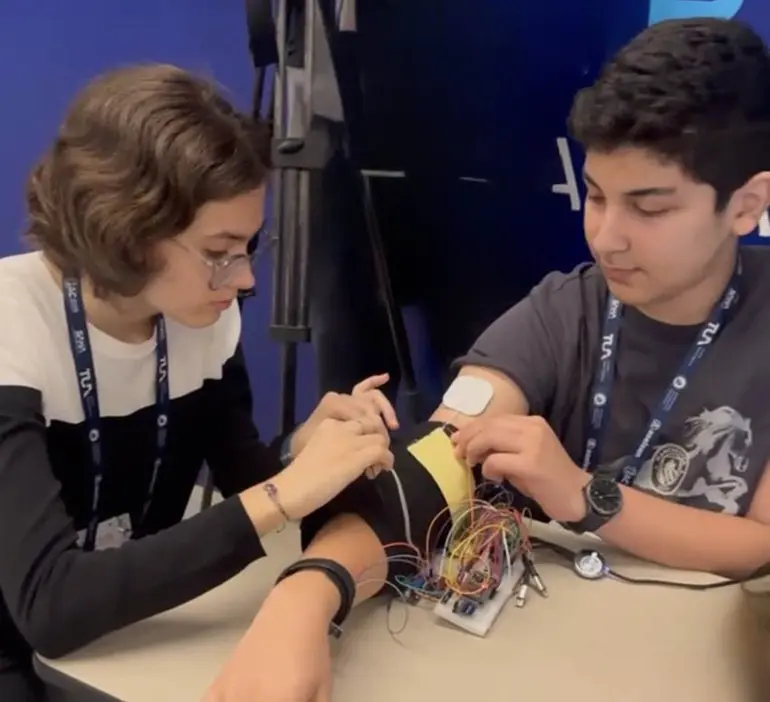
Students from the Fatih İslam Seçen Science and Art Center (BİLSEM) in Istanbul have developed an innovative wearable system designed to mitigate the severe muscle atrophy experienced by astronauts during long-duration space missions. Currently in its prototype phase, the lightweight technological solution integrates directly into space suits to deliver electrical micro-signals that keep human muscles active in zero-gravity environments.
The project was carried out under the umbrella of the "Istanbul Science Club" at BİLSEM by a dedicated team of high school researchers: Aziz Yılmaz, a 10th-grade student at Kabataş Erkek High School, along with Elif Naz Şengezer and Ertuğrul Şükrü Kovan, both 9th-grade students at Yeşilköy Anadolu High School. Guided by their physics teacher and project advisor, Burcu Türkkan, the student researchers designed a localized stimulation device that wraps around critical body areas—such as the arms, legs, or lower back—much like a blood pressure cuff. By delivering controlled electrical impulses directly to muscle tissue, the system forces muscles to contract and remain engaged even when the physical demands of Earth’s gravity are entirely absent.
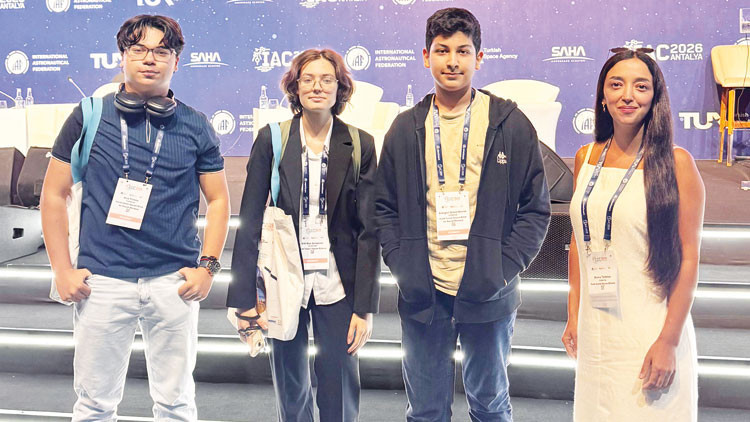
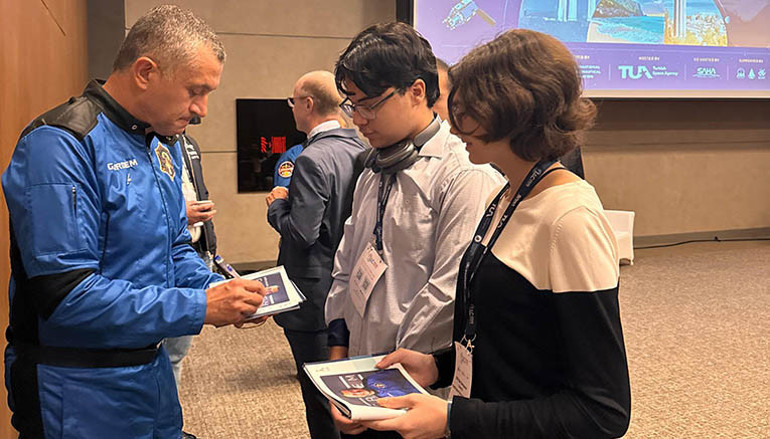
The team recently showcased their breakthrough prototype at the 77th International Astronautical Congress (IAC), held in Antalya from October 5 to October 9. Their presentation drew significant attention from international space professionals and scientific experts, earning high praise from Turkey’s first astronaut, Alper Gezeravcı, who reviewed the project firsthand during the event.
Unused Muscles Begin to Atrophy
The underlying physiological challenge that inspired the project stems from how the human nervous system adapts to microgravity. On Earth, human muscles work continuously to maintain posture, preserve balance, and absorb the physical forces exerted by daily movements such as standing or walking. Because gravity exerts a constant downward pull, the brain routinely sends tiny electrical signals along the nervous system to keep key muscular structures actively engaged, even when a person is unaware of it.
In the microgravity environment of space, however, this continuous muscular demand disappears. Aziz Yılmaz, the 10th-grade researcher who delivered the technical presentation at the International Astronautical Congress, explained the biomedical mechanics behind the device and how microgravity disrupts normal muscle function.
"The micro-signals sent by our device to astronauts essentially replace natural neural impulses," Yılmaz explained. "When the human brain wants to use a muscle on Earth, it sends very small electrical waves along the nerve pathways. Our prototype functions on the exact same principle by delivering signals to the muscles that mimic the ones naturally produced by the brain."
Yılmaz pointed out that while terrestrial gravity keeps human muscles active automatically, space conditions trigger a rapid physiological shutdown in muscular maintenance. "On Earth, our muscles are working constantly without us even realizing it—whether we are adjusting our balance, preventing a fall, or simply taking a step," he noted. "But in space, the situation is drastically different. Because there is no gravitational force, the brain determines that it no longer needs to exert power to keep the body standing upright. As a result, it stops sending electrical signals to the lower back and leg muscles. Without regular nerve stimulation and exertion, those unused muscles naturally begin to atrophy and melt away."

Adaptable Design for Legs, Waist, and Arms
To address this anatomical decay, the BİLSEM student team engineered a modular device that can be customized to the individual physical needs of each astronaut. Rather than creating a bulky, full-body suit that could restrict mobility, the team designed lightweight, independent modules that attach to targeted regions of standard astronaut attire.
"The devices we engineered to be worn inside astronaut suits can be placed precisely where the body needs them most," Yılmaz said. "An astronaut can choose to attach these units specifically to their legs, lower back, or arms. The device does not have to be worn as a single rigid garment; instead, it can be integrated piece by piece into different sections of the flight suit."
Because muscular mass and baseline physical conditioning vary significantly from person to person, the system incorporates a diagnostic calibration phase before flight. Pre-mission muscle measurements are taken for each astronaut while still on Earth to establish an individualized physiological profile. Once aboard a space station or spacecraft, astronauts can determine precisely how long to operate the device each day and which muscle groups require targeted stimulation. The volume and frequency of the electrical micro-signals are tailored specifically to match the wearer’s physical parameters.
Despite its sophisticated biological mapping, the hardware remains exceptionally compact and energy-efficient. The entire prototype weighs approximately 150 grams and is powered by a small, rechargeable battery capable of providing roughly five hours of continuous operation on a single charge. The device has a designed operational lifespan of two years and requires only one to two hours of daily application in microgravity to deliver effective muscle preservation.

Beyond its primary application in space exploration, the student development team emphasizes that the technology holds immense promise for terrestrial medicine. "Although our device was specifically engineered for astronauts working in space, the underlying technology can easily be adapted for bedridden medical patients or individuals suffering from severe muscle atrophy on Earth," Yılmaz highlighted.
During the congress in Antalya, the team had the unique opportunity to demonstrate their prototype to Türkiye’s pioneering astronaut, Alper Gezeravcı. "We presented our work directly to Astronaut Alper Gezeravcı during the congress, and we succeeded in capturing his strong interest," Yılmaz added. "Receiving a passing grade and full endorsement from our national astronaut was a immense point of pride for our entire team."
Struggling to Stand After Returning from Space
The practical necessity of the student-developed device is underlined by the extreme physical toll long-duration spaceflight takes on the human body. As mission durations on the International Space Station and future lunar or Martian expeditions expand, muscle degeneration remains one of the most critical health barriers facing space agencies worldwide.
Elif Naz Şengezer, a 9th-grade researcher on the team, explained that extensive literature reviews conducted prior to building the prototype revealed a clear gap in existing microgravity countermeasures. "Through our research into existing scientific literature, we realized that despite the severity of the problem, there were relatively few targeted, lightweight mechanical solutions designed specifically to counteract localized space-induced muscle loss," Şengezer said. "During extended space missions, astronauts can lose up to 30 percent of their total muscle mass. According to our primary modeling and projections, the wearable device we developed has the potential to reduce that overall muscle loss down to around 21 percent."

That reduction in muscle loss could fundamentally alter the post-mission recovery experience for returning crew members. Team member Ertuğrul Şükrü Kovan stressed that the physical difficulties astronauts face immediately upon re-entering Earth’s gravitational field can be debilitating.
"When astronauts complete their missions and return to Earth, the severe muscle loss they have experienced makes it extremely difficult for them to stand upright or walk unsupported," Kovan explained. "In fact, many returning astronauts are forced to rely on wheelchairs for up to a month after landing because their weakened leg muscles simply cannot bear their own body weight under Earth’s gravity. It is an extraordinarily challenging and uncomfortable rehabilitation process for them. The system we have designed offers a direct, proactive solution to minimize that exact hardship."
System Undergoing Testing at Experiment Center
The concept has advanced past theoretical design and is actively undergoing rigorous scientific validation. Burcu Türkkan, the BİLSEM physics teacher guiding the young researchers, shared details regarding the developmental timeline and ongoing empirical testing of the prototype.
"We have been actively developing this system since last January," Türkkan stated. "Right now, the prototype system is undergoing formal testing at a specialized animal experiment center. Following this active testing phase, the empirical data we gather will allow us to conduct detailed analytical evaluations regarding how much mandatory physical exercise time astronauts must perform in space when wearing this technological garment."
Currently, astronauts aboard orbital facilities like the International Space Station must dedicate upwards of two to two-and-a-half hours every single day to intense physical exercise using specialized treadmills and resistance devices to slow down bone and muscle decay. However, physical exercise alone does not fully prevent muscle degradation.
"Even when astronauts adhere strictly to rigorous daily exercise routines in space, they still suffer significant muscle loss," Türkkan noted. "The wearable device we have engineered offers a targeted physiological supplement that directly addresses this persistent gap."
Looking ahead, the development team plans to compile their laboratory findings and present their finalized research data to the international scientific community. "We aim to synthesize all the empirical results obtained from our ongoing experimental tests and present our complete research findings at an international science conference in Poland next year," Türkkan concluded.