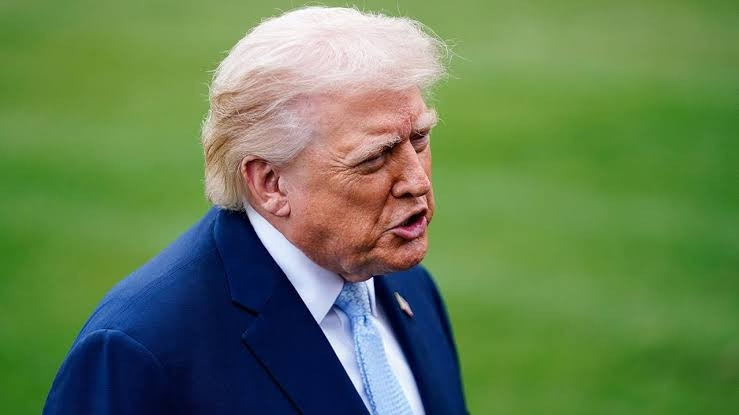
WASHINGTON — Speaking to members of the press as he departed the White House for a campaign rally in Kansas, Donald Trump delivered sweeping remarks on international affairs, addressing unrest in France, the ongoing war between Russia and Ukraine, and wider geopolitical dynamics involving Iran and China. In an expansive exchange before boarding his flight, Trump attributed the turmoil across French cities entirely to immigration policies, suggested that Ukrainian President Volodymyr Zelenskyy should potentially step aside from ceasefire negotiations, and outlined his ongoing diplomatic communication with Russian President Vladimir Putin.
Trump directly tied the recent domestic instability across France to cross-border movement, dismissing assessments that the widespread protests were rooted in educational or domestic economic grievances. Instead, he maintained that the European nation was suffering the direct consequences of failing to implement strict border controls over the preceding years.
"The situation in France is really very sad. What is happening in France is about immigration; it is not about schools or anything else," Trump told reporters gathered at the White House. He reiterated his long-standing criticism of European border management, asserting that the unrest currently shaking French metropolitan centers was the predictable outcome of permissive immigration frameworks.
According to Trump, the issue had been a primary subject of discussion in his past personal interactions with French President Emmanuel Macron. Trump asserted that he had directly cautioned the French leader at their very first meeting against allowing broad migratory flows into the country, advising him that failing to seal France’s borders would ultimately lead to widespread destabilization.
"The problem is immigration, and I told President Macron, ‘Close your borders,’" Trump said. "When I first met Macron, I told him, ‘Close your borders, or you will ruin your country.’ We closed our borders; they didn’t close theirs. And now they have ruined their country. It will be very difficult for France to return to how it once was."
"Paris Will Very Soon Be a Muslim City"
Continuing his critique of French immigration policy, Trump argued that the demographic landscape of major French urban centers had shifted fundamentally due to an influx of individuals coming from various parts of the globe. Focusing his remarks specifically on the French capital, Trump asserted that Paris was rapidly transforming as a consequence of sustained migrant arrivals.
"Paris will very soon be a Muslim city," Trump told reporters, claiming that the current population of immigrants residing in France does not share or integrate into the traditional cultural values of the host nation. He maintained that the administration under Macron had made an irreversible error by not heeding his advice on strict border enforcement, reiterating his view that border security remains the fundamental prerequisite for domestic order.
While Trump framed the widespread instability in France exclusively around the question of migration and border enforcement, the domestic crisis within the country unfolded amid broader social and economic demonstrations. In France, widespread unrest had culminated in massive nationwide protests on October 17, when the "yellow vest" demonstrators, reinforced and backed by student movements, mobilized across major urban centers to voice opposition against high fuel costs and the rising cost of living.
The nationwide demonstrations quickly descended into intense confrontations across numerous metropolitan areas. Clashes between demonstrator factions and law enforcement authorities led to the detention of approximately 2,400 individuals across the country. In the ensuing street battles, nearly 1,000 security personnel—including police officers, gendarmes, and responding firefighters—sustained injuries. Furthermore, the unrest was accompanied by widespread property destruction, during which at least 1,500 storefronts and commercial establishments were vandalized and looted, leaving municipal authorities struggling to restore order. Despite the explicit domestic and economic grievances voiced by the demonstrators, Trump maintained that such demonstrations were merely a secondary symptom of wider demographic and border failures.
Trump Suggests Zelenskyy Hand Over Negotiations with Russia
Turning from domestic European developments to the conflict in Eastern Europe, Trump addressed the war between Russia and Ukraine. Reasserting his desire to see an immediate cessation of hostilities, Trump revealed that active discussions are currently being conducted with Moscow to broker an end to the protracted war.

Trump highlighted his personal rapport with Russian President Vladimir Putin, stating that their communications during this period have remained productive. In contrast, Trump expressed open frustration with the Ukrainian leadership, asserting that the Kremlin currently appears far more amenable to reaching a settlement than the administration in Kyiv.
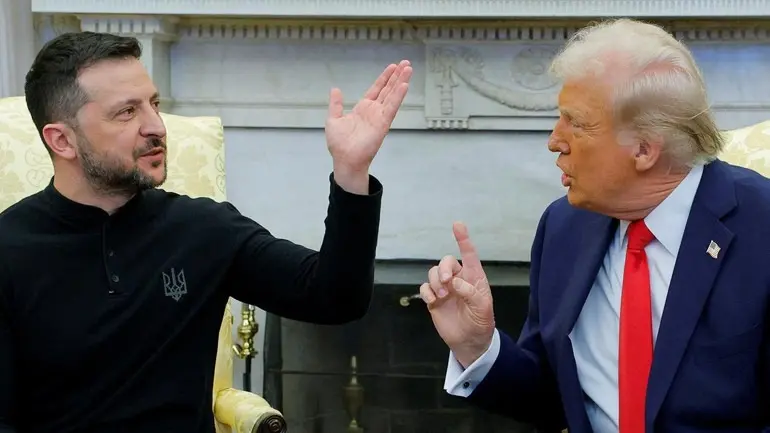
"Maybe it is time for Zelenskyy to hand over the negotiations to someone else," Trump remarked, suggesting that Ukraine’s current president had become an impediment to concluding an agreement. According to Trump, Moscow has shown a willingness to engage, whereas the leadership in Kyiv has resisted making the concessions necessary to finalize a peace deal.
Trump’s comments followed reports of friction regarding a recent diesel agreement involving Russia, an arrangement that had drawn sharp condemnation from Zelenskyy. The Ukrainian president had reportedly expressed strong dissatisfaction with the move, openly accusing Trump of positioning himself on the wrong side of history.
When reporters questioned Trump regarding Zelenskyy’s criticism, the former president pushed back forcefully against the Ukrainian leader’s assessment.
"Zelenskyy doesn’t know what he’s talking about," Trump said. "He should have solved this war a long time ago. If he had listened to me, he would have made a good deal long ago, and one million people in his country would still be alive today."

Trump emphasized that the scale of human loss and physical devastation suffered by Ukraine could have been averted through earlier, pragmatic compromise, laying the blame for the protracted conflict squarely on the reluctance of Ukrainian leadership to pursue direct diplomatic resolution earlier in the hostilities.
"Putin Isn’t Touching Iran, and That’s a Good Thing"
Delving further into the strategic balance of international diplomacy, Trump reiterated that he is currently maintaining active negotiations with Putin regarding Ukraine. However, he declined to publicly detail specific terms or proposals, cautioning that divulging sensitive components to the media would jeopardize the delicate talks currently underway.
"We are actively negotiating with Putin on Ukraine, and I don’t want to get into the details and ruin the negotiations," Trump stated.
Beyond Ukraine, Trump noted that his diplomatic dialogue with the Russian president extended to regional dynamics in the Middle East, particularly regarding Tehran. Trump observed that Moscow had maintained a measured stance toward Iran, a posture that he described as distinctly advantageous to current American strategic objectives.
"Putin isn’t touching Iran, and that is a good thing, because we are hitting Iran very hard economically and militarily," Trump explained. He characterized Moscow’s relative restraint toward bolstering Tehran as a constructive development, observing that Russian authorities could have elected to provide far more substantial backing to the Iranian government amidst escalating American pressure, but had instead chosen to limit their involvement.

Trump extended a similar assessment to Beijing, arguing that China has likewise exercised a degree of moderation concerning both the Middle East and Eastern Europe. Trump observed that while China possessed the capability to offer significantly greater support to Tehran in counteracting American economic and military actions, it had largely refrained from doing so.
"China is also acting reasonably on both Iran and Ukraine," Trump said. "Russia could have done much more to help Iran, but they did very little. China could have also done much more for Iran. I view this as a very positive development."
Looking ahead to upcoming diplomatic engagements, Trump pointed to his scheduled visit to China in November, indicating a willingness to participate in high-level multilateral discussions if circumstances align. Addressing inquiries regarding potential diplomacy during the trip, Trump confirmed that he would be receptive to convening a trilateral summit alongside both Vladimir Putin and Chinese President Xi Jinping.
"If Putin and Xi want to get together in a trilateral meeting, I would like to do that in China," Trump said, signaling an openness to direct three-way talks to address outstanding security disputes, regional conflicts, and international economic friction.
Before concluding his remarks and departing for the Kansas campaign stop, Trump briefly addressed recent operational challenges affecting Ukrainian defense forces, specifically reports that the Starlink satellite communications service providing critical internet connectivity to the Ukrainian military had suffered disruptions. Trump stated that he did not know who was responsible for causing the interruption to the network, but emphasized that he wanted the party responsible for the outage to be identified.