St. Petersburg has rapidly positioned itself as one of the most compelling destinations for Turkish travelers, driven by convenient flight connections, simplified entry requirements, and a rich cultural heritage that rivals Western Europe’s historic capitals. Air connectivity between Turkey and Russia’s cultural epicenter has expanded significantly to accommodate surging demand, with airlines now operating approximately 300 flights per week to St. Petersburg.
Among these, multiple carriers provide up to 10 daily flights from Istanbul, while AJet recently introduced new scheduled services out of Ankara in response to heightened passenger interest. Additional charter flights operating from Antalya further bolster capacity. The impact of this enhanced transport network is clearly reflected in visitor statistics: while 69,000 Turkish tourists visited St. Petersburg throughout the entirety of last year, that same figure was matched within just the first six months of the current year.
For visitors arriving from Turkey, St. Petersburg offers much more than a conventional city break. From the moment travelers set foot in the city, there is an immediate sense of stepping into a different era. Wide boulevards, pastel-hued imperial palaces, intricate canal networks, arched bridges, and world-renowned museums transform the urban landscape into an expansive open-air museum. If motor vehicles were removed from its streets, the city’s preserved architectural fabric would easily persuade onlookers that they had been transported back to the 19th century.

It is with good reason that St. Petersburg is frequently described as the "Venice of the North." Intersected by more than 90 rivers and streams and connected by hundreds of bridges, navigating the city involves constant encounters with water, mirror-like reflections, and postcard-worthy panoramas. Canal tours along the Neva River offer a striking alternative vantage point, revealing a city that is equally captivating under the bright daylight as it is when evening illumination sets its historic facades aglow.
‘Ah, If You Only Knew How Many Times I Fell in Love Like This!’
The streets of St. Petersburg served as a profound source of creative inspiration for Fyodor Dostoyevsky, providing the backdrop for some of his most emotional literary reflections. The legendary romanticism of the city’s White Nights period often proves even more haunting and impressionistic in person than in Dostoyevsky’s celebrated novella of the same name.
The urban design creates an atmosphere where history feels immediate and tangible. Wandering along the embankments of the Neva or floating down its quieter tributaries, travelers experience the same setting that captivated 19th-century writers, poets, and composers. The interplay between water, classical architecture, and changing light gives the city an ethereal quality that sets it apart from traditional tourist centers across the continent.

A New Surprise at Every Step
To truly grasp the character of St. Petersburg, a walk along Nevsky Prospekt is essential. Serving as the city’s primary visual and cultural axis, Nevsky Prospekt is its most vibrant, iconic, and continuously active avenue. Lined with historic cafes, grand commercial structures, literary bookstores, boutiques, and street performers, the avenue remains alive at all hours of the day and night.
Planned during the early 18th century under the reign of Tsar Peter the Great, Nevsky Prospekt gradually evolved into the central artery of St. Petersburg. Stretching approximately 4.5 kilometers from the Admiralty building to the Alexander Nevsky Monastery, the avenue is far more than a commercial street; it is an open corridor through which the history, architecture, and daily life of the city unfold simultaneously.
Walking down Nevsky Prospekt yields continuous architectural and cultural discoveries. On one side, the majestic colonnades of Kazan Cathedral command attention, while nearby, the refined Art Nouveau features of the Singer Building—home to the city’s famed House of Books—stand as an architectural highlight. Historic shopping arcades and framed views of intersecting canals line the path, offering a clear explanation of why St. Petersburg leaves such an indelible impression on visitors.

The avenue also maintains a deep historical connection to Russian literature. It directly inspired Nikolai Gogol’s famous short story Nevsky Prospekt and serves as an essential reference point for readers seeking to understand the urban environment that shaped Dostoyevsky’s characters. Navigating the lively crowds along the avenue offers a rare juxtaposition where the past and present exist side by side. For first-time visitors, Nevsky Prospekt represents the natural starting point for an exploration of the city—a place to admire monumental architecture by day, stroll under glowing streetlights by evening, or pause at a sidewalk cafe to observe the urban rhythm.
A Route Removed from Schengen Stress
A primary driver behind St. Petersburg’s surge in popularity among Turkish travelers is the ease of access regarding entry procedures. For Turkish citizens holding special Green Passports, travel to Russia is entirely visa-free. Meanwhile, ordinary passport holders are spared the tedious administrative burdens often associated with Western European travel. Rather than gathering extensive paper documentation or waiting weeks for appointments, travelers can apply for a Russian electronic visa (e-visa) online using only their passport details and a digital photograph.
With processing times typically concluding within a few days, the streamlined e-visa system renders St. Petersburg an attractive alternative to the growing administrative complexity and appointment shortages linked to Schengen visa applications. This seamless entry process allows travelers to plan trips with minimal advance notice and zero paperwork fatigue.

In addition to visa convenience, economic factors play a major role in the city’s appeal. Compared to many heavily visited Western European capitals, St. Petersburg offers considerably more affordable pricing across accommodation, dining, local transport, and cultural tickets. This cost advantage allows visitors to enjoy a high-end cultural vacation—replete with museum visits, theater performances, and fine dining—without straining their travel budgets.
Hermitage, Church of the Savior on Spilled Blood, and Peterhof
Among the city’s vast collection of historical landmarks, the Hermitage Museum stands out as an extraordinary cultural institution. More than a simple museum, the Hermitage represents an entire world of artistic heritage. The foundations of its collection were laid in 1764 when Empress Catherine the Great acquired a substantial private collection of premier European paintings. Today, it is globally recognized as one of the largest and most prestigious art museums in existence.
The museum’s primary venue, the Winter Palace, is an architectural masterpiece in its own right. Walking through its gilded halls and grand state rooms, visitors gain a vivid sense of the opulence and power that defined Imperial Russia during the Tsarist era.

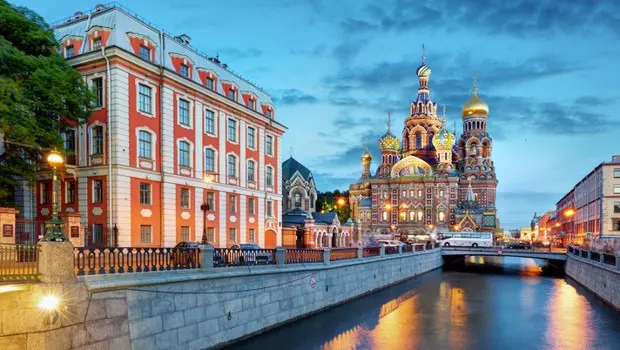
Another undeniable emblem of St. Petersburg is the Church of the Savior on Spilled Blood. With its colorful, intricate onion domes resembling a scene from a fairytale, the church stands in striking visual contrast to the surrounding neoclassical cityscape. However, its origin is rooted in a solemn historical event. The church was erected directly on the site where Tsar Alexander II was mortally wounded in an assassination attempt in 1881.
Construction of the memorial church began in 1883 under the direction of his son, Tsar Alexander III, and took more than two decades to complete, officially opening in 1907. While the exterior commands attention with its dramatic silhouettes, the interior features thousands of square meters of breathtaking mosaic artwork covering nearly every surface. The name "Spilled Blood" remains a direct historical marker of the fatal attack on Alexander II at that exact coordinate along the Griboyedov Canal.
Exiting the immediate city center leads travelers to another magnificent landmark: Peterhof, widely celebrated as the Summer Palace. Frequently referred to as the "Versailles of Russia," the estate fully justifies the comparison. Commissioned by Peter the Great in the early 18th century along the shores of the Gulf of Finland, Peterhof was designed as a grand imperial seaside residence intended to rival the finest palaces of Europe.

The true majesty of Peterhof lies in its expansive lower gardens and famous cascade fountains, which operate entirely without pumps using natural gravitational pressure. Golden statues, manicured green terraces, and grand water channels extending directly toward the Baltic Sea create an imposing display of imperial grandiosity. For nearly two centuries, Peterhof served as the primary summer retreat for Russian monarchs, and it remains one of the region’s most visited historic sites.
History, Art, and Literature at Every Corner
The defining appeal of St. Petersburg rests in its multi-layered lifestyle. A traveler can spend a morning touring grand imperial palaces, spend the afternoon walking the specific streets that framed classic 19th-century literature, attend a world-class opera or ballet performance in the evening, and end the night enjoying a coffee alongside a quiet canal bank.
The city’s culinary scene offers a similar breadth of choice. Visitors can choose between historic dining establishments serving traditional Russian dishes such as beef stroganoff, borscht, and blinis, or explore modern, upscale restaurants offering contemporary international cuisine. Because prices across food and beverage sectors remain moderate compared to alternative European capitals, travelers can enjoy extended stays and culinary exploration with relative ease.

A City to Miss a Little More with Every Return
Reaching St. Petersburg from Turkey is exceptionally straightforward, with direct flight times from Istanbul averaging approximately four hours. While the city attracts visitors year-round, the summer period of June and July—celebrated worldwide as the White Nights—represents its most iconic season. Due to the city’s high northern latitude, twilight merges directly into dawn, resulting in near-continuous daylight. During these weeks, the streets remain energetic well past midnight, with locals and tourists alike strolling along illuminated canals and watching the opening of the Neva River drawbridges.
Ultimately, St. Petersburg offers an ideal synthesis for Turkish travelers seeking European architectural splendor without the associated visa complications. Rich in history, artistic treasures, architectural monuments, and literary associations, the city delivers an immersive travel experience. St. Petersburg is not merely a destination to be checked off a list, but an atmospheric city meant to be explored slowly, reflected upon, and remembered long after the journey home.