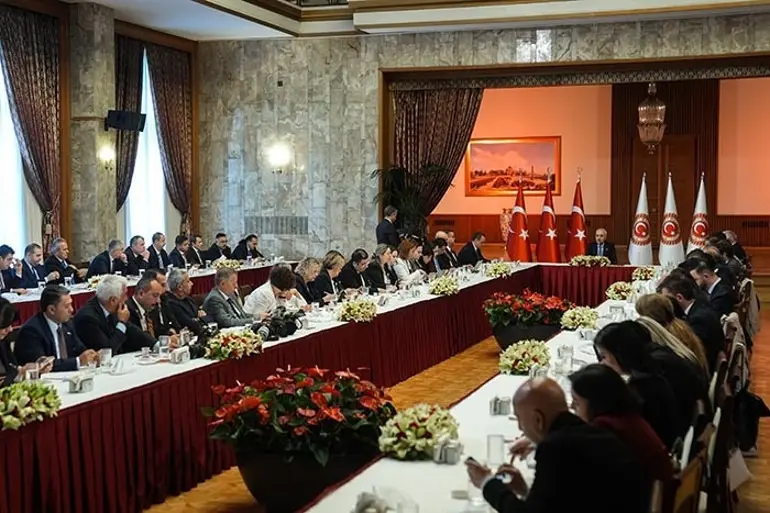
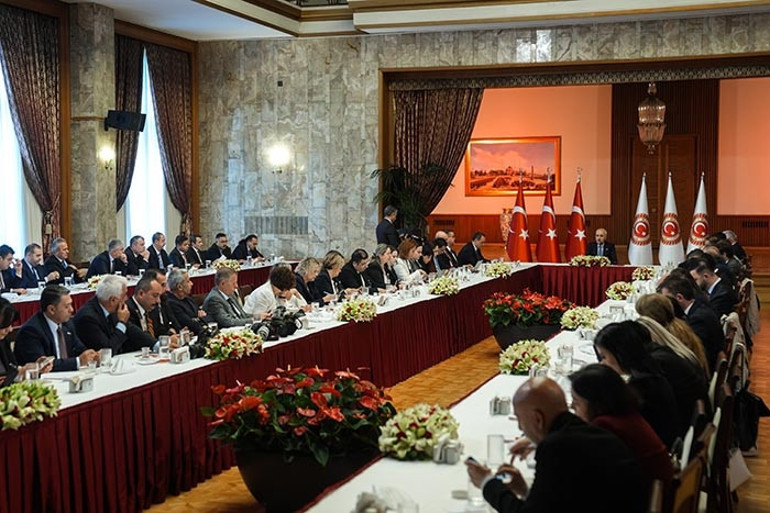
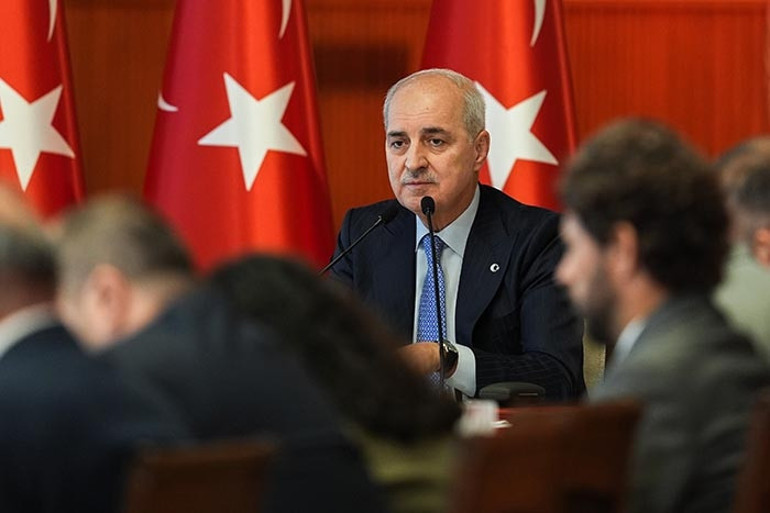
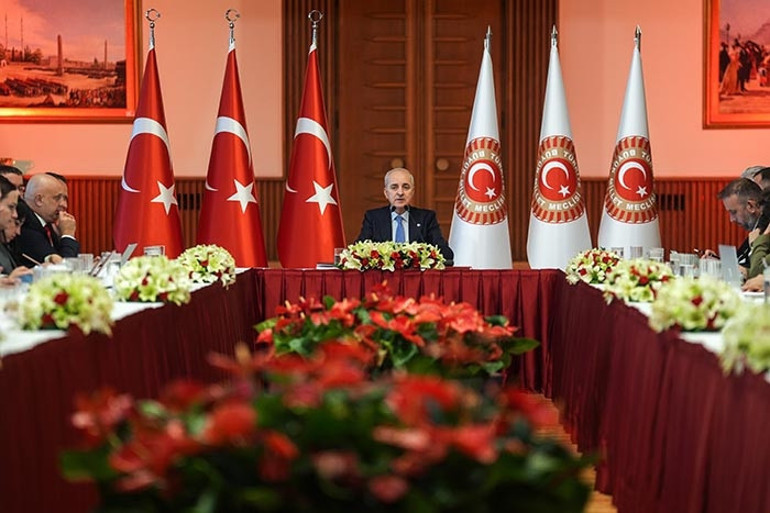
ANKARA — The Speaker of the Grand National Assembly of Turkey (TBMM), Numan Kurtulmuş, has provided a comprehensive assessment of the 28th Term’s 4th Legislative Year, touching upon critical domestic reforms, regional security dynamics, and the nation’s ongoing pursuit of a new, civilian constitution. During a wide-ranging evaluation meeting held at the parliament building, Kurtulmuş addressed journalists’ questions on topics ranging from capital market investigations to the potential for early elections, while emphasizing the parliament’s role as the "third eye" of the Turkish people in national reconciliation processes.
One of the most pressing issues addressed by the Speaker involved the ongoing investigations into transactions within the capital markets. Kurtulmuş underscored the necessity of maintaining absolute transparency and legal rigor to ensure that public confidence in the Turkish economy remains unshaken. He expressed a firm hope that these investigations would be concluded swiftly and thoroughly, regardless of who might be involved.
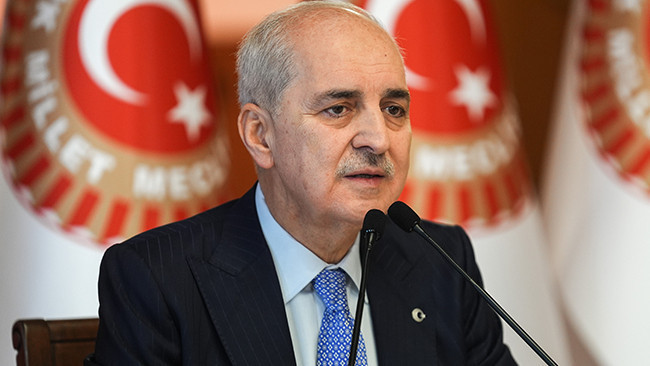
"I hope this matter remains a criminal issue within a very narrow scope and does not reach a point that shakes confidence in the Turkish economy," Kurtulmuş stated. He emphasized that for this to be achieved, the investigations must be completed without showing favoritism. "Whoever is involved, wherever these investigations lead, it is essential to ensure that those responsible are held accountable before the court of law without anyone’s tears being shed."
The Roadmap for Social Integration and the Monitoring Commission
Addressing the legislative agenda for the upcoming term, Kurtulmuş provided details on the planned establishment of a monitoring commission under the Law on Strengthening National Solidarity and Social Integration. He noted that work on the commission’s structure would begin in earnest once the Parliament reconvenes after its current recess.
The Speaker explained that the composition, membership count, and working principles of this commission would be determined through deliberations with various political parties. Kurtulmuş suggested that the body should be "functional" rather than overly broad. "Since it will not have an executive function—meaning it will not be making executive decisions or preparing a final binding report—we will establish it as a more streamlined, functional commission," he explained.

This commission is expected to play a vital role in the "Terror-Free Turkey" initiative, a process Kurtulmuş described as moving forward with precision. Despite the efforts of those he described as "provocateurs" who wish to see continued conflict in the region, Kurtulmuş expressed confidence that the process would reach a successful conclusion. He highlighted that developments in Syria and Iraq are increasingly supporting the will for a "terror-free region," and that Turkish authorities are closely monitoring the details regarding the disarmament and dissolution of terrorist organizations.
The Parliament as the "Third Eye" of the Nation
In a significant departure from historical conflict resolution models seen globally, Kurtulmuş pointed out that Turkey’s current approach does not involve foreign mediators or international organizations. In many global conflicts, a "third eye"—often a foreign state or an international body—is brought in to oversee the process between a state and an armed group.
"One of the most important features of the ‘Terror-Free Turkey’ process is the absence of a foreign third eye," Kurtulmuş asserted. "The third eye is the nation itself and the TBMM, which represents the nation. The commission to be formed within the TBMM will serve as the body that monitors this process on behalf of the people, so to speak."

He further elaborated on the need for a shift in mindset, stating that merely laying down weapons is insufficient if the "weapons in the mind" are not also discarded. This, he argued, requires a revision of political and social discourse. Kurtulmuş called for an end to both separatist language and discriminatory rhetoric that marginalizes segments of society. He reminded the audience that Turks and Kurds have lived together as brothers for centuries and are not emerging from a civil war, but rather working to consolidate a long-standing unity in the face of imperialist efforts to divide the region.
The Necessity of a New Constitution and Legal Reforms
A central theme of the Speaker’s address was the urgent need for a new, inclusive, and democratic constitution. Kurtulmuş characterized the creation of a new founding document as a "necessity" for Turkey to move forward. He argued that the current Parliament, characterized by its diverse political representation, is uniquely positioned to undertake this task.
"The TBMM has proven that it can implement deliberative democracy in an extremely serious manner," Kurtulmuş said, referencing the consensus reached in previous commission reports. "A Parliament where so many political parties and different ideas exist is actually the most suitable Parliament for making a new constitution. No single party has the majority to write a constitution on its own. Parties must come together; while everyone may have their own ideal constitution, we must create a common, strong, democratic, and participatory constitution that meets Turkey’s current needs and carries it into the future."

Beyond the constitution, Kurtulmuş identified several other "essential" legal reforms, including the need for a new set of Internal Regulations (İçtüzük) for the Parliament to accelerate legislative work, as well as updates to the Political Parties Law and the Election Law. He also suggested that the introduction of a Political Ethics Law would significantly contribute to the health of Turkish democracy.
International Relations and the Mecca Defense Agreement
Turning to international affairs, Kurtulmuş addressed the tripartite defense agreement signed between Turkey, Pakistan, and Saudi Arabia, often referred to as the Mecca Agreement. He clarified that the agreement is currently in a preparatory phase and has not yet been submitted to the TBMM for ratification. He expects the matter to reach the parliamentary agenda shortly after the opening of the new session.
In response to claims that the agreement was specifically positioned against Iran, Kurtulmuş was clear: "We do not see the Mecca Agreement as an agreement against Iran, and it should never be so. We hope that the Mecca Agreement, perhaps with the inclusion of Iran and other regional countries as it expands, turns into an agreement that ensures the security of the regional countries and the broader Islamic geography." He emphasized that the goal is to foster regional unity and security rather than to create a bloc against any specific neighbor.
Global Diplomacy and the United Nations
The Speaker also took the opportunity to praise President Recep Tayyip Erdoğan’s recent address to the 81st United Nations General Assembly. Kurtulmuş described the speech as a "historic milestone" that elevated Turkey’s long-standing critique of the global order.
"It was an extremely important, historic speech that carried the line he has maintained at the UN for 16 years to a higher level," Kurtulmuş said. He contrasted the standing ovation received by President Erdoğan with the protests that met Israeli Prime Minister Benjamin Netanyahu. Kurtulmuş characterized the mass walkout during Netanyahu’s speech as a "declaration of humanity."
"Anyone with even a shred of mercy and conscience in their heart changed their path to avoid being in the same hall as the most barbaric killer human history has ever seen," Kurtulmuş remarked. He predicted that the "genocidal government" of Israel would face increasing international isolation. "No matter where they flee, they will surely be held accountable for these crimes against humanity."
Domestic Politics and Parliamentary Statistics
Addressing recurring rumors regarding early elections, Kurtulmuş was blunt, stating that he does not expect such a decision from the Parliament in the near future. He noted that the TBMM is currently preparing for elections to be held on their regular schedule. "Early elections do not happen just because they are discussed; they happen when political conditions mature. If a renewal of elections is desired, the authority lies with the TBMM, requiring 360 votes."
Providing a statistical overview of the past legislative year, Kurtulmuş highlighted the Parliament’s intense workload. He revealed that 571 law proposals were submitted by deputies, and 36 laws were enacted. The General Assembly worked for a total of 929 hours and 21 minutes over 125 sessions, producing over 24,000 pages of minutes. He described the TBMM as one of the busiest parliaments in the world.
Furthermore, Kurtulmuş detailed the Parliament’s commitment to sustainability and "green" initiatives. Since June 2023, the TBMM has saved 2.5 million kilowatt-hours of electricity, 300,000 cubic meters of natural gas, and 20,000 tons of water. Projects are also underway to establish a solar power plant in Konya to offset the Parliament’s energy consumption, alongside a rooftop solar project for the TBMM’s multi-story parking garage. These investments are expected to provide an additional economic contribution of 115 million TL.
As the TBMM prepares to open its 5th Legislative Year on October 1st, Kurtulmuş reiterated his support for the rights of press members and the continued expansion of parliamentary diplomacy, which saw 209 Turkish delegations visit foreign countries and 36 foreign delegations hosted in Turkey over the past year. He concluded by emphasizing that the "door is wide open" for a new era of national solidarity and democratic progress.