
ISTANBUL — When Merve Veziroğlu survived being stabbed 58 times inside her Istanbul home in August 2023, medical professionals described her recovery as nothing short of miraculous. Now, the architect and prominent social media content creator faces another grueling chapter in her quest for justice: Turkey’s Court of Cassation has overturned the 26-year prison sentence handed down to her former husband, sending the case back for a retrial scheduled to begin on November 5.
The high court’s decision to overturn the conviction of Yunus Yıldırım has ignited widespread outrage among women’s rights advocates and legal experts across Turkey. Yıldırım, who attacked Veziroğlu in their bedroom, appealed his conviction on the grounds that he lacked "homicidal intent" because he ceased the stabbing and contacted emergency services. By accepting that argument and invoking the legal concept of voluntary abandonment, the top appeals court has opened the door to a significantly reduced sentence—a prospect that Veziroğlu says makes her feel as though the trauma she endured is being dismissed by the judicial system.
"With this decision, everything I lived through flashed before my eyes like a film strip," Veziroğlu said in an interview following the ruling. "In my beloved homeland, I unfortunately felt unheard, unseen, and disregarded. What is even more painful is to think about the kind of violence this decision will embolden."
The case is set to be heard again on November 5 at 1:00 p.m. before the Istanbul Anadolu 21st High Criminal Court in the Kartal district, where judges must determine whether to comply with the appellate ruling or resist it and maintain the original judgment.
A Morning of Calculated Terror
The assault occurred on the morning of August 4, 2023, culminating a pattern of escalating abuse. According to details shared by Veziroğlu and her legal counsel, Ayşe Esra Çetin, the ordeal began early in the day with psychological violence. Yıldırım seized Veziroğlu’s mobile phone to sever any possibility of her summoning help or contacting the outside world. He then locked her inside the master bedroom of their residence, effectively trapping her before launching a vicious assault with a knife.
Over the course of the attack, Veziroğlu was stabbed 58 times. Forensics and medical reports revealed that more than half of the wounds were concentrated in her neck area. Desperate to survive, the young woman fought back with all the strength she could muster, wrapping herself tightly in a bed duvet in an attempt to shield her body from the incoming blows.
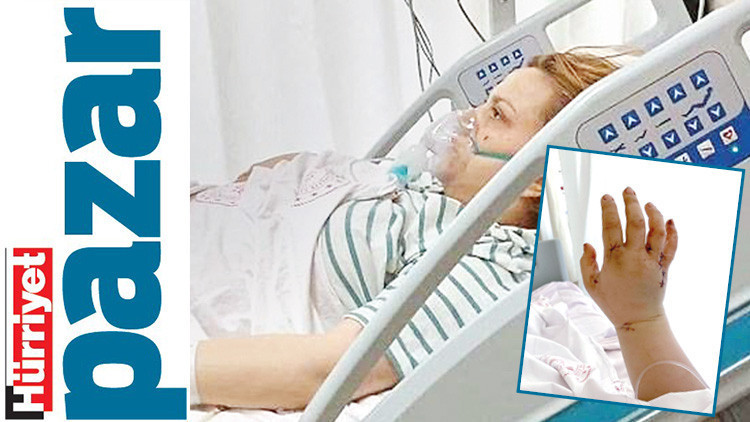
Despite her defensive efforts, the brutality of the attack left her critically injured. Her rib was fractured, one of her lungs collapsed, and she sustained severe defensive wounds across her wrists and fingers as she desperately covered her throat. After the assault ceased, Yıldırım contacted emergency services (112) and informed authorities of the situation.
Emergency responders rushed Veziroğlu to the hospital, where trauma surgeons and intensive care teams worked around the clock to stem massive hemorrhaging and stabilize her breathing. While she ultimately survived after prolonged intensive care, her recovery remains far from complete. To this day, Veziroğlu suffers from nerve damage, loss of sensation, and diminished strength in her hands and wrists, alongside lasting physical and psychological scars.
On May 31, 2024, the Istanbul Anadolu High Criminal Court convicted Yıldırım, sentencing him to 20 years in prison for attempted murder of a spouse and an additional six years for aggravated deprivation of liberty, culminating in a total sentence of 26 years. A regional appeals court subsequently upheld the lower court’s judgment in its entirety.
However, the case took an unexpected turn when the defense elevated the appeal to the Court of Cassation. The high court ruled that the conviction for deprivation of liberty lacked sufficient evidence beyond Veziroğlu’s own testimony, stating that the legal elements of that offense were not met. More controversially, the court ruled that because the assailant halted his stabbing spree and dialed emergency medical services to facilitate her hospitalization, the provisions of "voluntary abandonment" under Article 36 of the Turkish Penal Code should apply. Consequently, the high court determined that Yıldırım should not be punished for attempted murder, but rather for intentional injury with aggravated consequences—a statutory shift that dramatically curtails potential prison time.
‘This Concerns Every Single One of Us’
For Veziroğlu, the appellate decision was an agonizing psychological setback, reviving memories of an ordeal she has spent more than a year trying to heal from.
"Physical wounds may heal with time, but the psychological wounds of surviving such terror are never easy to close," Veziroğlu remarked. She explained that after the ruling became public, she received an outpouring of solidarity across social media platforms, prompting her to call upon the public and civic observers to pack the courtroom on November 5.

"First and foremost, the rulings issued in the aftermath of this incident have long ceased to concern only me," she said. "Every single decision rendered here concerns all of us. Women find it much easier to empathize because so many live with these fears. But receiving heartfelt support from conscientious men also gives me immense hope. I invite every person with a conscience to stand beside me on the day of the hearing."
Addressing the defense’s central contention—that the defendant harbored no intent to take her life—Veziroğlu vehemently rejected any narrative of spontaneous anger or benevolent cessation. She pointed out that the perpetrator had demonstrated prior planning and a calculated understanding of how to manipulate the legal system.
"He told me himself that he had planned everything," Veziroğlu recounted. "He had even called his brother beforehand and told him what he was going to do, and his brother didn’t even attempt to stop him. If a relative had told me something like that, I would have intervened no matter what."
She also discovered after the attack that Yıldırım had taken deliberate steps to ensure neighbors would not alert law enforcement when the assault began. "I saw from an interview our landlord gave afterward that he had secretly spoken to them behind my back. While telling me, ‘This landlord is a creep, let’s never speak to him,’ he was telling the landlord, ‘We can’t get along, we argue a lot.’ He did that deliberately so that when screaming or noises were heard from the apartment, no one would call the police."
Veziroğlu recalled that Yıldırım operated under the conviction that the legal consequences for domestic violence would be minimal. "He thought, ‘I’ll serve five months and get out.’ He truly believed he would go to prison without working, just rest there, and walk free in a few months."
The August 2023 attack was also not the first time Yıldırım had engaged in violent behavior. Veziroğlu explained that previous complaints and legal filings had been dropped under duress. "I had to withdraw prior complaints and cases because of his threats. Because he was never arrested and never removed from my life, I couldn’t break free. In fact, after the incident, I learned that there was another woman before me who had filed a official complaint against him. He had threatened her with death and subjected her to violence as well. She reached out to me afterward and described everything in full detail."

A Battle Fought in Intensive Care
The physical aftermath of the attack required an exhausting battle for survival. Veziroğlu spent weeks immobilized in medical wards, enduring agonizing pain and heavy sedation.
"A massive portion of that time was spent in sheer agony, praying to God for healing," she said. "I remained completely motionless for days, kept alive by medications. Because my lung had collapsed, I couldn’t even cry for a very long time. In those moments, you inevitably ask yourself how you can possibly continue living after enduring such things."
Among the messages of solidarity she received after speaking out about the Supreme Court’s decision was an emotional note from the physician who treated her in the emergency room and intensive care unit.
The doctor wrote to her: "… I watched the video you posted late at night and couldn’t sleep. As you recounted what happened, I relived those days all over again. In fact, what you describe is only a fraction of what occurred… How we sprinted through the emergency room, trying desperately to halt the bleeding and close your wounds… In intensive care, every night when your consciousness was deeply clouded, administering heavy medication and monitoring your vitals hour by hour… Checking your oxygen levels second by second so your lung wouldn’t collapse again… They tell doctors never to form personal bonds with patients, but I am so glad I bonded with you as if you were my own sister. The greatest professional happiness I will ever experience in my life was the day we discharged you."
When asked what continues to give her resilience as she reconstructs her life and faces a renewed court battle, Veziroğlu pointed to spiritual conviction and a sense of shared purpose.
"Faith in God and submission," she said. "I know that He knows what is in my heart, and I believe there are rewards prepared for me. Beyond that, I draw strength from the realization that I can serve as a source of inspiration and courage for other women who are fighting to survive."

‘A Crucial Crossroads in the Fight Against Violence’
The forthcoming trial is poised to become a landmark dispute regarding how Turkish criminal courts define homicidal intent and apply leniency provisions in domestic violence prosecutions. Attorney Ayşe Esra Çetin outlined the procedural background and the legal ramifications of the Court of Cassation’s reversal.
"Following the Istanbul Anadolu High Criminal Court’s ruling on May 31, 2024, both our side and the defense filed appeals," Çetin explained. "We appealed because we firmly believed that the gravity of what Merve suffered warranted a punishment far exceeding 26 years. The defense, on the other hand, argued that the defendant lacked intent to kill, that he terminated the stabbing act voluntarily and summoned an ambulance, and that he never committed the crime of unlawful deprivation of liberty. On those grounds, they claimed 26 years was excessive and demanded a reduction."
After the intermediate appellate court affirmed the sentence, the defense brought the matter to the Court of Cassation, which dismantled both components of the conviction.
"On the charge of deprivation of liberty, the Court of Cassation held that there was no corroborating evidence other than Merve’s own testimony showing that the defendant locked the bedroom door to carry out the attack or physically prevented her from escaping," Çetin said. "Therefore, it ruled that he should be acquitted on that count due to absence of elements of the crime. Regarding the stabbing, the high court held that because the defendant inflicted various injuries and subsequently dialed 112 to facilitate her transfer to the hospital, voluntary abandonment provisions must apply, requiring him to be penalized only for intentional injury."
Çetin criticized the high court’s logic as deeply flawed and fundamentally biased toward the perpetrator.
"On November 5, the local trial court must first decide whether to abide by the Court of Cassation’s reversal or resist it," Çetin noted. "Our explicit demand will be for the court to issue a decision of resistance and uphold the original 26-year prison sentence. The fact that my client sustained 58 knife wounds—more than half targeting her vital neck region—demonstrates beyond any doubt the sheer intensity of the defendant’s homicidal intent."

The attorney underscored that medical experts have universally deemed Veziroğlu’s survival an extraordinary anomaly rather than a calculated outcome orchestrated by her attacker. "Treating her survival as if it were the product of the defendant’s benevolent effort to save her is utterly unacceptable to us. Interpreting voluntary abandonment so expansively is legally unsound."
Çetin also took issue with the dismissal of the confinement charge. "To claim that there is no independent evidence that Merve was prevented from leaving the room ignores the basic reality of domestic assaults. In an incident where an individual is forcibly locked inside a private room, the absence of outside eyewitnesses is completely consistent with the nature of the act. The reversal falls into a contradiction within itself on this point."
According to the legal team, the stakes of the retrial could not be higher. If the local court yields to the appellate guidance, the reclassification of the offense to aggravated bodily injury would result in a drastic mitigation of penalties.
"The worst-case scenario is that the local court complies with the reversal and sentences the defendant merely for intentional injury aggravated by its consequences," Çetin warned. "In that scenario, the prison sentence will be cut almost in half."
The legal debate directly echoes statements made by the defendant during earlier trial proceedings, where witnesses noted he had threatened Veziroğlu by declaring, "Even if I kill you, I’ll serve five or six months and walk out."
"At this juncture, the fundamental question is whether our criminal justice system can maintain internal coherence and integrity in combating violence against women," Çetin concluded. "Allowing Article 36’s voluntary abandonment doctrine to be stretched this broadly undermines the entire deterrent framework that lawmakers instituted to punish severe violence against women. We believe that a resolute decision of resistance by the local court, coupled with a strict and accurate demarcation of voluntary abandonment, will represent a crucial crossroads in this country. When a man stabs a woman 58 times, the fact that he calls emergency services after leaving her on the brink of death should not grant him legal clemency. As a lawyer, I find this legally indefensible; as a woman, I find it profoundly alarming."