As the protracted military offensive by Israel across the Gaza Strip continues to leave widespread devastation in its wake, the region’s vital agricultural sector has suffered catastrophic damage. Among the hardest-hit segments of local agriculture are the historic orchards and groves that form a cornerstone of Palestinian rural life, heritage, and economy. Vast tracts of agricultural land have been heavily impacted, rendering much of the terrain unusable, fragmented, or completely destroyed. Compounding this agricultural crisis, Palestinian farmers find themselves entirely cut off from large portions of their own lands. These restricted areas have been designated by military authorities as "red lines," imposing severe access barriers that prevent cultivators from tending to, managing, or harvesting their crops.
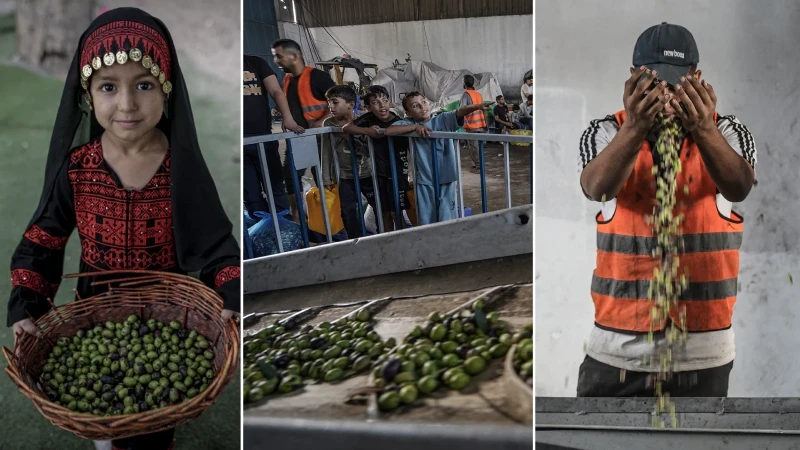
Despite these immense operational hazards, physical barriers, and the constant threat of danger, resilient local farmers are refusing to abandon their ancestral connection to the land. Displaying profound perseverance, they have sought out and managed to reach the few remaining olive trees that have somehow survived the surrounding destruction. Gathering whatever meager yields can be salvaged from these battered groves, farmers have transported their harvested olives to a local extraction facility located west of the town of Al-Zawaida. There, amid the ruins of a heavily disrupted infrastructure, the olives are processed to yield precious oil, serving as a vital lifeline for local sustenance and whatever remains of the agricultural economy.
The plight of these contemporary farmers unfolds against the backdrop of a deeply rooted historical landscape. The geography of Palestine and the wider Gaza region is internationally and historically recognized as one of the oldest and most significant genetic centers for the olive tree anywhere in the world. Archaeological evidence indicates that olive cultivation in this fertile Mediterranean strip dates back through the Chalcolithic and Early Bronze Ages, establishing an unbroken, millennia-old tradition of production that has been meticulously handed down through generations of local families. This deep agrarian heritage is woven into the very fabric of Palestinian identity, culture, and survival, symbolizing steadfastness and continuity across centuries of shifting political and environmental landscapes.
Within the broader Palestinian territories, this heritage is physically embodied by ancient trees locally known as "Rumi." These monumental olive trees boast astonishing lifespans ranging between 1,500 and 3,000 years. Concentrated particularly in and around historical areas such as Bethlehem and Nablus, these ancient botanical landmarks are renowned not only for their immense age but also for their remarkable resilience. Thanks to sophisticated, deeply entrenched root systems developed over millennia, these trees have demonstrated an extraordinary capacity to withstand prolonged periods of severe drought and environmental stress, standing as silent witnesses to the passage of empires and civilizations.
The specific growing conditions in the Gaza Strip present a unique agricultural environment that contrasts sharply with other parts of the region. Unlike the mountainous, terraced terrain characteristic of the West Bank, Gaza is defined primarily by its coastal plain geography. Here, agricultural practices are shaped by distinct regional factors, including cooling maritime breezes blowing in from the Mediterranean Sea, relatively mild winters, and a unique coastal soil composition consisting largely of sandy and loamy elements. These coastal conditions directly influence the development, maturation, and overall quality of the olive trees that manage to take root along the coastal strip.
Furthermore, the climatic dynamics of Gaza influence the operational rhythm of the agricultural year. Because the region experiences a warmer climate overall compared to the elevated terrain of the West Bank, the annual olive harvest in Gaza typically commences earlier. While harvesting in cooler elevated regions might occur later in the autumn, local farmers in Gaza usually begin gathering their crop several weeks ahead of their counterparts elsewhere, kicking off the labor-intensive harvest period between the end of September and the very beginning of October.