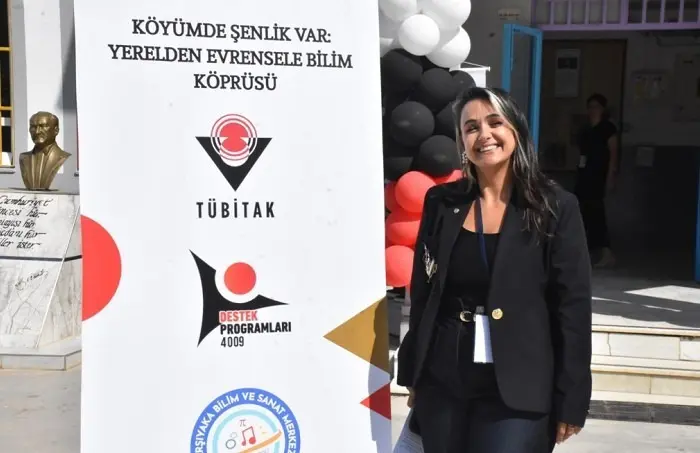
İZMİR, Turkey — A groundbreaking science festival titled “Köyümde Şenlik Var: Yerelden Evrensele Bilim Köprüsü” (There is a Festival in My Village: A Science Bridge from the Local to the Universal) has successfully brought the wonders of scientific inquiry from bustling urban centers directly to rural school grounds in İzmir. Organized under the prestigious TÜBİTAK 4009 Nature Education and Science Schools Support Program, the project is one of only two initiatives in the entire İzmir province to receive official approval and funding. The event transformed a quiet rural community into a vibrant hub of interactive learning, bridging the gap between urban and rural education through hands-on activities, academic lectures, and celestial observations.
The complex, multi-layered educational initiative was carried out under the coordination of the İzmir Provincial Directorate of National Education. The execution of the project was spearheaded by the Karşıyaka Science and Art Center (BİLSEM)—an institution renowned for its specialized programs for gifted and talented students—and hosted by the Ödemiş Şehit Er Kamil Alkan Primary School. To ensure the highest level of scientific accuracy and pedagogical value, the project drew upon a diverse pool of experts. Faculty members and researchers from two of Turkey’s leading higher education institutions, Ege University and Dokuz Eylül University, volunteered their expertise. They were joined by field specialists and local forest chiefs, who helped ground the scientific concepts in the natural realities of the rural environment. The collaborative effort aimed to democratize science, proving that high-level academic knowledge is not the exclusive domain of metropolitan institutions but can be effectively shared with rural communities.
Transformative Workshops for All Generations
The festival was designed as an inclusive, multi-generational experience, featuring custom-tailored workshops for students, educators, and the local village populace. Rather than relying on passive learning, the organizers constructed six distinct, interactive stations to engage students in active experimentation and creative problem-solving.
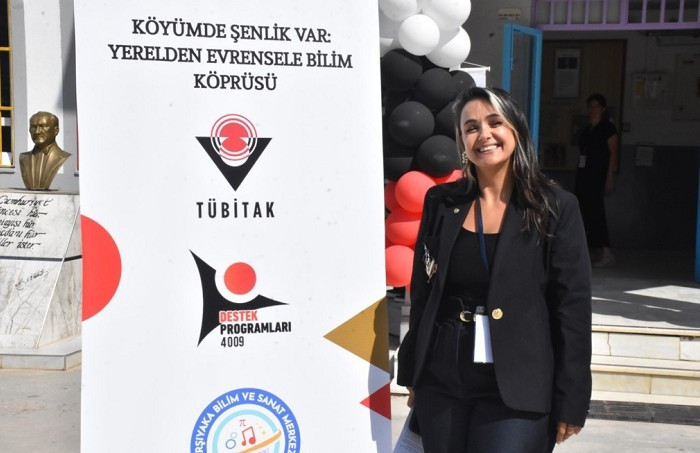
For the young students, the STEM (Science, Technology, Engineering, and Mathematics) station was a major highlight. Here, children were tasked with designing and building their own functioning electric vacuum cleaners from simple materials, learning the basics of electrical circuitry, airflow, and engineering design. Other student-focused stations included wood printing, which blended artistic expression with traditional craftsmanship; music-based rhythm and sound workshops that explored the physical properties of acoustics and auditory perception; and drama-focused activities designed to foster affective development, empathy, and collaborative communication. To ensure personalized attention, the student body was divided into six smaller groups, allowing each child to actively participate and experiment at every single station.
The educational outreach extended beyond the students to the village’s teaching staff. Educators participated in specialized pedagogical workshops focused on self-awareness, space physics, and the methodology of "place-based education." This approach encourages teachers to step outside the traditional classroom and utilize the local natural and cultural environment as a primary teaching tool. By training local teachers in these modern methods, the project aims to leave a lasting educational legacy that continues long after the festival concludes.
Simultaneously, the adult members of the community, including parents and local farmers, were provided with practical training sessions tailored to their daily lives. These included an agricultural workshop focused on sustainable farming practices, an interactive talk on the global climate crisis and its local ramifications, essential first-aid training, and seminars aimed at strengthening school-parent cooperation. As twilight fell, the focus shifted from the terrestrial to the celestial. Large, professional-grade telescopes were erected in the village square, turning the night sky into a shared laboratory where villagers and children alike gazed at stars, planets, and distant constellations under the guidance of academic astronomers.
Promoting Educational Equity on the Equinox
Project Coordinator Zeliş Kurt highlighted the rigorous selection process of the TÜBİTAK 4009 program, emphasizing that only two projects from the metropolitan province of İzmir received official approval. She expressed immense pride in the team’s achievement and explained that the timing of the festival was a deliberate, symbolic choice.

The event was strategically scheduled for September 21, the Autumn Equinox. Kurt explained the profound philosophy behind this decision: "On the Equinox Day, when day and night are in perfect balance and equality across the globe, we wanted to champion the principle of equal opportunity in education for our rural school students. Our core mission was to liberate science from the confines of urban centers, shopping malls, and closed conference halls, and transport it directly to the heart of our villages. Under the coordination of the İzmir Provincial Directorate of National Education and alongside our numerous esteemed partners, we successfully united our rural citizens and young students with the inspiring world of science."
By choosing the equinox, the project team sent a powerful message about educational accessibility. In many developing regions, advanced scientific resources, interactive museums, and academic outreach programs are concentrated in major cities, leaving rural students at a disadvantage. “Köyümde Şenlik Var” sought to challenge this disparity, demonstrating that with the right institutional backing and collaborative spirit, world-class educational experiences can be delivered anywhere, regardless of geographical isolation.
A Wonderful Festival Environment
The hosting of such a high-caliber scientific event was a monumental occasion for the Ödemiş Şehit Er Kamil Alkan Primary School. School Principal Zekeriya Sadi Kula shared his initial excitement upon learning about the TÜBİTAK 4009 project, noting that these intensive science programs have historically been geared toward older demographics, specifically middle and high school students.
"When the opportunity was finally extended to primary schools last year, we did not hesitate," Kula explained. "We immediately submitted our application to serve as the host institution. Upon our acceptance, we were partnered with the Karşıyaka Science and Art Center. Working closely, step-by-step with our project coordinator, Zeliş Kurt, and with the unwavering support of our dedicated teachers and local parents, we succeeded in creating an extraordinary festival environment."

Principal Kula emphasized that the primary goal of the initiative was not merely to teach scientific facts, but to instill a lifelong passion for discovery. For children living in remote areas, early exposure to university academics, advanced technology, and hands-on engineering can be a life-altering experience. "We aim to plant the seeds of curiosity in the minds of our students who are geographically distant from the city centers," Kula stated. "By sparking new questions, broadening their horizons, and exposing them to diverse scientific disciplines, we hope to inspire them to pursue careers in science, technology, and research in the future."
The success of the festival in Ödemiş serves as a scalable model for future educational interventions across Turkey. By leveraging the resources of metropolitan science centers and universities, and directing them toward eager rural communities, the “Köyümde Şenlik Var” project has successfully built a sustainable, replicable bridge between local realities and universal scientific truths.