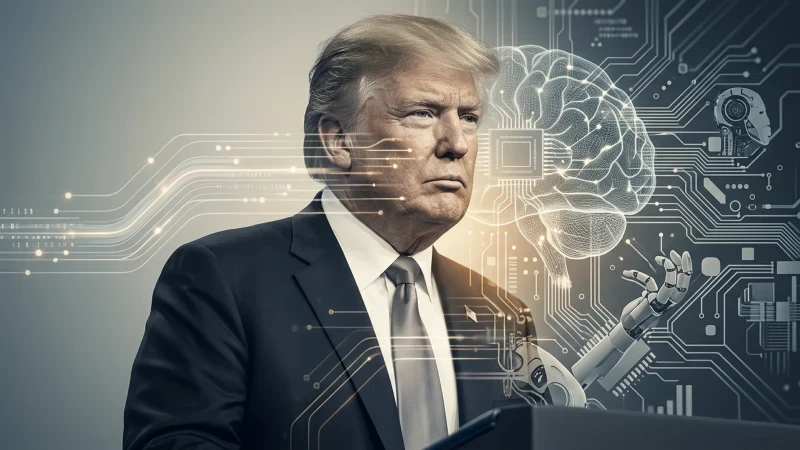
NEW YORK — In a striking address delivered at the United Nations General Assembly in New York, United States President Donald Trump announced a significant semantic shift regarding one of the most transformative technologies of the modern era. Declaring that the world has officially entered the era of "super intelligence," the U.S. President stated that official United States government documentation as well as broader global discourse would begin moving away from the conventional term "artificial intelligence" in favor of the newly preferred nomenclature.
The decision to pivot toward the term "super intelligence" follows an interactive approach adopted by the administration. Prior to his formal UN address, President Trump utilized the social media platform Truth Social to engage with his followers, presenting an online poll to gauge public preference. According to the administration, the poll tested a series of alternative descriptors including "superior intelligence," "extreme intelligence," and "exalted intelligence." Ultimately, the designation "super intelligence" emerged as the clear front-runner among the options presented, paving the way for its integration into official rhetoric and diplomatic engagements.
‘Super Intelligence’ Terminology Faces Skepticism from Global Technology Experts
Despite the rapid adoption of the term within high-ranking U.S. political circles, technology experts and academic specialists around the globe have expressed strong reservations, suggesting that the terminology is unlikely to gain widespread or formal acceptance within the broader tech sector. Industry analysts and researchers pointed out that terms denoting "super intelligence" are traditionally reserved for advanced, highly hypothetical systems that far surpass current capabilities, rather than the machine learning and generative tools deployed in today’s digital landscape.

Simon Coghlan, a researcher from the University of Melbourne, weighed in on the administration’s lexical pivot, noting that the new adoptions are inherently misleading. According to Coghlan, applying such grandiose terminology to contemporary systems significantly exaggerates the actual operational capacities of current artificial intelligence technologies, blurring the line between present-day computational engineering and speculative future milestones.
Echoing similar concerns, Ben Leong from the National University of Singapore emphasized that industry professionals and software engineers would likely prefer to reserve terms implying "super intelligence" for genuinely elevated, future-tier systems. Leong suggested that diluting the vocabulary on current iterations could create confusion among the public and policymakers alike regarding the true developmental stage of modern computing infrastructure.
Internal Administration Support Contrasts with International Hesitation
While technical circles maintain a cautious stance, the policy shift announced by President Trump has found immediate alignment within key branches of the U.S. administration. High-ranking officials have quickly pivoted to align their public statements and digital communications with the President’s directives. Ethan Klein, serving as the Chief Technology Officer of the United States, alongside Michael Waltz, the Permanent Representative of the United States to the United Nations, both adopted the "super intelligence" phrasing in their recent public remarks and social media communications, signaling a unified executive branch approach.

In contrast, international partners have displayed a marked lack of enthusiasm for the terminology change. Canadian Artificial Intelligence Minister Evan Solomon addressed the shifting linguistic trends by noting that Canadian authorities and public officials are generally disinclined to follow suit, indicating that Canadians are not particularly eager to adopt sudden lexical revisions for established technological frameworks.
Navigating China Competition and Opposition to Preemptive Regulation
Beyond the debate over terminology, President Trump used his platform to address broader geopolitical and economic dimensions surrounding the technology. Dismissing growing international anxieties that advanced computational systems pose existential or severe societal risks as little more than an overblown narrative, the U.S. President firmly reiterated his opposition to heavy-handed governmental regulations and oversight mechanisms aimed at curbing technological progress.
Addressing the intense geopolitical competition between Washington and Beijing, President Trump emphasized that the United States currently maintains a clear lead in the global technological race. The U.S. leader underscored that his administration remains fully committed to maintaining this strategic dominance and ensuring that American technological leadership remains unchallenged on the global stage.

The developments surrounding technological competition and terminology are anticipated to remain at the forefront of international diplomacy, particularly as President Trump is scheduled to hold high-level bilateral meetings with Chinese President Xi Jinping later this week, where the future trajectory of advanced technology cooperation and competition is expected to be a central topic of discussion.