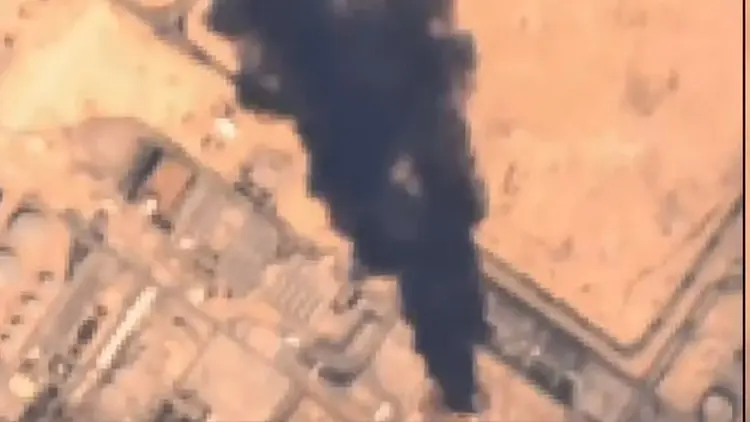
Yemen’s Iran-backed Houthi movement has announced that it carried out a coordinated military operation targeting facilities belonging to Saudi Arabia’s national oil company, Saudi Aramco, in the capital city of Riyadh. The group stated that the cross-border assault was executed using a combination of ballistic missiles and unmanned aerial vehicles, marking a significant escalation in its ongoing campaign against critical infrastructure deep within the kingdom.
The claim was made in an official written statement issued by the Houthi military spokesman, Yahya Saree, who asserted that the operation succeeded in directly striking its intended targets at Aramco’s Riyadh installations. According to Saree, the impact of the projectiles ignited fires at the targeted locations, sending visible plumes of thick smoke into the sky above the affected sites.
The assault represents one of the group’s most audacious attempts to strike at the commercial and administrative heart of Saudi Arabia, bringing the protracted military confrontation from Yemen’s internal front lines directly to the kingdom’s political and economic capital.
The military spokesman framed the operation against the state energy giant as a direct retaliatory response to an intensive aerial campaign conducted by the Saudi-led coalition inside Yemen. In his statement, Saree alleged that Saudi Arabia had launched 60 airstrikes across Houthi-controlled territory over the preceding 24 hours alone, hitting various targets in the Yemeni capital, Sanaa, as well as several other surrounding provinces.
Expanding on the scale of the coalition’s recent air operations, Saree claimed that the total number of Saudi airstrikes directed at Yemen had reached 1,410 since September 3. The spokesman argued that the sheer volume and frequency of these coalition air raids compelled the Houthi armed forces to orchestrate a substantial retaliatory strike against high-value strategic targets within Saudi territory.
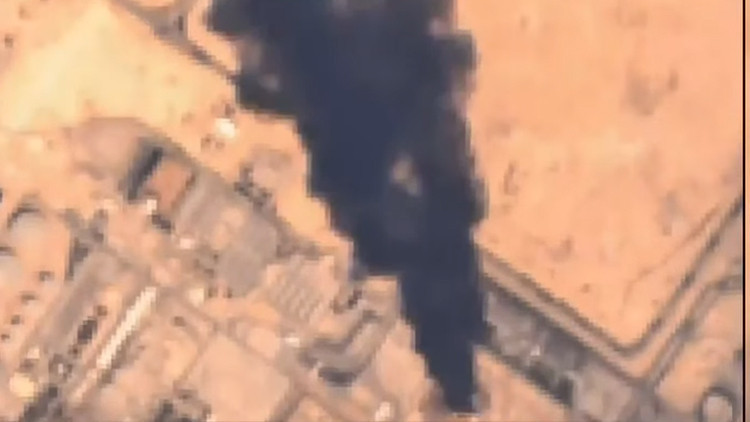
The strategic choice of target carries profound implications. Saudi Aramco, as the state-owned petroleum and natural gas company of Saudi Arabia, constitutes the undisputed backbone of the kingdom’s national economy and plays a central role in the global energy market. Directing advanced weaponry toward Aramco assets in Riyadh underscores the Houthis’ persistent intent to exert economic and political pressure on the Saudi leadership, utilizing asymmetric military capabilities to demonstrate that vital infrastructure far beyond the Yemeni border remains vulnerable to long-range fire.
Threats to Continue Cross-Border Operations
Following the announcement of the strike on Aramco, the Houthi military command issued explicit warnings that its cross-border operations against Saudi Arabia would not cease. In his statement, Yahya Saree affirmed that the group remains prepared to maintain and intensify its missile and drone offensives against targets across the kingdom as long as Saudi military actions inside Yemen persist.
The threat to sustain cross-border operations highlights the established doctrine of deterrence that the Houthis have sought to project throughout the conflict. By retaliating against industrial, military, and energy assets located in major Saudi population centers, the movement attempts to impose a tangible cost on Riyadh for its ongoing military intervention. The Houthi leadership has repeatedly signaled that it views its arsenal of ballistic missiles and unmanned aerial vehicles as a counterweight to the coalition’s overwhelming superiority in conventional air power.
The warning also arrives amid a broader environment of mounting regional friction. The Houthis, who receive political and material backing from Iran, have increasingly relied on domestic and imported missile and drone technologies to execute complex, long-range missions. The group has argued that these cross-border barrages are purely defensive maneuvers designed to compel the Saudi-led coalition to halt its air campaign and lift restrictions on areas under Houthi control.
The latest claims of damage and fires at the Aramco installations in Riyadh serve as a stark reminder of the fragile security environment characterizing the Arabian Peninsula. While cross-border attacks along the immediate border regions have been a constant feature of the conflict, strikes aimed at the interior of the kingdom, particularly its central administrative hub, represent a deliberate effort to alter the psychological and operational dynamics of the war.

A Protracted Civil War and Regional Intervention
The confrontation between the Houthis and Saudi Arabia is deeply rooted in the broader civil war that has devastated Yemen for years. The current crisis began in earnest in September 2014, when the Houthi movement, formally known as Ansar Allah, mobilized from its northern heartlands and seized control of the capital, Sanaa, along with several key administrative provinces across the country.
The takeover precipitated the collapse of the transitional political process and forced the internationally recognized government of Yemen to retreat from the capital. The rapid territorial expansion of the Houthi forces fundamentally altered the domestic balance of power, placing key state institutions, military installations, and urban centers under the authority of an armed movement aligned with Tehran.
In response to the Houthi advance and the perceived threat of an Iranian-aligned entity establishing permanent control over a strategic territory bordering the kingdom, Saudi Arabia assembled an Arab military coalition. In March 2015, the coalition officially launched an extensive intervention aimed at rolling back Houthi territorial gains and restoring the internationally recognized Yemeni government to power.
The intervention initiated a devastating and protracted conflict that has drawn in multiple domestic factions and regional actors. Over the years, the Saudi-led coalition has utilized its air superiority to conduct thousands of airstrikes across Yemen, targeting Houthi command nodes, weapons depots, and military concentrations. Despite this sustained military pressure, the Houthis have managed to maintain a firm grip on Sanaa and substantial portions of the Yemeni highlands and northern population centers.
At the same time, the internationally recognized government, operating with political, diplomatic, and military backing from the Arab coalition, has continued to challenge Houthi authority across fragmented front lines. The result has been an entrenched military stalemate that has exacted a catastrophic humanitarian toll on the civilian population of Yemen, leaving the nation’s infrastructure shattered and its economy in ruins.

Intensifying Battles and the Cycle of Escalation
The recent claim of an attack on Riyadh reflects an acute escalation in the broader conflict. In recent periods, fighting on the ground between Yemeni government forces and Houthi fighters has intensified significantly across several contested provinces, with both sides seeking to secure territorial advantages and improve their leverage in any future political calculations.
As these internal clashes have accelerated, the Houthis have redoubled their cross-border campaign against Saudi Arabia. The group’s military strategy has increasingly centered on asserting that any surge in coalition airstrikes on Yemeni soil will be met with immediate and proportional retaliatory action against Saudi territory. By linking their missile and drone launches directly to specific waves of coalition aerial bombardment—such as the 60 airstrikes over a 24-hour window cited by Saree—the Houthis attempt to frame their deep-strike capabilities as a necessary response to foreign intervention.
This operational cycle has created an enduring pattern of escalation. Intense air activity by the coalition over Sanaa and other governorates is frequently followed by Houthi missile launches directed at southern Saudi border towns, commercial airports, military bases, and occasionally strategic economic installations in metropolitan centers like Riyadh. Conversely, cross-border projectile attacks inevitably trigger retaliatory air campaigns by the coalition targeting Houthi launch sites, drone assembly facilities, and military garrisons inside Yemen.
The reliance on ballistic missiles and unmanned aerial vehicles has transformed the character of the Yemeni conflict. These systems, which can be launched from concealed or mobile platforms within Yemen’s rugged terrain, present complex operational challenges for conventional air defense networks. Even when projectiles are intercepted or fail to achieve catastrophic damage, their mere deployment toward vital economic assets like Saudi Aramco introduces substantial volatility to regional security and commercial shipping corridors.
With the Houthi military command openly threatening further operations and coalition air operations continuing unabated, the cycle of strike and counter-strike shows few signs of diminishing. The war remains defined by its deep regional entanglements, the irreconcilable positions of the warring parties, and an asymmetric operational environment where the battle lines extend far beyond the borders of Yemen itself.