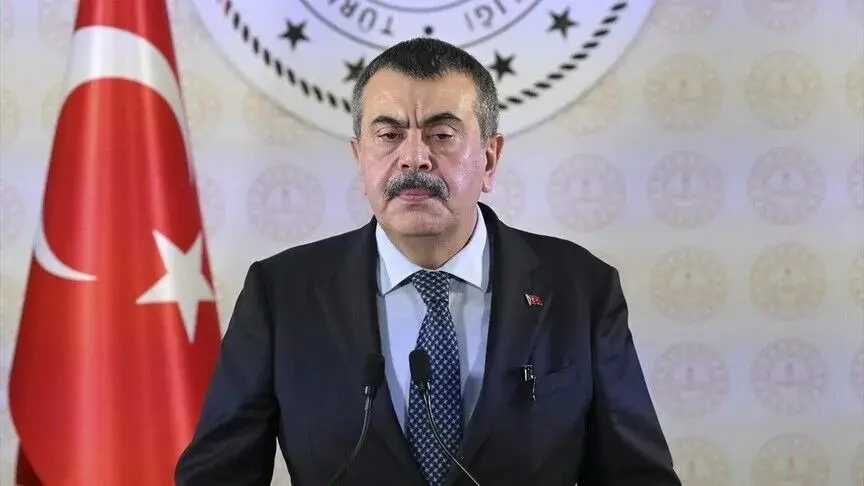
HAKKARI — Turkey’s Minister of National Education, Yusuf Tekin, has announced that the country has reached a historic milestone in its educational standards, emerging as a global leader in academic improvement. Speaking during a comprehensive visit to the southeastern province of Hakkari, Minister Tekin revealed that Turkey is the only country within the Organisation for Economic Co-operation and Development (OECD) to consistently raise its averages across all three core assessment areas—mathematics, reading, and science—in recent international evaluations.
The Minister’s visit to Hakkari was part of a broader initiative by the Ministry of National Education to conduct on-the-ground evaluations of regional educational needs, review local infrastructure investments, and engage directly with educators, administrators, and local youth. The visit underscored the government’s long-term strategy to bridge regional disparities and elevate Turkey’s nationwide academic performance to meet international benchmarks.
Upon arriving in Hakkari, Minister Tekin was received with high-level provincial protocol. He traveled by helicopter to the Fatih Military Base (Fatih Kışlası) in the Yeni Mahalle neighborhood, from where he proceeded by road to the Hakkari Governorate.
At the governorate, the Minister was welcomed by Hakkari Governor İbrahim Taşyapan, Deputy Governors Burak Gürbüz, Bilal Çelik, and Murat Güneş, alongside AK Party Hakkari Provincial Chairman Zeydin Kaya, MHP Hakkari Provincial Chairman Fatih Öztepe, Provincial Director of National Education Nurettin Yılmaz, and various local institutional directors. Local school children greeted the Minister with bouquets of flowers. After signing the Governor’s Honor Book, Minister Tekin presided over a closed-door Provincial Education Evaluation Meeting to review the state of education in the region.
Comprehensive Assessment of Hakkari’s Educational Landscape
Following the conclusion of the evaluation meeting, Minister Tekin held a press conference to share details of the discussions and outline the government’s future plans for the province. He explained that his visit was not an isolated event, but part of a coordinated deployment of the Ministry’s senior leadership to the region.
"Today, we gathered here in Hakkari alongside the heads of our central departments and general directors to conduct a thorough, localized review," Minister Tekin told reporters. He noted that while he was conducting high-level meetings at the governorate, general directors from the Ministry of National Education were dispatched to Hakkari’s various districts to inspect facilities and resolve administrative and operational challenges on site.
"Our general directors visited districts across the province, addressing localized issues directly with school administrators and district officials," Tekin said. "We then concluded our joint meeting, where the Provincial Director of National Education delivered a comprehensive presentation. We listened to our district directors, evaluated the challenges, and formulated concrete solutions to optimize Hakkari’s educational ecosystem."
A Threefold Increase in Hakkari’s Teaching Force
A central focus of the Minister’s address was the dramatic transformation of Hakkari’s educational capacity over the last two decades. Minister Tekin presented comparative data illustrating how targeted investments have fundamentally altered the teacher-to-student ratio in the province since 2002, leading to much more personalized and effective instruction for local students.
"When we look at the numbers from 2002, Hakkari had a total of 1,527 teachers serving the entire province," Minister Tekin explained. "Today, that number has risen to 4,176 teachers. This represents a nearly threefold increase in our human resource capacity in the region."
What makes this increase particularly significant, according to the Minister, is that it far outpaces student population growth during the same period. In 2002, Hakkari’s student population stood at 58,457, whereas today it is approximately 61,000—representing a modest increase of about 3 percent. By dramatically expanding the teaching staff while the student population remained relatively stable, the Ministry has successfully reduced average class sizes and ensured that educators can devote more individual attention to each student.
Infrastructure Overhaul: Over 2,100 New Classrooms Constructed
The expansion of Hakkari’s teaching staff has been accompanied by an equally aggressive school construction program. Minister Tekin provided detailed figures on the physical transformation of the province’s classrooms, highlighting the massive financial investments required to modernize school infrastructure in the mountainous southeastern region.
In 2002, Hakkari possessed only 1,148 classrooms across the entire province. Today, that figure has reached 2,916. "During this period, we constructed and commissioned 2,139 additional classrooms in Hakkari," Tekin announced. "This massive expansion has allowed us to reach an exceptionally strong position regarding both the number of active classrooms and the average number of students per class."
The Minister revealed that the financial investment required to achieve this level of physical expansion was substantial. "The total investment value for the classroom construction and modernization projects we have carried out in Hakkari alone stands at 18 billion Turkish Liras," Tekin stated, emphasizing the government’s commitment to providing state-of-the-art facilities to every corner of the country, regardless of geographical challenges.
Expanding Specialized Facilities, Laboratories, and Creative Spaces
Beyond standard classrooms, the Ministry of National Education has focused on diversifying Hakkari’s educational offerings by building specialized facilities designed to foster scientific inquiry, artistic talent, physical education, and basic student well-being.
Minister Tekin pointed out that in 2002, Hakkari did not have a single Science and Art Center (BİLSEM)—specialized institutions dedicated to supporting gifted and talented students. Today, three fully operational BİLSEM facilities serve the province, offering advanced curricula in science, technology, and the arts.
Physical education and scientific literacy have also seen massive boosts. The number of school gymnasiums in Hakkari has grown from just nine in 2002 to 31 today. Similarly, the number of science and computer laboratories has nearly quadrupled, rising from 52 to 190 over the same period.
Even basic hygiene and comfort facilities have undergone a major upgrade. "In 2002, we had only 39 school toilet facilities across the province; today, we have 170," Minister Tekin noted. "These are not just minor details; they are vital indicators of the comprehensive modernization and dignity we have brought to our schools."
Turkey’s Rising Standing in Global PISA and OECD Metrics
Shifting his focus from local achievements to the national stage, Minister Tekin discussed Turkey’s performance in international education assessments, referencing the OECD’s 2025 Education Report and recent Program for International Student Assessment (PISA) results. He asserted that Turkey’s long-term systemic reforms have yielded unprecedented global success.

"Turkey has reached an outstanding position among OECD countries regarding the reduction of student-to-teacher ratios and classroom density," Tekin said. "According to the OECD’s comparative data, Turkey is now among the countries with the fewest human resource shortages in education, showcasing the success of our teacher recruitment and deployment policies."
This structural progress has translated directly into academic achievement on the global stage. Tekin highlighted Turkey’s trajectory in PISA examinations, which measure the critical thinking and problem-solving skills of 15-year-old students worldwide.
"Turkey is the only OECD member state to simultaneously raise its average scores across all three assessed areas: mathematics, reading literacy, and science," Minister Tekin declared. "To put this in historical context, during the 2003 exams, Turkey could not even break into the top 30 among the 38 OECD countries. Today, in an expanded global assessment featuring 91 participating countries, Turkey proudly ranks within the top 15."
The Turkey Century Education Model: Cultivating Values and Academic Excellence
While celebrating academic and statistical success, Minister Tekin emphasized that Turkey’s educational philosophy extends far beyond exam scores. He argued that a truly successful education system must also serve as the moral and cultural anchor of society.
"Education is not merely a mechanism for academic instruction or test preparation," Tekin asserted. "Our expectation from our national education system is to raise generations who are academically outstanding, but who also embrace our national, spiritual, and moral values. We must cultivate youth who cherish our state and national traditions, and who possess a deep-seated sense of unity, solidarity, and social responsibility."
To achieve this balanced approach, the Ministry has introduced the "Turkey Century Education Model" (Türkiye Yüzyılı Maarif Modeli), a comprehensive curriculum overhaul designed to integrate civic virtues directly into standard academic subjects.

According to Tekin, this model ensures that core principles such as justice, human rights, democracy, social solidarity, and compassion are not taught as isolated electives, but are woven naturally into the fabric of every subject, from mathematics to literature. The ultimate goal, he explained, is to foster a generation that is globally competitive yet deeply rooted in its own cultural identity and constitutional responsibilities.
Strengthening National Unity Through Educational Development
Minister Tekin concluded his address by linking educational progress directly to Turkey’s broader social cohesion and economic development. He stated that reducing regional disparities in education is one of the most effective tools for fostering national solidarity.
"We will continue to be an active part of every step that strengthens Turkey’s unity and brotherhood," Tekin said, expressing gratitude to the local politicians, non-governmental organizations, academics, and teachers who have supported the Ministry’s initiatives. "Through the Turkey Century Education Model, we are committed to raising a generation that respects human rights, values democracy, protects fundamental constitutional liberties, and respects the rule of law."
Following his program at the Hakkari Governorate, Minister Tekin continued his local engagements by visiting the AK Party Hakkari Provincial Presidency to meet with local party members and discuss regional developments. He then proceeded to the historic Meydan Medresesi, a landmark cultural site in the heart of Hakkari, to participate in a "Youth Meeting" (Gençlik Buluşması), where he spoke directly with local students about their aspirations and educational needs.