ISTANBUL — In an era where technological advancement is often criticized for isolating individuals and promoting sedentary lifestyles, a group of Turkish high school students is demonstrating that scientific innovation can be a powerful vehicle for social good and human connection. Organized by the Büyükçekmece District Directorate of National Education under the auspices of the TÜBİTAK Science Fairs Support Program, the "Empati BilimLAB" (Empathy ScienceLAB) fair recently showcased how the next generation of researchers is centering their scientific endeavors on the core values of "goodness" and "empathy."
The science fair, which featured months of rigorous preparation, brought together young minds determined to make a tangible difference in their communities. From developing physical-activity-inducing video games to simulating smart traffic management systems designed to save lives in congested urban areas, the event highlighted the profound impact of combining STEM (Science, Technology, Engineering, and Mathematics) education with social responsibility.
A Collaborative Celebration of Science and Human Connection
The "Empati BilimLAB" festival represents a broader educational philosophy that seeks to bridge the gap between abstract scientific concepts and real-world humanitarian applications. Under the TÜBİTAK Science Fairs Support Program, which aims to encourage young people to conduct research, understand scientific methodology, and develop innovative solutions to local and global issues, the event in Büyükçekmece stood out for its unique focus on emotional intelligence and community welfare.
The scale of the initiative was substantial. More than 50 teachers and over 100 volunteer students collaborated to organize 41 distinct science workshops. The preparation for these workshops was not a hasty endeavor; students and educators had been working continuously since February to design, test, and refine their projects.
Importantly, the fair was designed to be highly inclusive. While high school students took the lead in presenting their research and engineering solutions, the workshops were open to participants ranging from kindergarten to high school. This multi-tiered educational approach allowed older students to mentor their younger peers, fostering a collaborative learning environment where even the youngest children could actively produce and contribute to scientific processes aimed at doing good.
Speaking at the opening ceremony of the event, Büyükçekmece District Director of National Education Zekeriya Artar emphasized the dual purpose of the initiative. "With the workshops organized within the scope of this festival, we aim to encourage our children to embrace science," Artar stated. "However, while doing this, we also want our children to develop a deep sense of empathy."

By centering the fair on empathy, organizers sought to shift the educational narrative from purely technical achievement to socially conscious innovation, proving that the ultimate goal of science should be the betterment of human life.
Getting Gamers Moving: A Motion-Controlled Computer Game
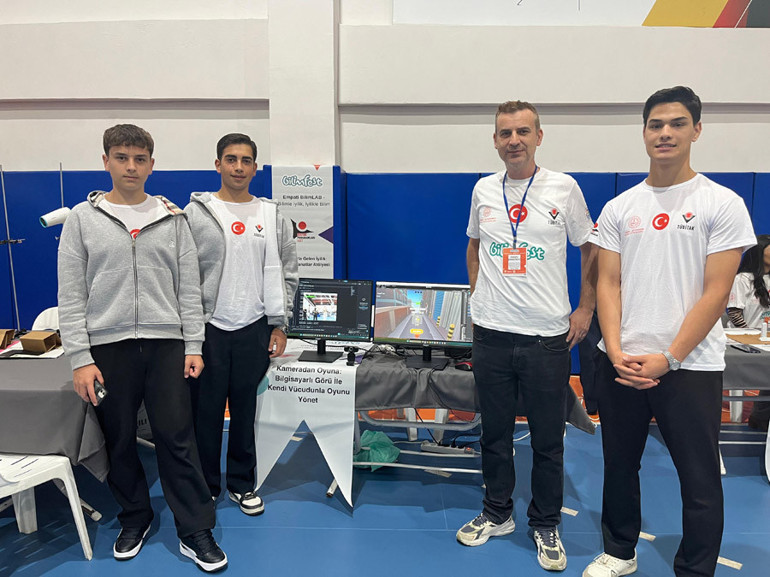
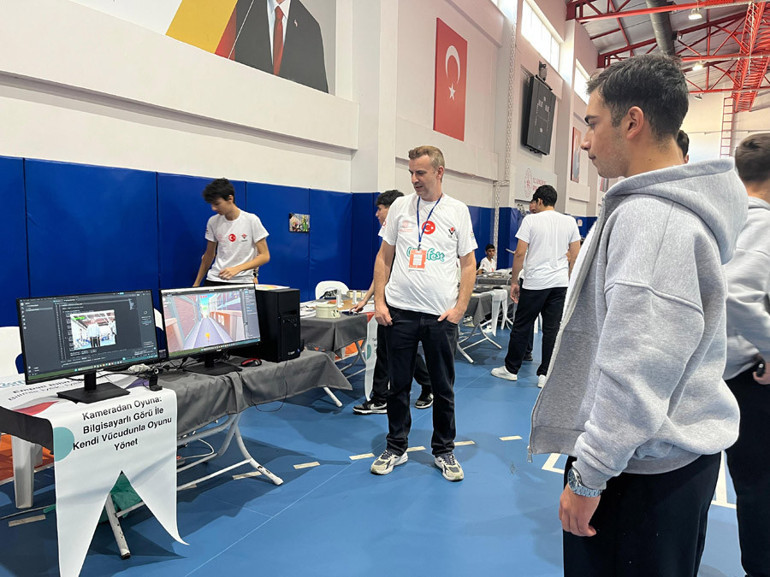
Among the highly anticipated innovations showcased at the fair was a project titled "Kameradan Oyuna" (From Camera to Game), which directly addresses one of the most pressing contemporary health concerns affecting youth: sedentary screen time. In a world where children spend hours sitting in front of computers, this project seeks to turn gaming into an active, health-promoting experience.
Developed by 12th-grade students from the Rosvita – Timur İmrağ Vocational and Technical Anatolian High School under the guidance of Hüseyin Şirinsürücü, a teacher in the Electricity-Electronics Technology Department, the project utilizes camera-based motion-tracking technology to replace traditional controllers. Instead of sitting passively at a desk using a keyboard or mouse, players must use physical body movements to navigate the digital environment.

"With this project, a camera detects the user’s body movements and uses them to direct the character in the game," explained Şirinsürücü, detailing the mechanics of the system. "For example, when the child raises their right arm, the character moves to the right; when they raise their left arm, it moves to the left. For the character to jump, the child must raise both hands in the air, and to make the character duck, the child must physically bend down."
The development process for "Kameradan Oyuna" took between two and three months of continuous coding, calibration, and testing. According to Şirinsürücü, the primary objective was to ensure that even during recreational screen time, children are encouraged to remain physically active, thereby combating the physical stagnation associated with modern video games.
The project received widespread acclaim at the fair, particularly from younger attendees who eagerly participated in the interactive demonstration. By turning physical exercise into a prerequisite for gameplay, the high school developers demonstrated how technology can be re-engineered to support physical well-being rather than compromise it.

A Traffic Synchronization Solution for Emergency Ambulances
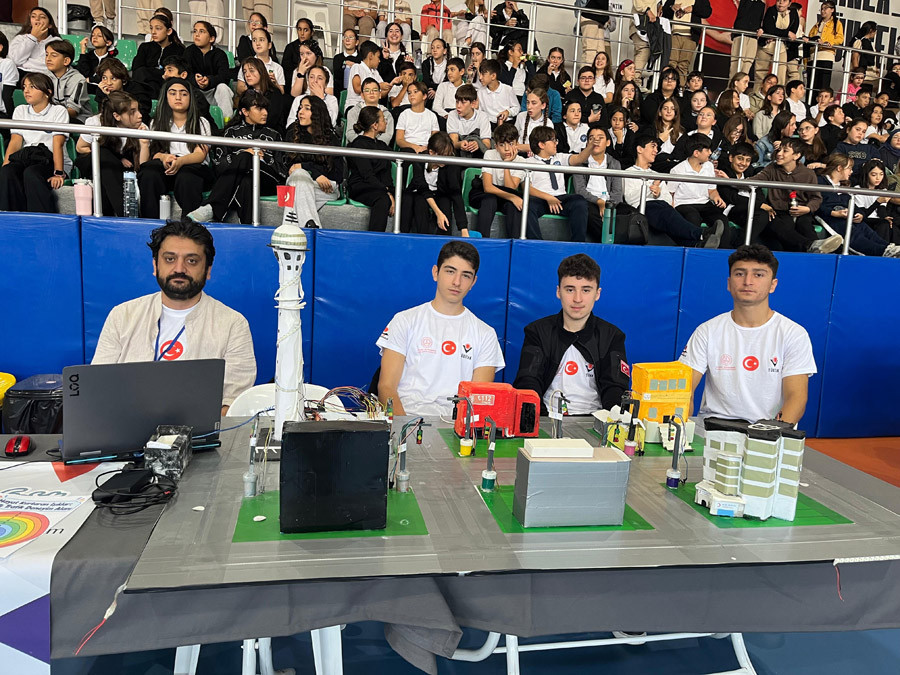
Another standout project addressing a critical public safety issue was a simulated traffic synchronization system designed specifically to aid emergency service vehicles. In major metropolitan areas like Istanbul, severe traffic congestion is not merely an inconvenience; it is a life-threatening obstacle that significantly delays first responders.
Recognizing this critical vulnerability, Yavuz Selim Yılmaz, a student at the Rosvita – Timur İmrağ Vocational and Technical Anatolian High School, partnered with his classmates to design a smart infrastructure solution. The project focuses on dynamically managing traffic lights to create an unobstructed pathway for emergency vehicles.
"Due to the ongoing traffic problem in Istanbul, all emergency vehicles, including ambulances, often arrive at the scene of an incident much later than they should," Yılmaz explained. "To prevent this and save valuable time, we developed a project that requires the reorganization of traffic lights."
The team’s simulated system functions by establishing a direct communication link between emergency vehicles and municipal traffic infrastructure. The moment an ambulance departs from a hospital or dispatch center, the system automatically calculates its route. As the vehicle approaches intersections along its path, the corresponding traffic signals automatically turn green to clear the lane, while cross-traffic signals are switched to red to ensure safe passage.
"If this project is fully realized and implemented on a metropolitan scale, it will make an invaluable contribution to preserving human life," Yılmaz added. By applying engineering principles to the logistical challenges of emergency response, the students showcased how smart-city technologies can be utilized to protect vulnerable citizens during critical medical emergencies.
Uncovering the Botanical Identities of Local Flora
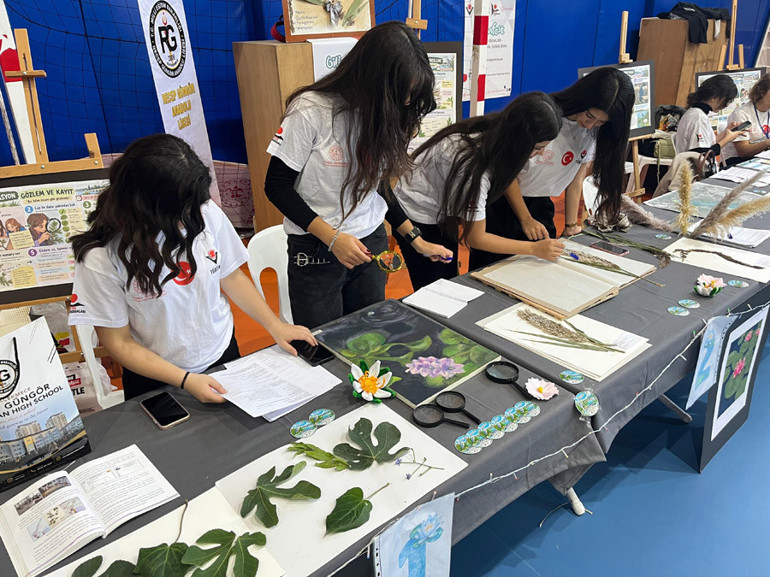
While some students focused on digital technology and urban infrastructure, others turned their attention to environmental preservation and ecological literacy. Students from the Recep Güngör Anatolian High School presented a project dedicated to documenting and preserving the local biodiversity surrounding Büyükçekmece Lake, a vital natural water reservoir and ecological haven in the region.
Esmanur Kaplan, a student at Recep Güngör Anatolian High School, explained the meticulous scientific process she and her classmates undertook to catalog the area’s plant life.
"We carefully examined the unique characteristics of the various plant species we collected from the shores of Büyükçekmece Lake," Kaplan said. "After classifying them, we dried and preserved them. Through this method, our goal was to establish a comprehensive ‘identity card’ for each plant."
The workshop established by Kaplan and her team functioned as a hands-on herbarium laboratory. Visitors to the fair were invited to step into the shoes of botanical researchers, learning the traditional and scientific techniques used to preserve plant specimens, document ecological data, and register biodiversity.
By engaging their peers in the physical process of scientific preservation, the students highlighted the vital role that local ecosystems play in urban environments. The project underscored the idea that empathy is not limited to human-to-human interactions, but also extends to the stewardship of the natural world and the preservation of local habitats for future generations.
Through initiatives like "Empati BilimLAB," the young researchers of Büyükçekmece have shown that when scientific inquiry is guided by empathy, the resulting innovations possess the power to heal, protect, and educate. By addressing sedentary lifestyles, emergency response times, and environmental conservation, these high school students have set a compelling example of how science can be put at the service of humanity.