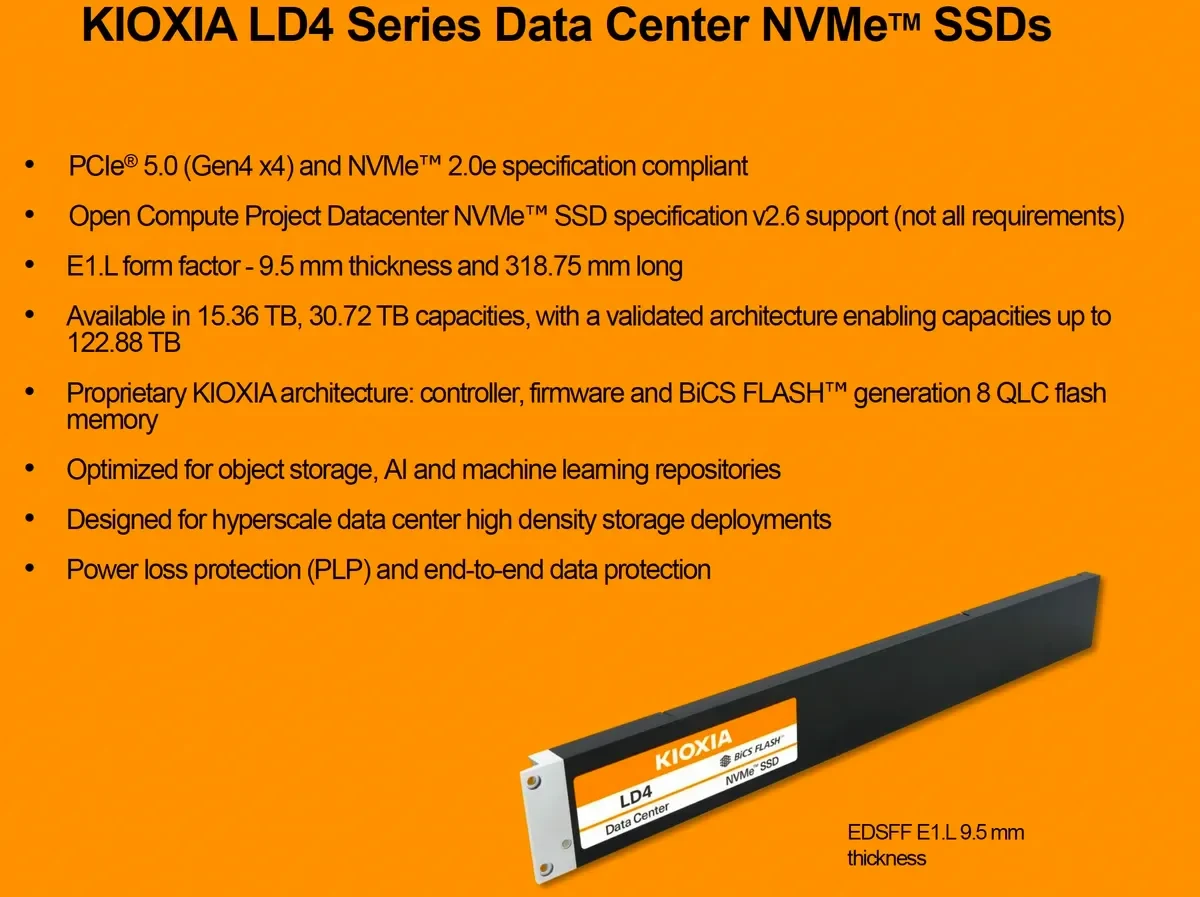
Japanese memory manufacturer Kioxia has formally introduced its new LD4 SSD series, a line of ultra-high-capacity solid-state drives engineered specifically to meet the expanding storage demands of modern enterprise data centers and hyperscale cloud infrastructure. Built using the elongated Enterprise and Data Center Standard Form Factor (EDSFF) E1.L design, the new drive family marks a major milestone for Kioxia as its first dedicated E1.L SSD product line. The series is architected to support storage capacities reaching up to an extraordinary 122.88 terabytes (TB) on a single drive, aiming squarely at read-heavy workloads, massive artificial intelligence data repositories, and scalable cloud environments.
As data center operators worldwide grapple with physical space constraints, rising energy overheads, and the continuous influx of unstructured data generated by machine learning and cloud applications, high-density storage solutions have shifted from a luxury to a operational necessity. The introduction of the LD4 series addresses these challenges by offering a dramatic increase in volumetric storage density, enabling server infrastructure to store substantially more information within the same physical rack footprint.
The LD4 series represents a direct response to the evolving architectural needs of next-generation server platforms. By transitioning away from legacy storage designs, Kioxia aims to provide enterprise clients with a foundation capable of supporting intensive data-handling tasks while streamlining airflow, thermal dissipation, and space utilization in standard server racks.
Technical Details and Capacity Specifications
At the technical core of the Kioxia LD4 SSD series is the company’s eighth-generation BiCS FLASH 3D QLC (Quad-Level Cell) NAND flash memory technology. By utilizing QLC technology, each individual memory cell is capable of storing four bits of data, compared to the three bits stored in traditional TLC (Triple-Level Cell) architectures. This higher bit density allows Kioxia to stack a significantly greater volume of storage capacity within the same physical silicon footprint, serving as the foundational foundation for the series’ massive capacity capabilities.
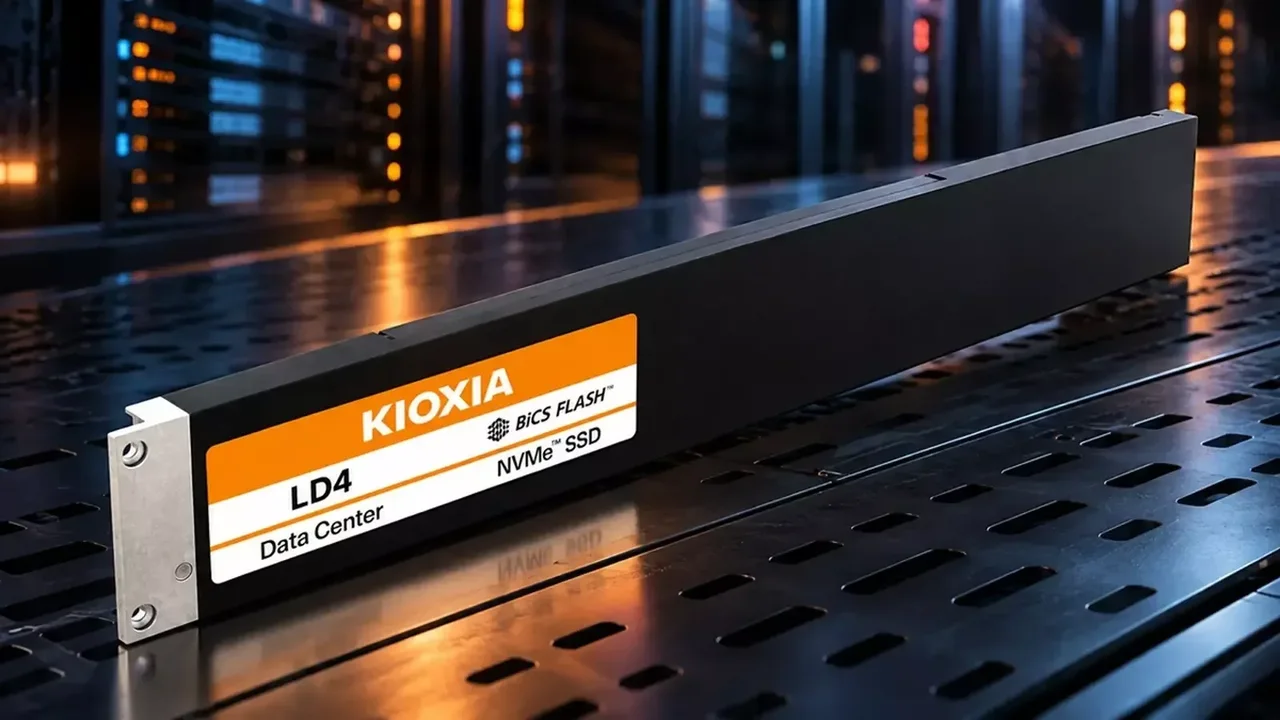
The primary architectural highlight of the LD4 family is its design capability to accommodate up to 122.88 TB of storage capacity on a single drive module. However, Kioxia has clarified that the maximum 122.88 TB variant is not yet commercially available for purchase. Instead, the company confirmed that the underlying drive architecture supporting this extreme density has been fully validated. For immediate qualification and testing purposes, Kioxia has begun shipping working engineering samples of 15.36 TB and 30.72 TB models to select enterprise customers and technology partners.
In terms of physical design, the LD4 series departs from traditional 2.5-inch form factors in favor of the standardized E1.L (EDSFF 1U Long) specification. Drives built to the E1.L standard feature an elongated, thin profile, with physical dimensions measuring 318.75 millimeters in length, 38.4 millimeters in height, and a thickness of just 9.5 millimeters. This extended design provides a substantially larger surface area on the internal printed circuit board (PCB), allowing memory engineers to place a much higher number of NAND flash packages along the length of the drive without exceeding standard height constraints.
The physical parameters of the E1.L form factor are particularly optimized for deployment in 1U server chassis—the standard unit height for rack-mounted enterprise servers. In a typical 1U server configuration, long-format "ruler" SSDs can be inserted vertically or horizontally across the front backplane of the server. This layout allows data center operators to pack dozens of high-capacity drives into a single rack unit, drastically raising the storage density per square foot of server room floor space. Furthermore, the thin 9.5 mm profile facilitates optimized front-to-back airflow through the server chassis, assisting thermal management systems in maintaining safe operational temperatures across dense drive arrays.
From an interface standpoint, the LD4 series features compatibility with the PCIe 5.0 specification, though its operational speed characteristics are tailored to specific bus configurations. The drives operate at data transfer rates equivalent to a PCIe 4.0 x4 link, utilizing four lanes operating at 16 Gigatransfers per second (GT/s) per lane. This configuration yields a theoretical maximum single-direction interface bandwidth of approximately 7.88 gigabytes per second (GB/s).
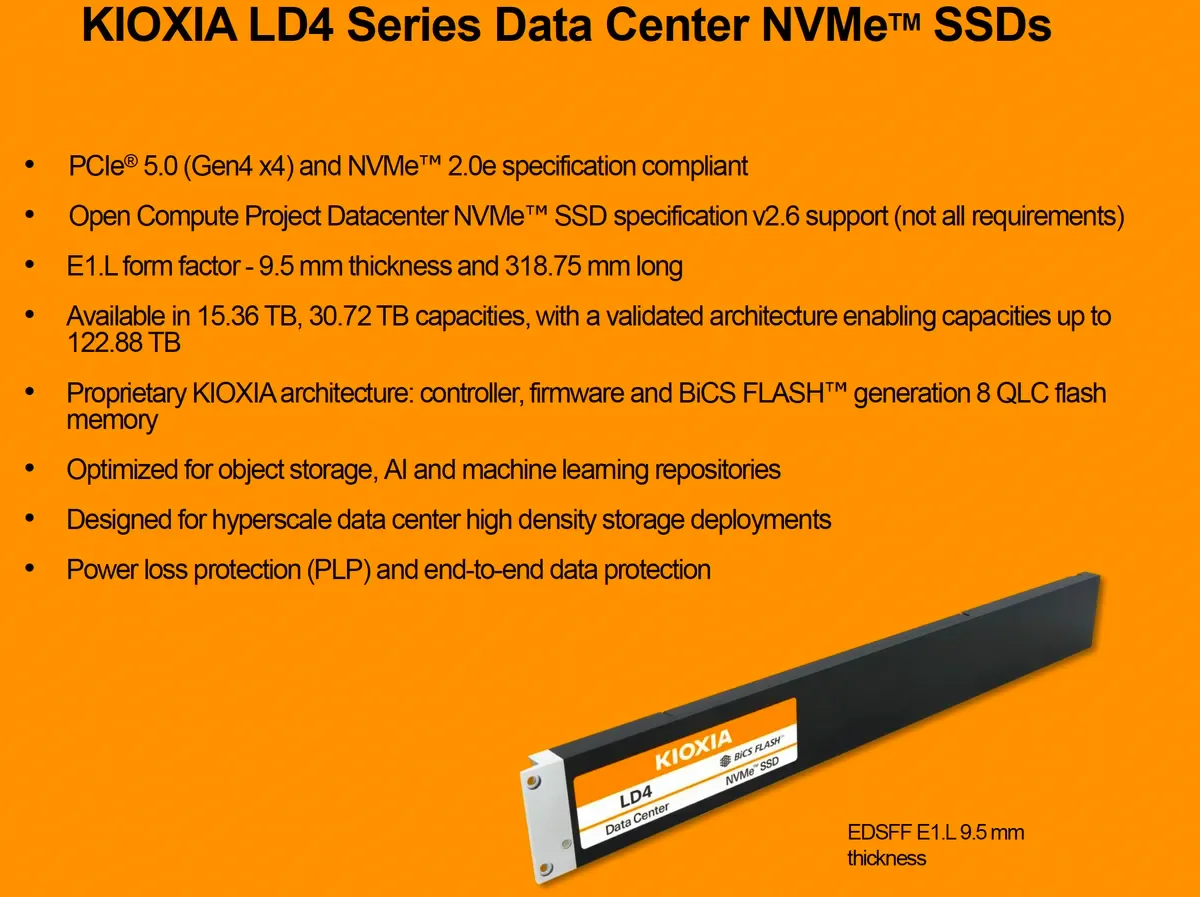
Protocol compatibility is aligned with modern enterprise standards. The LD4 series conforms to the NVMe 2.0e specification, ensuring seamless integration with modern storage management stacks and enterprise operating systems. Additionally, the drives meet the key operational requirements outlined in the Open Compute Project (OCP) Datacenter NVMe SSD Specification Version 2.6. To maintain simplicity and reliability across large-scale server deployments, Kioxia has implemented a single-port connection design for the LD4 drive architecture, tailored for hyper-scale environments that rely on software-defined redundancy rather than dual-port hardware failover paths.
Applications and Future Plans
The Kioxia LD4 SSD series is tailored specifically for enterprise applications where data ingestion, retention, and massive scale outshine constant, intensive drive rewriting. Primary target workloads include large-scale artificial intelligence and deep learning training data lakes, object storage clusters, content delivery networks (CDNs), business intelligence data warehouses, and read-dominant database applications. In these environments, vast quantities of data are written once or periodically updated, but accessed continuously by distributed computing nodes.
Despite revealing the structural and architectural specifications of the LD4 series, Kioxia has withheld several key performance metrics. Detailed benchmarks regarding real-world drive performance remain unreleased. The company has not yet published figures for sequential read and write speeds, random access throughput measured in IOPS (Input/Output Operations Per Second), or read/write latency profiles. Consequently, while the PCIe interface offers a theoretical throughput ceiling of roughly 7.88 GB/s, actual real-world transfer speeds across various file block sizes cannot yet be formally evaluated.
Similarly, endurance and energy efficiency data for the LD4 series have not been fully disclosed. Kioxia has omitted specific figures for Drive Writes Per Day (DWPD), Total Bytes Written (TBW), and operational or idle power consumption metrics. In enterprise data center environments, endurance ratings and power draw per terabyte are critical variables used by system architects to calculate Total Cost of Ownership (TCO), thermal dissipation requirements, and long-term reliability.
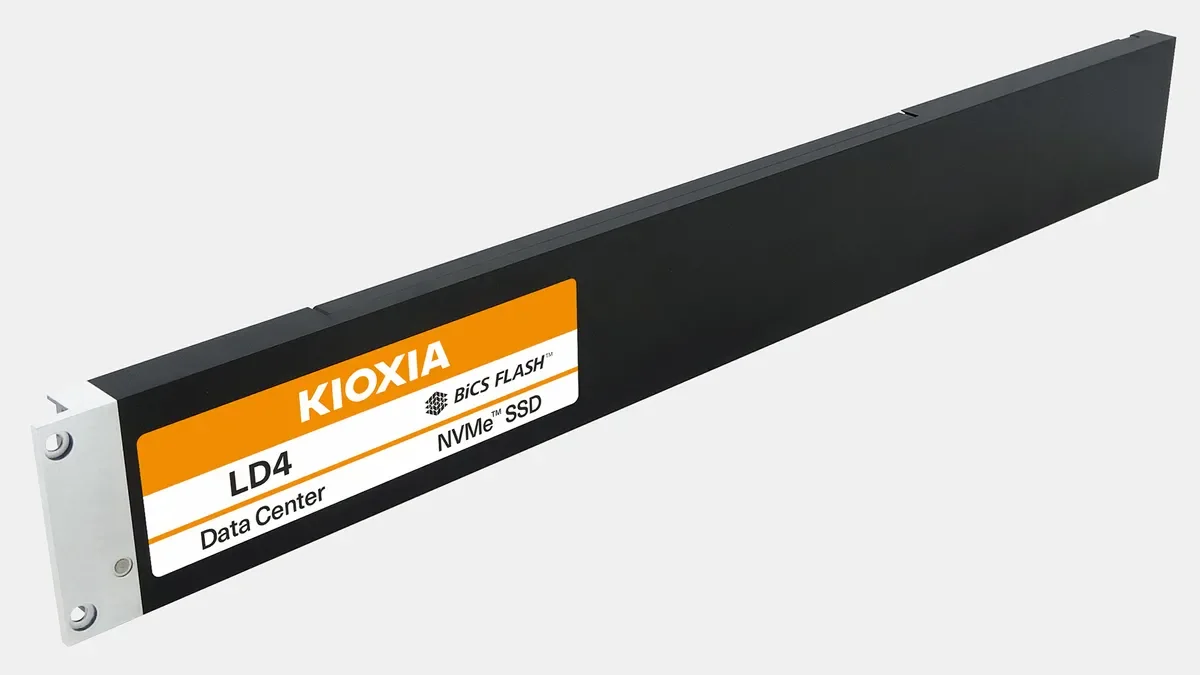
The 15.36 TB and 30.72 TB drive samples currently distributed to select clients serve primarily as functional validation units. These early samples enable enterprise customers, server original equipment manufacturers (OEMs), and cloud service providers to test drive compatibility, validate firmware integration, and evaluate system-level behavior within their custom server hardware environments. Kioxia noted that the technical attributes and firmware profiles of these early evaluation drives may undergo further refinement prior to full commercial mass production.
Industry observers and enterprise clients will gain a closer look at the new storage platform at the upcoming OCP Global Summit, scheduled to take place from October 12 to October 15, 2026, in San Jose, California. Kioxia plans to display the LD4 SSD series during the event, showcasing its design to the broader open-source hardware and hyper-scale data center community.
Kioxia has not yet announced commercial availability dates, mass production schedules, or pricing details for the LD4 SSD series, nor has it provided a specific timeline for when the top-tier 122.88 TB capacity model will hit the market.