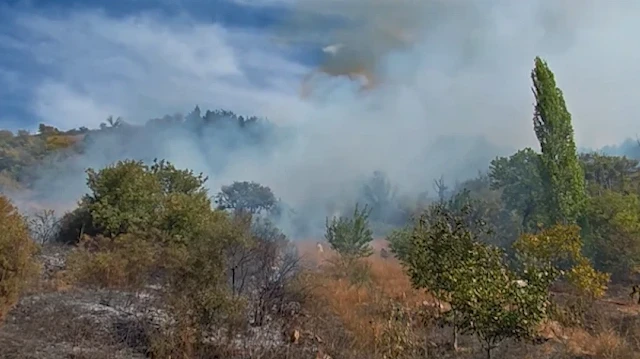
MANİSA — A potentially catastrophic wildfire that broke out along a roadside in the Demirci district of Manisa was swiftly brought under control by local emergency response teams. Thanks to a rapid coordinated effort involving both aerial and ground assets, the flames—which quickly spread from the roadside through agricultural fields and toward dense forest cover—were successfully contained within a single hour, averting a major ecological and public safety disaster.
The incident unfolded on a Monday afternoon in late September, heightening concerns due to the high vulnerability of forested terrain during periods of dry weather. According to the preliminary reports and timeline of events, the fire initially ignited on the shoulder of a local roadway in Demirci. The exact cause of the ignition along the roadside remains under review by local authorities, but typical factors in such incidents often include inadvertent human actions, such as discarded cigarette butts or roadside debris igniting under high ambient temperatures.
Given the rural and semi-agricultural nature of the terrain surrounding the initial ignition point, the flames did not remain confined to the asphalt edge for long. Fueled by dry vegetation and prevailing local winds, the fire rapidly advanced across adjacent agricultural lands. These farming fields, situated immediately adjacent to extensive regional woodland, acted as a dangerous bridge for the advancing blaze. Within minutes of the initial emergency call, the flames reached the boundary of the local forest, threatening to infiltrate deep into the timberlands and spark a widespread, uncontrollable forest fire.
Recognizing the severe threat posed to the region’s ecosystem, local forestry directorate units and municipal firefighting teams were immediately dispatched to the scene. Emergency dispatchers elevated the response level to ensure maximum coverage, deploying a robust combination of ground personnel and aerial intervention units. The integration of air support proved critical in the early stages of the operation, allowing fire suppression teams to drop water loads directly onto the fast-moving front of the fire where ground vehicles faced limited access due to the uneven topography of the agricultural and woodland margins.
Concurrently, numerous fire trucks, water tankers, and crews from the regional firefighting departments established defensive perimeters along the vulnerable forest edges. Firefighters worked under intense pressure to create firebreaks and suppress the leaping flames, executing strategic maneuvers designed to cut off the fire’s advance toward the thicker parts of the forest. The synergy between the aerial water drops and the relentless ground-level suppression efforts choked off the oxygen supply and lowered the temperature of the burning biomass, halting the forward momentum of the wildfire.
After approximately one hour of intensive and coordinated struggle, the combined forces of the forest management teams and local firefighters successfully brought the blaze under control. Officials confirmed that the rapid intervention prevented what could have easily escalated into a devastating environmental crisis, protecting both vital local agricultural assets and expansive tracts of valuable regional forest.
Once the active flames were extinguished, the emergency response teams transitioned immediately into cooling-down operations. Crews thoroughly soaked the charred perimeter, digging into hotspots and monitoring smoldering embers to ensure that sudden flare-ups would not occur under the afternoon sun or changing wind conditions. Following the completion of the cooling phase, the affected area was declared secure, though monitoring teams remained on standby to oversee the zone and prevent any secondary ignition risks.
Local authorities have utilized the incident to reiterate vital warnings regarding roadside fire safety and the heightened risks of ecological damage during sensitive seasonal periods. Residents, motorists, and farmers operating near rural roadways and forested boundaries have been repeatedly urged to exercise extreme caution, avoid any activities that could spark an accidental flame, and immediately report any signs of smoke or unauthorized burning to emergency services.
The successful containment of the Demirci roadside fire stands as a testament to the preparedness, responsiveness, and tactical efficiency of Manisa’s regional forestry and firefighting units, whose swift mobilization successfully turned the tide against a fast-spreading environmental threat and preserved the safety of the local community.