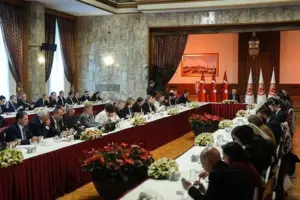
NEW YORK — On the sidelines of the United Nations General Assembly, a gathering of significant geopolitical weight took place as United States President Donald Trump hosted a high-level summit featuring twelve prominent leaders and representatives from across the Middle East. The meeting, held in the heart of New York City, served as a platform for the President to reinforce diplomatic ties and offer a striking public endorsement of Turkish President Recep Tayyip Erdoğan, whom he described in glowing, albeit characteristic, terms.
The assembly brought together a diverse and powerful roster of regional figures, highlighting the complex web of alliances and interests currently defining the Middle East. Among those in attendance were Syrian President Ahmed Shara, the Emir of Qatar Sheikh Tamim bin Hamad Al Thani, King Abdullah II of Jordan, Iraqi Prime Minister Ali Zeydi, and Lebanese Prime Minister Nawwaf Salam. The presence of these leaders, alongside representatives from six other regional nations, underscored the United States’ ongoing efforts to engage with a broad spectrum of Middle Eastern stakeholders during the world’s premier diplomatic forum.
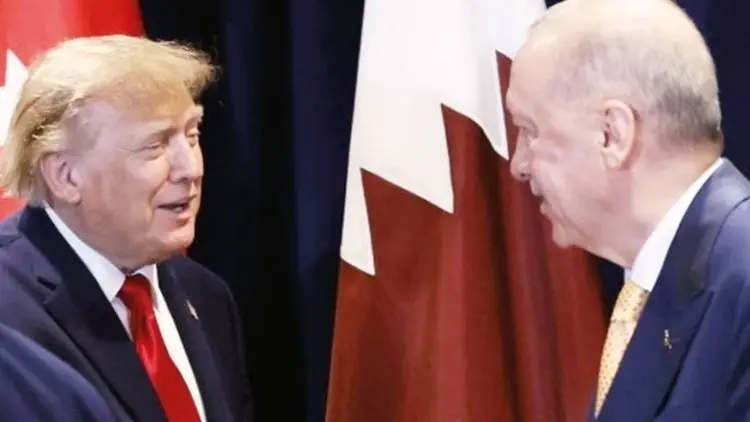
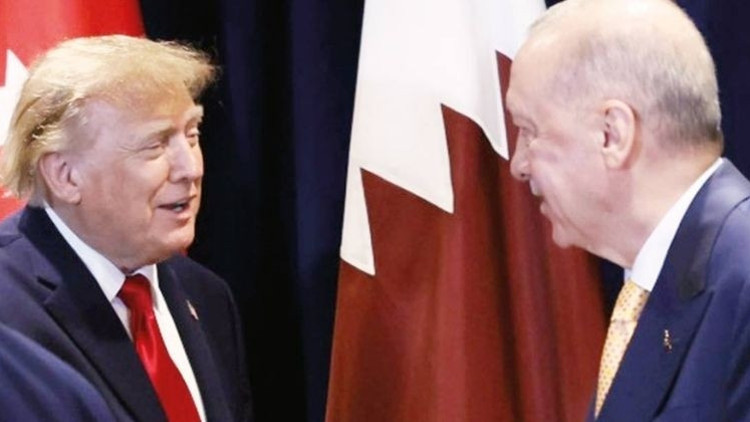
Throughout the session, President Trump focused considerable attention on his relationship with President Erdoğan. Speaking both at the commencement of the meeting and during the subsequent discussions, the American leader spared no effort in praising his Turkish counterpart. Trump’s rhetoric emphasized a personal rapport that has often defined the interactions between Washington and Ankara during his tenure.
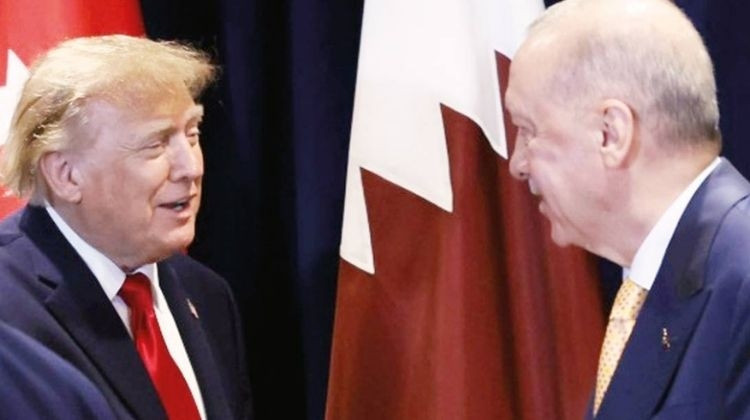
‘Erdoğan is a Great Guy’
The centerpiece of the President’s remarks was a candid assessment of President Erdoğan’s character and leadership style. Addressing the gathered leaders and the press, Trump spoke of the Turkish President not merely as a strategic partner, but as a personal confidant.
"Erdoğan is a close friend of mine," Trump stated, signaling a level of personal chemistry that often bypasses traditional diplomatic formalities. He went on to describe the Turkish leader’s reputation for being a formidable negotiator and a steadfast defender of his nation’s interests. "He’s a tough one," Trump remarked, adding a layer of professional respect to his personal praise. "You can’t deal with him; he’s really tough."
In the lexicon of the American President, the label of "toughness" has frequently been used as a badge of honor for world leaders who command authority and demonstrate resilience on the international stage. Trump’s comments suggested that he views Erdoğan’s uncompromising nature not as an obstacle, but as a quality that commands respect. "He is a great guy," the President concluded, reinforcing his positive outlook on the future of U.S.-Turkish relations.
The warm exchange comes at a time when the relationship between the United States and Turkey continues to be a focal point of global security, particularly regarding North Atlantic Treaty Organization (NATO) cooperation and regional stability in the Eastern Mediterranean and the Levant. By publicly reaffirming his bond with Erdoğan, Trump appeared to be signaling a desire for continued close coordination on these and other critical issues.
A Gathering of Regional Powerhouses
While the rapport between Trump and Erdoğan took center stage, the meeting was equally significant for the breadth of its attendance. The inclusion of twelve regional leaders and representatives indicated a concerted effort by the U.S. administration to address the Middle East as a collective of interconnected interests rather than a series of isolated diplomatic challenges.
The presence of Syrian President Ahmed Shara was particularly noteworthy. As Syria continues to navigate its complex internal and external political landscape, the invitation to a U.S.-hosted summit in New York suggests a shift in the diplomatic engagement surrounding Damascus. Observers noted that the inclusion of the Syrian leadership alongside traditional U.S. allies like Jordan and Qatar points toward a broader strategy of regional reintegration and dialogue.
The Emir of Qatar, Sheikh Tamim bin Hamad Al Thani, and King Abdullah II of Jordan also played pivotal roles in the discussions. Both nations have long served as essential mediators and stabilizing forces in the region. Qatar’s role in international diplomacy and its economic influence, combined with Jordan’s critical position as a security partner and host to significant refugee populations, made their participation vital to the summit’s objectives.
The meeting also featured Iraqi Prime Minister Ali Zeydi and Lebanese Prime Minister Nawwaf Salam, representing two nations that sit at the crossroads of regional competition and internal reform. Their involvement highlighted the summit’s focus on the "Levant" corridor, where economic stability and security cooperation remain top priorities for the international community.

Navigating the Complexities of the Middle East
The summit took place against the backdrop of the annual United Nations General Assembly (UNGA), a time when the streets of Manhattan become the world’s most concentrated hub of diplomacy. For the leaders of the Middle East, the UNGA provides a rare opportunity to engage in "sideline diplomacy"—the informal but often high-impact meetings that occur outside the main assembly hall.
President Trump’s decision to host this specific group of twelve leaders suggests a focus on creating a unified front or at least a clearer channel of communication among regional powers. The discussions were expected to touch upon a wide array of topics, including regional security, counter-terrorism efforts, energy cooperation, and the ongoing economic transitions facing many of the participating nations.
By bringing together leaders from countries that have, at various times, been at odds with one another, the U.S. administration sought to emphasize common goals. The rhetoric of "toughness" and "friendship" used by Trump in relation to Erdoğan may well be the template the administration hopes to apply to other regional relationships—one based on personal respect between strong leaders and a shared commitment to national interests.
The Turkish delegation, led by President Erdoğan, reportedly welcomed the American President’s comments. For Ankara, the public endorsement from the White House serves as a validation of its influential role in regional affairs. Despite occasional friction over specific policy areas, the personal link between the two presidents has historically served as a pressure valve, allowing for the resolution of disputes that might otherwise have escalated through traditional bureaucratic or legislative channels.

The Broader Impact of the New York Zirvesi
As the meetings concluded, the consensus among diplomatic observers was that the summit represented a significant moment of alignment. The image of the U.S. President surrounded by the leaders of Turkey, Syria, Qatar, Jordan, Iraq, and Lebanon provided a powerful visual of the current geopolitical landscape.
The emphasis on President Erdoğan’s "toughness" also serves as a message to the broader international community. It suggests that the U.S. recognizes and respects the assertive foreign policy that Turkey has pursued in recent years. This acknowledgment is crucial as the two nations continue to navigate their roles within NATO and their respective interests in the Middle East.
Furthermore, the participation of leaders like Ali Zeydi and Nawwaf Salam underscores the importance of the "periphery" states in the Middle East. Stability in Baghdad and Beirut is often seen as a prerequisite for broader regional peace, and their inclusion in this high-level dialogue signifies a recognition of their strategic importance.
As the United Nations Summit continues, the ripples from this meeting are expected to influence the various bilateral talks scheduled throughout the week. The "great guy" and "close friend" labels bestowed upon Erdoğan by Trump will likely set the tone for the upcoming interactions between their respective delegations, as they move from the public praise of the summit to the detailed negotiations of policy and security.

The event in New York has once again highlighted that in the world of high-stakes international relations, personal dynamics can be just as influential as formal treaties. With President Trump and President Erdoğan reaffirming their partnership, the geopolitical trajectory of the Middle East appears to be increasingly shaped by the rapport between its most prominent and "tough" leaders.