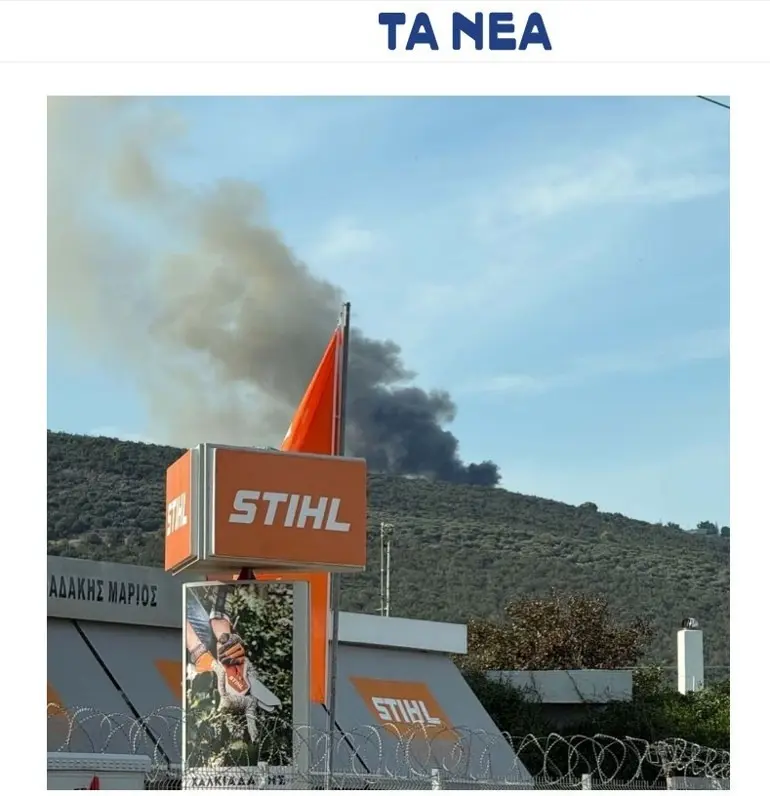
A major fire at the Hellenic Navy’s primary helicopter base in Kotroni has ignited severe controversy across Greece’s defense sector, following allegations that the blaze destroyed critical equipment and irreplaceable spare parts essential for maintaining the country’s naval aviation fleet. While military authorities moved quickly to contain the physical damage and downplay the operational consequences, prominent Greek defense observers have accused the military leadership of enforcing an institutional code of silence to conceal the true scale of the setback.
The incident occurred at the Kotroni Naval Helicopter Base, situated near Marathon in eastern Attica, when flames broke out inside storage facilities housing flammable support materials. In the immediate aftermath, Greek defense publication Militaire published a scathing assessment titled "A Heavy Blow to the Navy," reporting that the destroyed inventory included vital mechanical components and mission systems for both the service’s veteran workhorse helicopters and its newest frontline acquisitions. The outlet sharply criticized the Ministry of National Defence and the Hellenic National Defence General Staff, accusing senior officials of imposing an "omerta"—a strict vow of silence—rather than providing an honest accounting of the logistical fallout.
The controversy comes at a particularly delicate time for the Hellenic Armed Forces, marking the latest in a series of damaging domestic facility crises in recent years that have raised urgent questions regarding infrastructure security, emergency preparedness, and post-incident transparency.
Fire Outbreak at Kotroni Naval Helicopter Base
The fire at the Kotroni facility erupted inside two dedicated storage warehouses designated for flammable materials, sending dense columns of black smoke into the sky that were visible from numerous residential areas and coastal vantage points across Attica. The rapid generation of smoke immediately raised alarm throughout the surrounding district, prompting a coordinated emergency mobilization from both civilian civil protection agencies and military personnel stationed at the installation.
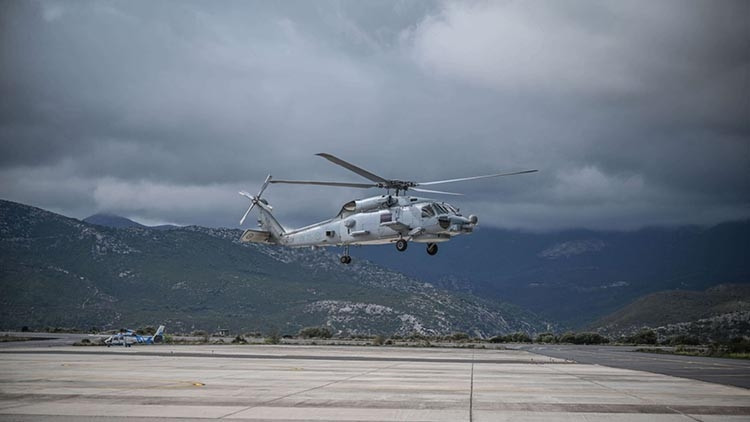
According to operational reports detailed by the Greek daily Ta Nea, civil defense and regional fire services responded with considerable resources to prevent the fire from compromising the wider operational infrastructure of the air station. The firefighting deployment included 35 professional firefighters, two specialized emergency response teams, organized volunteer units, multiple municipal water tankers, and a firefighting helicopter tasked with aerial water drops.
Thanks to the rapid deployment of ground and aerial assets, emergency crews managed to contain and extinguish the flames before the fire could jump to neighboring base structures or ignite the surrounding Mediterranean brush. Authorities officially confirmed that no military or civilian personnel sustained injuries during the blaze or the subsequent containment efforts.
In their initial public statements, military and fire officials stressed that neither of the affected warehouses held active live munitions, eliminating the immediate risk of high-order explosions similar to past military facility fires. Officials also assured the public that the threat of the flames spreading into nearby forested areas or adjoining base infrastructure had been successfully neutralized. An official investigative unit was formally tasked with determining the precise cause of the ignition, examining whether the incident stemmed from an electrical failure, procedural negligence, or environmental factors.
Despite these immediate official assurances regarding site safety, concerns rapidly shifted from the physical containment of the blaze to the nature and strategic value of the materials consumed by the flames inside the two depot buildings.

Militaire: A Severe Blow to Hellenic Naval Aviation
The official narrative of a contained, non-critical industrial accident was swiftly challenged by Militaire, a leading Greek defense news outlet known for its coverage of military affairs and internal armed forces dynamics. In its detailed report, the publication asserted that the fire had inflicted an exceptionally damaging blow on the Hellenic Navy’s operational readiness by gutting stores of specialized hardware, maintenance materials, and components that cannot be easily or rapidly replenished.
According to Militaire, the destroyed inventory directly impacts two cornerstone platforms of the Hellenic Navy’s airborne maritime component: the long-serving Agusta-Bell AB 212 anti-submarine warfare helicopters and the recently acquired, state-of-the-art Sikorsky MH-60R Seahawk (Romeo) multi-mission helicopters.
The loss of components for the legacy AB 212 fleet represents a particularly acute logistical crisis. Having served the Hellenic Navy across several decades, these twin-engine maritime helicopters rely on supply chains that have largely dried up globally. The publication emphasized that spare parts, replacement assemblies, and specialized avionics for the aging AB 212 platform are now exceedingly scarce on the international defense market, with certain mission-critical items being virtually impossible to procure from original manufacturers or secondary vendors. For an armed service that relies heavily on its existing helicopter inventory to maintain continuous surface surveillance and anti-submarine patrol coverage throughout the Aegean and eastern Mediterranean, the permanent loss of these reserves leaves the operational future of the AB 212 airframes severely compromised.
Simultaneously, the fire reportedly consumed significant inventories of equipment and spare parts earmarked for the navy’s brand-new MH-60R Romeo fleet. The MH-60R represents the centerpiece of Greece’s modern naval aviation modernization program, designed to provide advanced sensor fusion, anti-submarine combat capabilities, and network-centric warfare integration alongside modern surface combatants. While Militaire noted that replacement parts for the modern MH-60R platform remain available through active production lines and allied defense supply channels, acquiring them to replace the burned stock will require substantial and unplanned financial outlays. The financial strain is compounded by extended procurement lead times, leaving brand-new airframes potentially vulnerable to maintenance delays.

Militaire directed its sharpest criticism toward the political and military leadership, asserting that the Ministry of National Defence and the General Staff had deliberately closed ranks rather than acknowledging the logistical damage. The outlet characterized the leadership’s total lack of substantive public disclosure as an institutional "omerta"—an organized silence designed to deflect political accountability and prevent public scrutiny over how vital military assets were stored and protected. The publication further contended that the fire at Kotroni represents merely the latest link in an ongoing chain of opaque, insufficiently explained incidents that have undermined the operational integrity of the Greek military in recent years.
To underscore this systemic concern, Militaire drew a direct parallel between the Kotroni fire and the disaster that struck the Stefanovikeio Army Aviation Base three years earlier during Storm Daniel. During that extreme weather event, extensive flooding inundated the inland airfield, resulting in the submersion and loss of numerous AH-64 Apache attack helicopters. The outlet pointed out that years after the disaster, defense authorities have still failed to release an authoritative, detailed accounting of the exact number of Apache gunships permanently decommissioned or damaged during the flooding, maintaining an informational blackout that mirrors the current handling of the Kotroni fire.
The Shadow of the Nea Anchialos Ammunition Disaster
The concerns raised in the wake of the Kotroni incident are heavily informed by memory of the catastrophic events that unfolded at the Nea Anchialos Air Base in July 2023, an event that remains one of the most serious base safety breaches in modern Greek military history.
Located approximately 25 to 30 kilometers from Stefanovikeio, near the coastal city of Volos, Nea Anchialos serves as the home installation for the Hellenic Air Force’s 111th Combat Wing, a premier operational hub housing multiple squadrons of F-16 Fighting Falcon multi-role aircraft. During the ferocious wildfires that swept through the Magnesia prefecture in mid-2023, encroaching flames successfully penetrated the perimeter of the air base and reached an above-ground ammunition storage complex.

The heat and flames triggered massive, uncontrolled secondary detonations of stored ordnance, including heavy general-purpose aerial bombs and precision-guided missile components designated for the F-16 fleet. The sheer magnitude of the explosions shattered windows across surrounding municipalities, prompted widespread panic, and forced the emergency evacuation of thousands of civilians from nearby communities by land and sea.
The failure to maintain adequate defensive firebreaks around the munitions depot at the 111th Combat Wing forced the Hellenic Air Force to carry out an emergency tactical redeployment, scrambling dozens of frontline F-16 fighters from Nea Anchialos to the alternative air base in the city of Larissa to shield the aircraft from shrapnel, shockwaves, and encroaching flames. The incident led to immediate disciplinary measures, official investigations, and intense political fallout over the evident gaps in basic facility defense against seasonal hazards.
While authorities at Kotroni were quick to emphasize that no explosive ordnance was present in the burning storage buildings, the structural parallels between Nea Anchialos, Stefanovikeio, and the recent fire at the naval helicopter base have intensified scrutiny among military analysts. Across all three episodes, vital defense infrastructure and strategic platforms—whether frontline strike fighters, attack helicopters, or maritime naval helicopters—faced severe operational jeopardy not from hostile enemy action, but from peacetime safety lapses, environmental vulnerability, and facility management failures.
With independent defense observers continuing to demand clarity regarding the specific inventories lost in the Kotroni storehouses, the incident has renewed pressure on the Hellenic National Defence General Staff to address long-standing questions regarding logistics management, base protection standards, and institutional transparency.