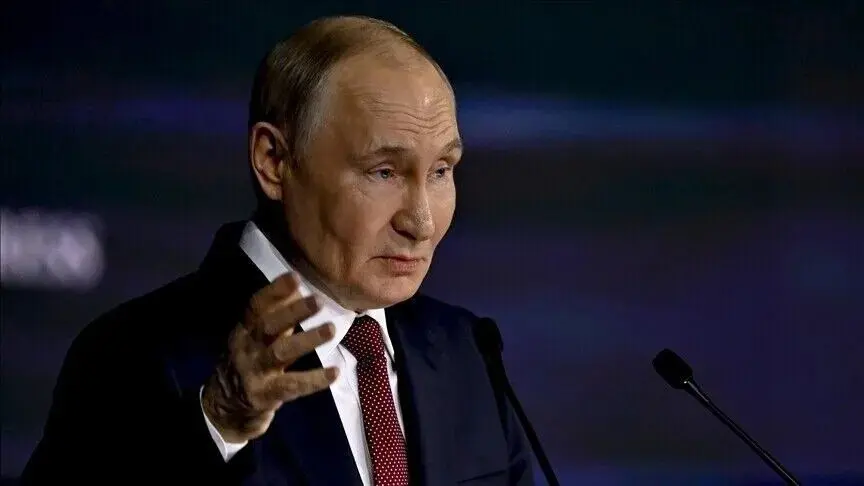
Russian President Vladimir Putin has announced that Moscow is prepared to supply crude oil and refined petroleum products to the United States and international markets following direct discussions with U.S. President Donald Trump.
MOSCOW — Russian President Vladimir Putin has confirmed that the Russian Federation is prepared to supply crude oil and refined petroleum products to the United States and broader global energy markets. The announcement, released via an official statement bearing Putin’s signature on the Kremlin’s website, follows a high-level telephone conversation between the Russian head of state and U.S. President Donald Trump.
The exchange between the two leaders addressed urgent developments in global energy security, the status of bilateral relations, and pressing geopolitical conflicts, underscoring an unexpected diplomatic and economic convergence aimed at stabilizing international fuel supplies.
According to the Kremlin’s formal readout of the call, the leaders dedicated significant attention to international energy balances and the pricing pressures confronting consumers worldwide. In his published statement, President Putin highlighted Russia’s capacity and willingness to play an active role in easing global supply constraints.
"The Russian side confirmed its readiness to supply oil and petroleum products to the United States and world markets," Putin stated. He emphasized the broader economic implications of the move, adding, "I believe this will have a positive impact on the global economy as a whole."
A Phased Framework for Diesel Exports
The Kremlin’s confirmation aligns directly with details previously disclosed by President Donald Trump regarding an agreement reached during the high-level dialogue. Speaking earlier on the matter, Trump revealed that negotiations had centered heavily on securing critical refined fuel supplies, specifically diesel fuel, through a structured, multi-stage delivery schedule designed to inject immediate liquidity into strained distribution networks.
Under the framework outlined by Trump, Russia is slated to begin by delivering an initial shipment exceeding 300,000 metric tons of diesel fuel destined for the United States and global markets. The logistical timeline anticipates a substantial expansion during the subsequent phase, with an additional 500,000 metric tons planned for delivery across November. Following the execution of these initial tranches, the agreement envisions scaling supply volumes further, reaching up to 1 million metric tons of diesel fuel.
Diesel fuel represents an indispensable pillar of modern economic activity, serving as the primary fuel source for commercial trucking, railway freight, agricultural machinery, maritime shipping, and heavy industrial operations. Extended shortages or sharp price spikes in middle distillates historically translate into rapid upward inflationary pressure on consumer goods, logistics networks, and food production. The structured introduction of Russian diesel into global commercial streams is intended to address these acute market pressures directly, offering immediate supply buffers to commercial markets.
Regulatory Facilitation via U.S. Treasury Licensing
The practical execution of an energy arrangement of this scale necessitates coordinated regulatory adjustments within the United States. In conjunction with the announcement of the bilateral understanding, the U.S. Department of the Treasury confirmed plans to issue a temporary general license.
The administrative measure is specifically crafted to permit the entry and distribution of Russian diesel fuel into global commercial channels without subjecting participating market actors, shippers, insurers, or financial intermediaries to punitive regulatory measures. General licenses issued by the Treasury Department serve as critical compliance mechanisms in international trade, providing the clear legal architecture necessary for commodity shipments to navigate existing regulatory hurdles.
By granting temporary general licensing for Russian diesel, Washington establishes a formal mechanism allowing domestic and international market participants to engage in purchasing, transporting, and distributing these specified energy volumes. The measure highlights an acknowledgment by economic policymakers that maintaining stability across international energy distribution networks requires targeted flexibility, especially regarding refined petroleum products that directly impact everyday industrial and commercial logistics.
Broader Diplomatic and Geopolitical Agenda
Beyond the specific parameters of the energy supply initiative, the telephone conversation between Putin and Trump encompassed an expansive review of key geopolitical files that have heavily strained international relations in recent years.
Foremost among these topics was the ongoing conflict in Ukraine. According to President Putin, the discussion featured an exhaustive examination of potential pathways and modalities directed toward achieving a comprehensive resolution to the Ukraine crisis. The Kremlin’s readout noted that both leaders evaluated the prospects for resolving the crisis, signaling an openness to engage on structural solutions to end the hostilities.

In addition to European security matters, the leaders turned their attention to the volatile situation surrounding Iran. The strategic developments in the Middle East, along with the evolving status of regional stability and nuclear proliferation concerns, were reviewed as critical components of the broader global security architecture. The dialogue also covered various dimensions of the bilateral relationship between Washington and Moscow, which had reached unprecedented levels of estrangement over recent years.
Institutional Coordination and Direct Channels of Communication
A central outcome of the high-level exchange was a mutual commitment to institutionalize continued dialogue between the two nations across multiple levels of governance. President Putin underscored that he and President Trump explicitly agreed on the necessity of preserving direct, leader-to-leader contacts moving forward.
Furthermore, the leaders agreed that diplomatic and operational engagement would not remain confined strictly to head-of-state interactions. Putin noted that sustained working-level cooperation will continue between the respective presidential administrations, intelligence agencies, and other specialized governmental bodies.
The maintenance of direct channels between presidential administrations ensures a conduit for managing daily diplomatic friction and monitoring the implementation of bilateral arrangements, such as the agreed energy tranches and regulatory licenses. Concurrently, operational contact between intelligence and security services provides an essential mechanism for risk mitigation, conflict prevention, counterterrorism coordination, and strategic stability discussions.
The agreement to maintain these multi-tiered communication lines represents an important procedural framework for both nations. By formalizing ongoing communication across specialized departments, Moscow and Washington seek to create regular working mechanisms capable of handling complex trade logistics, monitoring compliance with regulatory waivers, and navigating sensitive geopolitical crises concurrently.
Economic Stabilization and Future Prospects
President Putin’s assessment that Russian energy deliveries will yield positive consequences for the broader global economy reflects persistent concerns among international policymakers regarding energy market volatility. High fuel prices and refinery capacity bottlenecks have exerted sustained pressure on supply chains across both developed and emerging economies.

The infusion of hundreds of thousands of tons of refined fuel into international maritime and supply routes—culminating in the projected 1-million-ton threshold—aims to stabilize inventory levels and temper extreme pricing swings. For global buyers and domestic markets alike, the certainty of reliable refined product deliveries provides welcome predictability for transport operators and freight carriers who have operated under tight inventory conditions.
As the implementation phase begins, international market observers and commercial stakeholders are closely watching the formal publication of the U.S. Treasury Department’s temporary general license to understand the precise operational boundaries and compliance criteria governing the shipments. The logistical execution of the initial 300,000-ton shipment, followed by the planned November ramp-up, will serve as the first tangible test of the agreement’s operational viability.
Through this combination of high-level diplomacy, targeted regulatory licensing, and pragmatic energy market intervention, the dialogue between the Russian and U.S. leadership marks a substantial turn in international energy management, with direct implications for global supply chains, market stability, and diplomatic engagement across key global theaters.