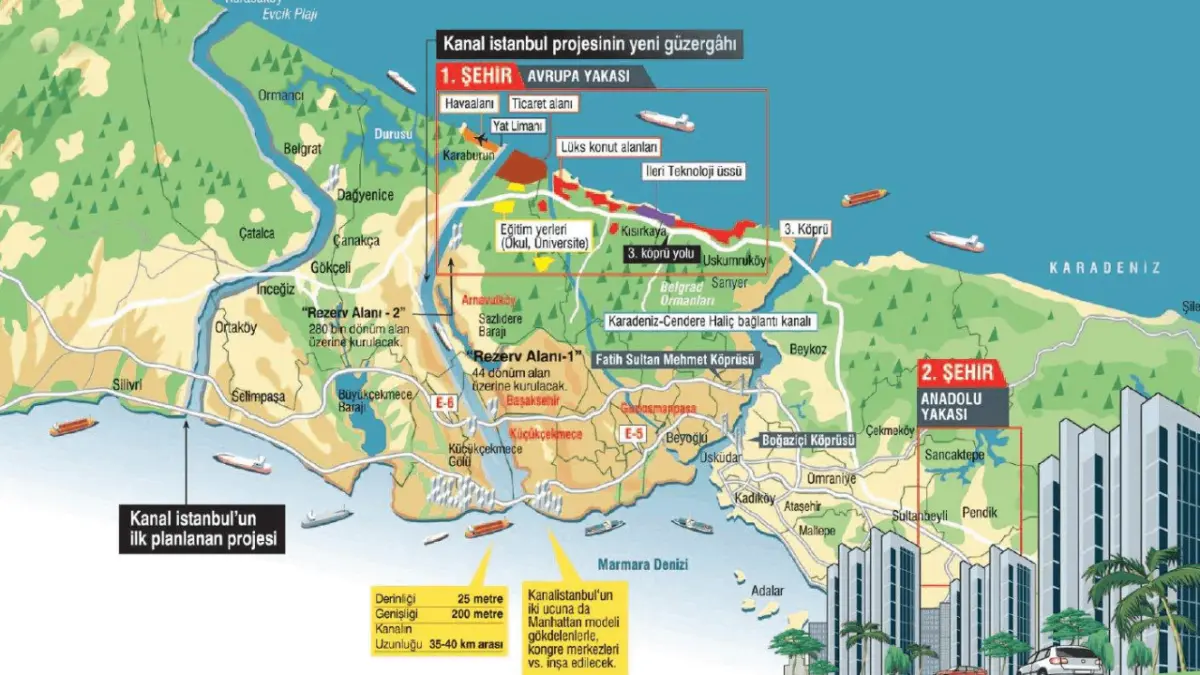
ISTANBUL — In a major legal setback for one of Turkey’s most debated mega-infrastructure undertakings, an Istanbul administrative court has formally annulled key zoning and spatial development plans designated for the multi-billion-dollar Kanal Istanbul project and its accompanying "Yenişehir" (New City) development.
The ruling, delivered by the Istanbul Administrative Court, struck down the project’s overarching environmental planning decisions, pointing to critical procedural deficiencies, the absence of necessary technical infrastructure evaluations, and a failure to abide by statutory urban planning principles. Specifically, the judiciary underscored that the planning framework had been improperly drafted as a localized "plan modification" rather than a comprehensive "plan revision," while completely lacking an essential urban technical infrastructure assessment report.
The decision has been hailed by opponents as a significant victory for urban conservation, environmental sustainability, and administrative oversight. The Istanbul Metropolitan Municipality (İBB), which has long opposed the artificial shipping corridor through legal challenges, underscored that the verdict severely weakens both the legal scaffolding and the environmental justifications behind the mega-project.
Istanbul Mayor Ekrem İmamoğlu welcomed the verdict in a public address shared via social media, framing the judicial intervention as an essential barrier against ecological degradation.
"The judiciary has once again said ‘stop’ to the Kanal Istanbul and Yenişehir project," İmamoğlu stated. "In the lawsuit filed, both the reserve building area declaration and the master Environmental Plan were canceled in terms of urban planning principles. Istanbul has its guardians to protect Istanbul and the entirety of the Marmara region. Everyone must read the striking findings of the court."
In an official statement released shortly after the verdict, the Istanbul Metropolitan Municipality echoed the mayor’s sentiments, noting that the ruling explicitly demonstrates that the legal and ecological premises upon which Kanal Istanbul was built are profoundly flawed, lacking the scientific diligence required for interventions of this scale.
Inadequate Scientific Analyses and Unchecked Urban Expansion
In the comprehensive justification accompanying its verdict, the administrative court delivered a detailed critique of the administrative mechanisms utilized to advance the project. Chief among the court’s concerns was the designation of the project corridor as a "reserve building area."
Under Turkish urban development statutes, the "reserve building area" classification is primarily intended to serve as a legal instrument for urban renewal and disaster risk mitigation—facilitating the relocation of residents from earthquake-vulnerable zones into safer, planned neighborhoods. However, the court determined that the authorities had diverted this mechanism far from its statutory objective. Instead of facilitating genuine seismic resilience and urban renewal, the reserve status was leveraged as a legal pretext to open pristine, irreplaceable natural zones to expansive commercial and residential developments.
The court noted with grave concern that the designated reserve zones encompass some of Istanbul’s most ecologically fragile assets, including vital water basins, active agricultural lands, and dense forest tracts. The judicial panel concluded that the declaration of these areas as construction reserves was executed without the requisite scientific baseline studies, geotechnical assessments, or thorough inter-agency evaluations.
Following the invalidation of the reserve area status, the court similarly annulled the corresponding 1/100,000 scale Environmental Plan (Çevre Düzeni Planı) modification, which had been structured on the basis of that now-defunct designation.
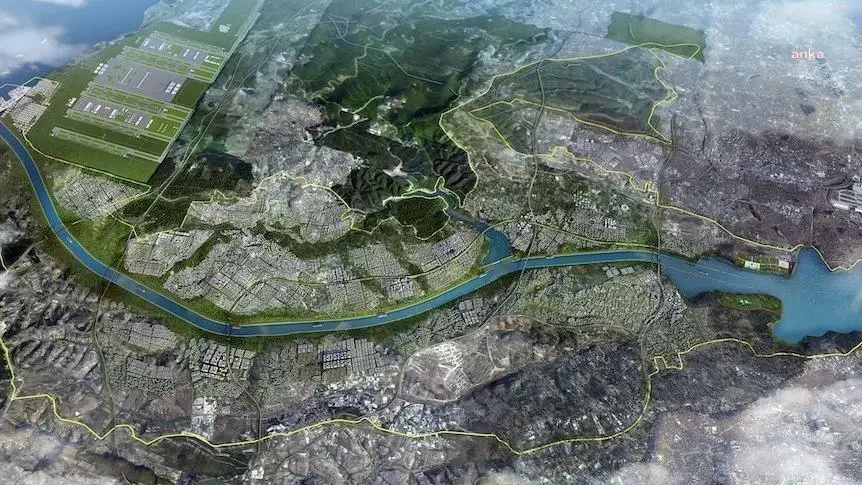
The court ruled that the alterations made to the 1/100,000 scale master plan were fundamentally incompatible with urban planning principles and directly violated the broader doctrine of "public interest." The judges cited significant procedural and substantive violations throughout the planning cycle, noting that opinions from relevant public and municipal institutions were either bypassed or left incomplete. Furthermore, the authorities failed to prepare detailed infrastructure viability reports capable of demonstrating how the region’s transport, water, sewage, and energy grids could withstand the immense pressures of a new satellite metropolis.
By introducing massive spatial alterations through piecemeal amendments rather than undertaking an exhaustive, holistic revision of the regional master plan, the administrative bodies were found to have dismantled the integrity of Istanbul’s environmental planning architecture.
Legal analysts and urban planning experts emphasize that the judicial invalidation of the reserve building area status carries cascading legal ramifications. Because the entire hierarchy of lower-tier zoning plans—including 1/5,000 scale master development plans and 1/1,000 scale implementation plans—draws its administrative authority from the overarching 1/100,000 scale master plan and the initial reserve designation, the court’s decision strips all subordinate planning instruments related to Kanal Istanbul of their legal foundation.
As a direct consequence of the ruling, the administrative and statutory framework governing the project has been effectively rendered void, obligating relevant ministries and planning bodies to halt current implementations and thoroughly re-evaluate every phase of the project’s planning and execution processes. The court’s judgment established that, given the severe environmental risks, unresolved infrastructure deficits, and permanent hazards posed to water security and natural ecosystems, the project in its current form fails to satisfy the foundational legal threshold of public interest.
Broader Ripple Effects Across Ongoing Litigation
The ruling from the administrative judiciary is anticipated to exert a decisive influence over several other parallel legal challenges currently progressing through the Turkish court system. The Istanbul Metropolitan Municipality, along with numerous professional chambers, environmental organizations, and civic groups, has mounted dozens of legal battles targeting various environmental impact assessments, zoning approvals, and expropriation decrees connected to the canal route.
In another major lawsuit spearheaded by the Istanbul Metropolitan Municipality, an independent expert panel (bilirkişi) appointed by the judiciary recently submitted an assessment firmly aligned with the municipality’s objections, highlighting catastrophic risks to Istanbul’s potable water reservoirs, ecological balance, and regional demographic stability. Legal observers widely expect that subsequent court decisions will follow the precedent reinforced by the latest annulment, potentially bringing the entire administrative apparatus surrounding the waterway to a legal standstill.
The ambitious and fiercely contested Kanal Istanbul project was initially conceptualized as an artificial sea-level waterway running parallel to the Bosphorus Strait, connecting the Black Sea to the Sea of Marmara. First championed as a means to alleviate maritime traffic and mitigate vessel collision risks along the narrow Bosphorus, the project quickly evolved into a massive real estate and urban development initiative spanning tens of thousands of hectares across Istanbul’s western periphery.
According to previously disclosed official specifications, the proposed artificial canal was designed to span approximately 45 kilometers (28 miles) in length, featuring a minimum base width of 275 meters and a navigable depth of 20.75 meters. The overall projected financial cost of the undertaking was publicly cited by Turkish President Recep Tayyip Erdoğan at approximately $15 billion, though independent economists and urban planners have repeatedly warned that the true capital expenditure, coupled with secondary infrastructure outlays, could rise significantly higher.
Physical groundwork tied to the broader project network officially commenced in June 2021 with a ceremonial groundbreaking for the 860-meter-long Sazlıdere Bridge, a major transit structure designed to traverse the planned canal route as part of the Northern Marmara Motorway integration. However, substantive excavation along the primary waterway corridor has faced chronic financial hurdles, logistical challenges, and sustained municipal and civic resistance.
With the administrative court’s decisive cancellation of the project’s master environmental zoning and reserve area declarations, the regulatory future of the waterway faces unprecedented uncertainty. The ruling reinforces the necessity for rigorous scientific accountability, statutory urban planning conformity, and institutional consultation, compelling state planners to reconsider whether a project of such transformative scale can legally proceed against the backdrop of mounting judicial and ecological resistance.