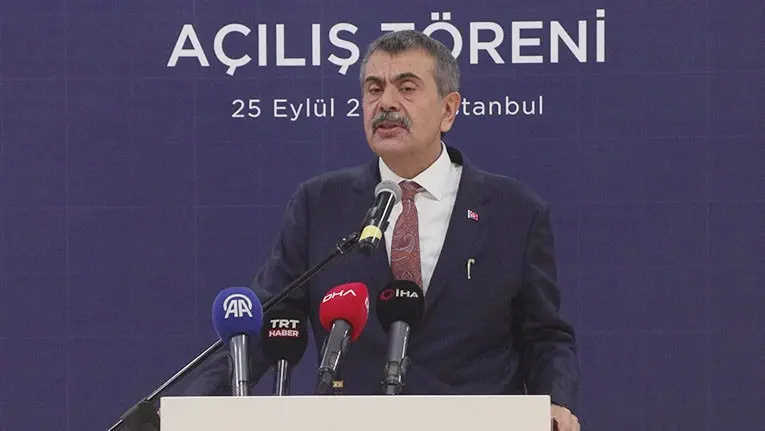
ISTANBUL — In a significant address highlighting the sweeping structural changes in Turkey’s educational landscape, National Education Minister Yusuf Tekin announced that 45 out of every 100 middle school graduates in the country chose to enroll in vocational high schools this year. Speaking at the official opening ceremony of a specialized defense industry high school in Istanbul’s Şile district, Minister Tekin emphasized that the overall average enrollment rate in vocational and technical education has now reached 43 percent nationwide, marking a historic milestone for the country’s vocational training system.
Minister Tekin’s remarks came during his official visit to the Şile district on September 25, 2026. As part of his program, the Minister first visited the Şile Municipality, where he met with Deputy Mayor Sacit Terzi and municipal staff to receive updates on ongoing local projects and administrative initiatives. Following the municipal visit, Minister Tekin attended the formal opening ceremony of the Şile Ayet Azar Aran Defense Industry Vocational and Technical Anatolian High School, an institution designed to prepare students for careers in Turkey’s rapidly growing defense and technology sectors.
During his keynote address at the opening ceremony, Minister Tekin reflected on the extensive reforms implemented over the last two decades, contrasting past educational challenges with contemporary achievements, and highlighting Turkey’s rising international standing in global education benchmarks.
Nearly 200 New Schools Awaiting Official Opening in Istanbul
Addressing the rapid expansion of educational infrastructure in the country’s largest metropolis, Minister Tekin revealed that there is a massive backlog of newly completed schools in Istanbul ready to begin operations.
"In Istanbul alone, we have nearly 200 schools that are physically complete and waiting for us to hold their official opening ceremonies," Minister Tekin stated. "According to our most recent data, the exact figure stands at just over 180 institutions. We plan to organize a collective opening ceremony for these schools in the near future, coordinated with the schedule of our Honorable President, Recep Tayyip Erdoğan, when his program permits."
This infrastructure boom is part of a sustained, long-term effort to expand classroom capacity, modernize existing facilities, and keep pace with the demographic demands of Istanbul’s growing student population. Minister Tekin framed this achievement as part of a broader historical transition, noting that the physical conditions under which Turkish children study today are incomparably superior to those of previous decades.
To illustrate this shift, the Minister shared a poignant historical anecdote involving a national correspondence campaign initiated in the early 2000s.
"During his tenure, the Prime Minister of the period, Bülent Ecevit, launched a unique project," Tekin explained. "He invited the public to write letters addressed to the future, specifically targeting the 100th anniversary of the Republic of Turkey. He asked citizens to describe the kind of Turkey they dreamed of seeing. Under this campaign, which was managed by the post office administration (PTT), thousands of citizens wrote down their hopes for the nation."
These historical letters, which focused heavily on educational aspirations, were kept in official archives for two decades before being delivered directly to Minister Tekin on October 29, 2023, in his capacity as the Minister of National Education.
"We read these letters one by one," Tekin said. "The anecdotes and hopes recorded in those letters, written prior to 2002, reveal a picture of Turkey that is truly striking. They describe an educational environment that was simply not worthy of the Republic of Turkey or its young generation."
The Minister highlighted specific letters written by educators at the time, which underscored the severe lack of basic facilities and the extreme overcrowding that plagued schools in the late 1990s and early 2000s.
"In terms of physical capacity, one of our teachers wrote, ‘I hope that by the 100th anniversary of our Republic, we will be able to conduct lessons in classrooms of 45 to 50 students.’ Think about that. This teacher was dreaming of teaching in a class of 45 or 50. This clearly indicates that at the time the letter was written, teachers were dealing with classrooms packed with 70 to 80 students," Tekin observed.
"Another teacher wrote, ‘I hope that by the 100th anniversary of our Republic, we will have schools where our children can properly access basic toilet and sanitation facilities.’ These written testimonies are a stark reminder of the physical conditions and infrastructural deficits that characterized our school buildings during that era."
International Acclaim: Turkey’s Twenty-Year Education Revolution
In contrast to these historical shortcomings, Minister Tekin pointed out that Turkey’s educational progress has not only transformed daily classroom life but has also earned prestigious recognition on the international stage. He pointed to the Programme for International Student Assessment (PISA), conducted by the Organisation for Economic Co-operation and Development (OECD), as the global standard for evaluating educational quality, physical capacity, human resources, and academic performance.

"PISA is an evaluation mechanism under the OECD framework upon which everyone in the international community agrees," Tekin said. "It measures the physical capacity, human resources, and academic quality of national education systems worldwide."
Tekin recalled that when Turkey first participated in the PISA evaluation cycle in 2003, the results reflected the deep-seated issues of the time. Among the 38 OECD member nations assessed, Turkey failed to rank within the top 30 in any of the primary subject areas evaluated.
However, recent evaluations demonstrate a dramatic upward trajectory. Minister Tekin shared feedback from a high-level international gathering held just days prior to his speech, which highlighted how far Turkey’s education system has come.
"Just ten days ago, the OECD’s 2025 evaluation meeting was held in Bratislava," the Minister announced. "During that meeting, senior officials from both the OECD and PISA explicitly stated, ‘Turkey has experienced an extraordinary education revolution over the past 20 years.’ This is an incredibly important acknowledgment. This development spans the overall quality of our physical infrastructure, the significant reduction in the number of students per teacher, and the overall strengthening of our educational human resources."
Restructuring and Modernizing Vocational Education
A central pillar of this "education revolution" has been the comprehensive restructuring of vocational and technical education, a process that began in earnest over a decade ago. Minister Tekin detailed how the Ministry moved away from a generalized, outdated vocational school model toward highly specialized, industry-aligned institutions.
"Since 2013, we have carried out what can truly be described as revolutionary work in vocational and technical education in Turkey," Tekin said. "Before 2013, the concept of ‘thematic’ vocational high schools did not exist in our country. All of our vocational institutions were standard, multi-disciplinary vocational and technical schools."
The Minister described the pre-reform system as highly disorganized and inefficient, failing to provide targeted training for students or meet the specific needs of employers.

"Imagine a vocational high school under the old system," Tekin remarked. "On one side of the corridor, you had a gastronomy department. Right next to it was an accounting department, and right beside that was a section for furniture and interior decoration. It was a completely mixed, chaotic structure. It was impossible to provide high-quality, specialized training under those conditions."
Starting in 2013, the Ministry of National Education launched a series of major initiatives designed to raise the prestige of vocational education, align curricula with actual industry standards, and resolve the structural disadvantages faced by vocational school students. Minister Tekin noted that he was deeply involved in designing and implementing these reforms during his previous tenure as the Undersecretary of the Ministry of National Education.
"I was personally involved in the very heart of this reform process as the Undersecretary at the time," Tekin said. "We took critical steps to restore the reputation of these schools and to eliminate the grievances experienced by the students who chose this path."
The fruits of these long-term reforms are now visible in the latest enrollment figures. The transition to thematic vocational schools—such as the newly opened defense industry high school in Şile—has successfully attracted high-achieving students by offering clear, direct pathways to employment in prestigious, high-tech sectors.
"Today, we have reached a point where 45 out of every 100 students who completed middle school this year chose to go to a vocational high school," Tekin concluded. "Furthermore, our overall average enrollment across all levels of vocational and technical education has reached 43 percent. This is an exceptionally important achievement for the future of our youth, our economy, and our country’s industrial development."